
THE TRUE MALAYSIA | MANUFACTURING & MATERIALS
Packaging, Printing & Labels in Malaysia
Explore the materials, manufacturing processes and services behind packaging that protects products, communicates brands and supports market access. From cartons and printed labels to flexible films, rigid containers and automated packing, build a clearer brief for sourcing or investment in Malaysia.
The True Malaysia is an independent information platform. The official resources linked here are editorial referrals — none implies a partnership, an endorsement, a certification check or an approval.
English is this page's source language. Publisher names, scheme names, URLs and check dates are held in their original form in both languages.
Researched and checked: 2026-10-12
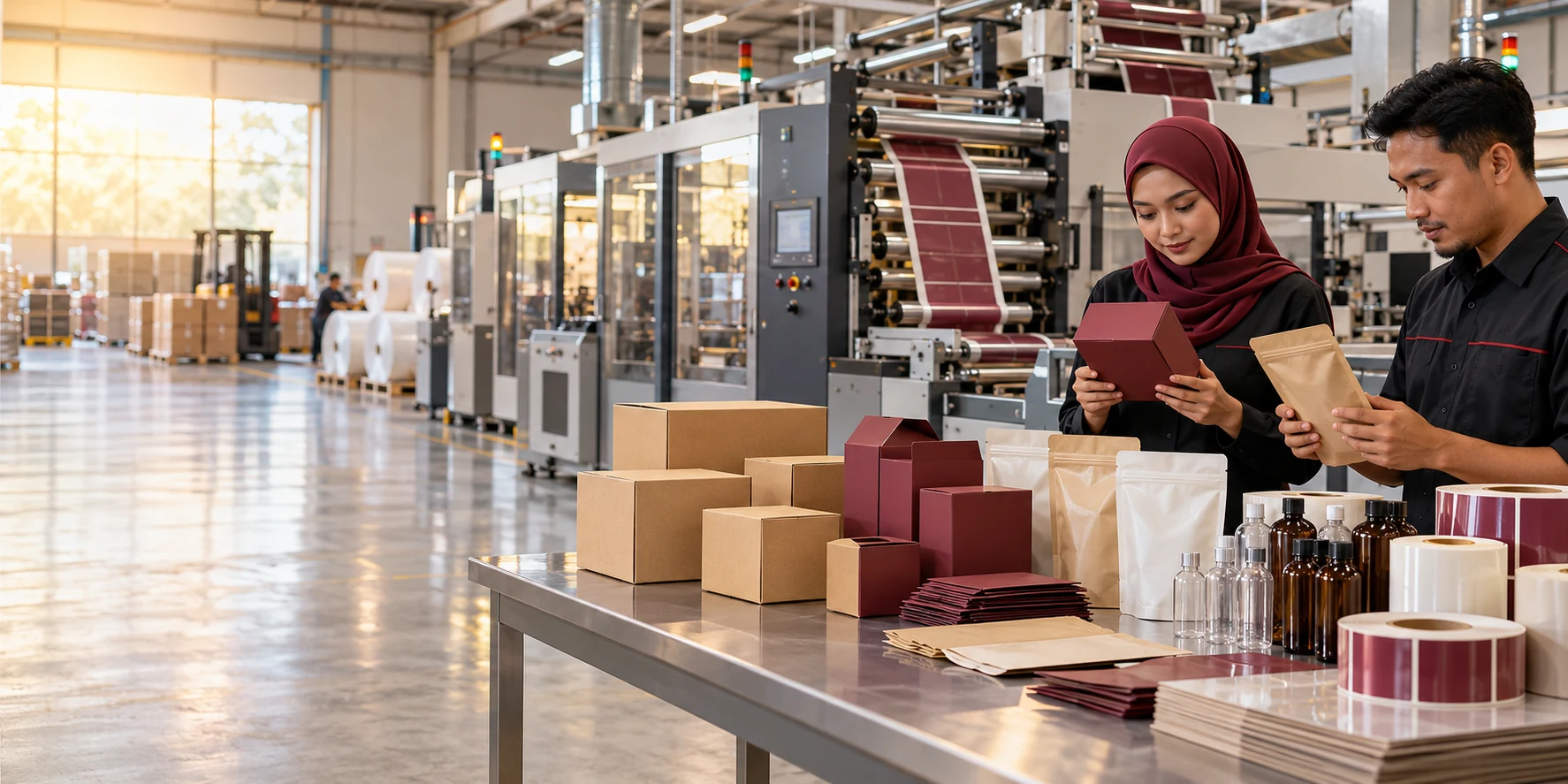
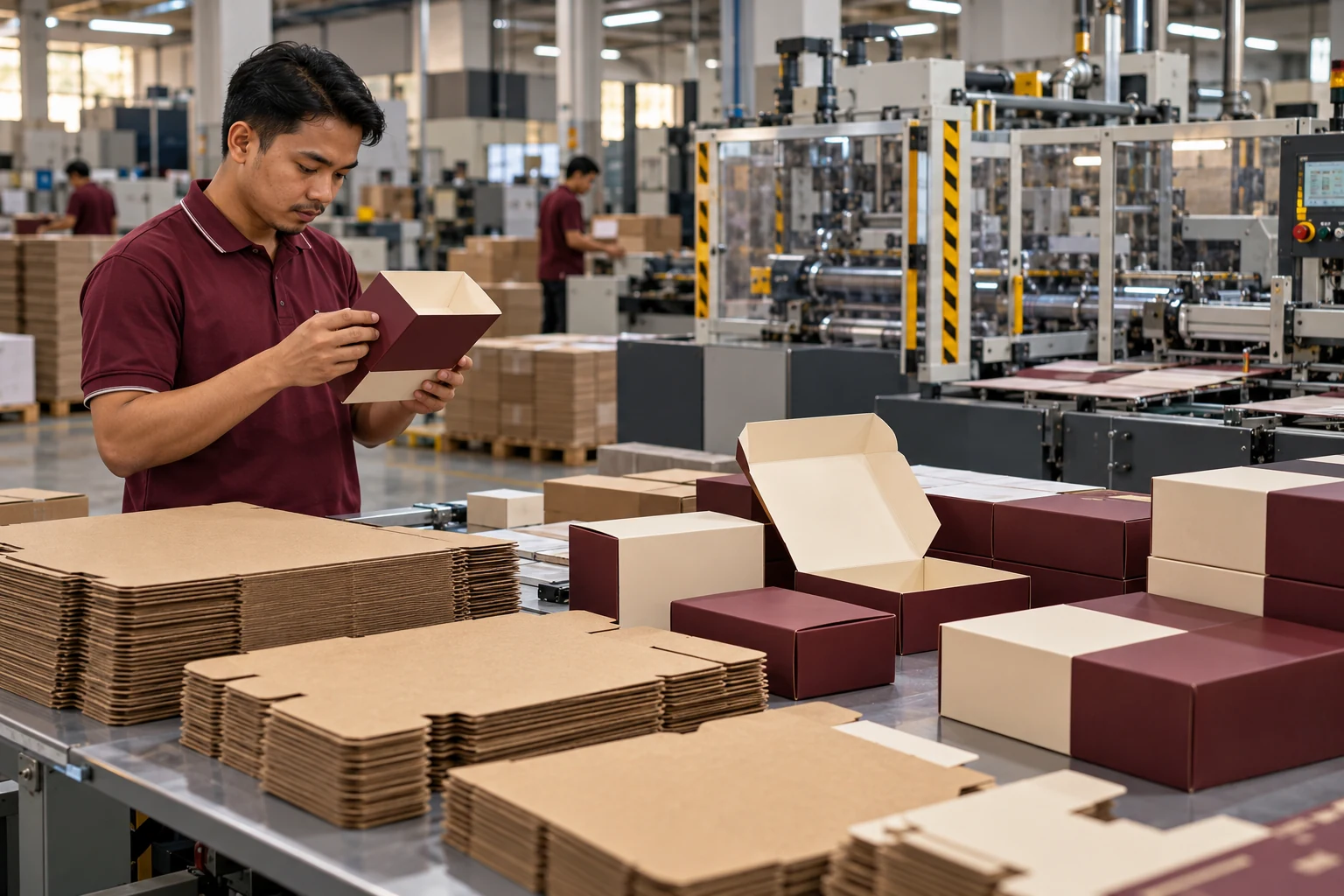
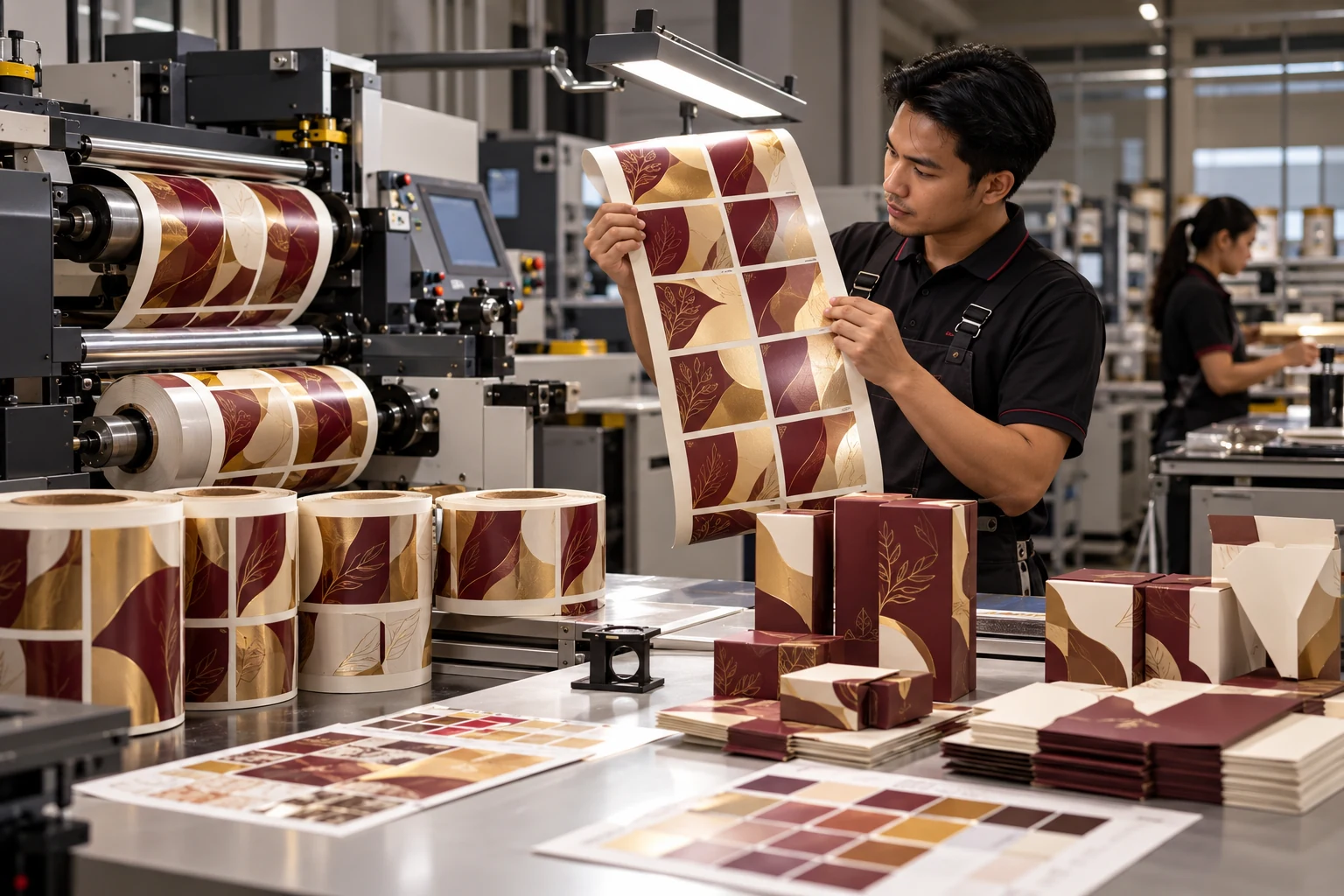
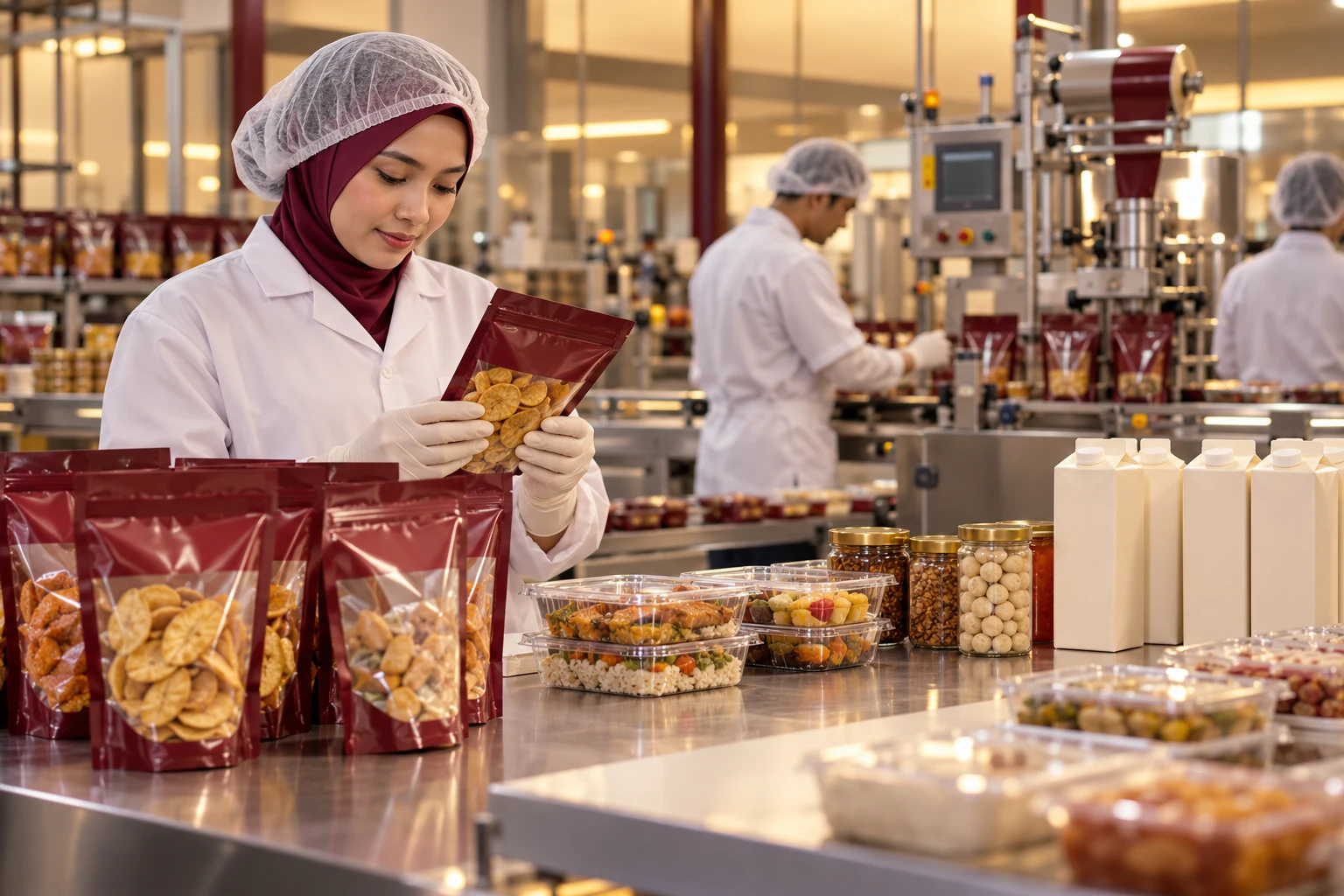
Every image on this page is a generated illustrative scene. None is a photograph of a named supplier's premises and none is evidence of capacity, certification or compliance.
Start Here
Three ways into the sector
No market-size counter appears on this page. The research pack behind it establishes no Malaysian packaging market value, export figure or supplier count, so none is printed — see the sources section for exactly what still needs sourcing.
Manufacturing capabilities
Paper products, printing, conversion and packaging services connect several manufacturing activities. Match the process and format to your product requirements.
Buyer needs
Define protection, barrier properties, colour accuracy, pack dimensions, order volumes and target-market labels before requesting quotations.
Commercial pathways
Explore supplier sourcing, packaging design, contract conversion, automation and project-specific manufacturing investment.
Where a sourced statistic is added later it must carry its year, scope and measurement. A paper or printing industry investment total is not packaging market revenue and is not packaging export value.
Process
Six stages, and what each one owes you
Expand a stage for the activities it covers, the questions worth asking and the output you should be holding before the next stage starts.
1 / 6
Materials & feedstocks
- What happens
- Paperboard, recovered fibre, polymer films and resins, glass, metal, inks and adhesives.
- What to ask
- Ask for grades, provenance and technical declarations.
- What you should hold
- An approved material specification.
2 / 6
Design & prepress
- What happens
- Structural design, dielines, colour management, print proofs and tooling.
- What to ask
- Ask who owns the files and the tooling, and how artwork changes are controlled.
- What you should hold
- An approved dieline, proof and tooling specification.
3 / 6
Printing & conversion
- What happens
- Offset, flexographic, gravure or digital print; cutting, folding, lamination, slitting and container forming.
- What to ask
- Ask about tolerances, run lengths, lead times and changeover.
- What you should hold
- Packaging samples and agreed production specifications.
4 / 6
Filling, sealing & inspection
- What happens
- Filling, capping, sealing, coding and packing.
- What to ask
- Agree seal integrity, fill control, traceability and inspection records.
- What you should hold
- Packed goods with agreed quality records.
5 / 6
Distribution & fulfilment
- What happens
- Transit cartons, pallets, protective materials and parcels.
- What to ask
- Specify stacking, handling, climatic exposure and distribution tests.
- What you should hold
- A transport-ready packaging design.
6 / 6
Recovery & circular systems
- What happens
- Collection, sorting, reuse and recycling routes.
- What to ask
- Check the actual collection route and the compatibility of coatings, adhesives and mixed materials.
- What you should hold
- A documented end-of-life plan, not a generic green claim.
What to Specify
Eight segments
Each card goes to a detailed section further down this page. None of them opens a new unfinished route.
Paperboard & cartons
Choose cartons and transit boxes around protection, board grade and print finish.
- Cartons
- Corrugated
- Retail
Flexible packaging & films
Compare pouches and films by barrier performance, sealability and material structure.
- Pouches
- Films
- Barrier
Rigid containers
Assess bottles, jars and cans by product compatibility, closures and transport needs.
- Bottles
- Jars
- Cans
Printing & labels
Plan packaging print and labels around colour accuracy, substrates and artwork control.
- Printing
- Labels
- Prepress
Food & beverage packaging
Match packaging to food type, temperature, shelf-life needs and market requirements.
- Food contact
- Shelf life
- Labelling
Quality & testing
Set measurable expectations for dimensions, seals, print and transit performance.
- Inspection
- Testing
- Traceability
Automation & fulfilment
Explore packing and palletising upgrades around throughput, changeover and safety.
- Packing
- Automation
- Logistics
Circular materials & design
Evaluate material reduction, reuse and recovery through evidence and local systems.
- Materials
- Reuse
- Recovery





Paperboard & cartons
Folding cartons, corrugated transit boxes and retail displays sit in the same family but behave differently in a supply chain. Board grade decides what the pack survives; compression requirements decide how it stacks on a pallet and in a container; print finishes decide how it looks after the journey rather than in the proof. Moisture exposure deserves a specific answer, because a carton specified for an air-conditioned warehouse and one specified for an open-sided lorry in the monsoon are not the same carton. Coatings change both barrier performance and recyclability, so settle them with the recovery route in mind rather than afterwards. Ask for samples made on the production line you will actually be supplied from, and keep one as the retained reference.
Flexible packaging & films
Pouches, sachets, wraps and laminates are specified by what has to be kept out and what has to stay in. Start with the barrier need — oxygen, moisture, light, aroma — then the sealability of the chosen structure against the filling line that will run it, then the structure itself. Shelf-life validation belongs in the specification, not in a later conversation, and it has to be run on the real product rather than a proxy. Minimum order quantities on film are usually set by the print cylinder or plate and the web width, so ask early. A mono-material design is easier to recover in principle; it still needs a route-specific recyclability assessment, because what a local collection system actually accepts is a different question from what a material is capable of.
Rigid containers
Glass, metal and plastic bottles, jars and tubs each bring their own failure modes. Closure fit is the one most often discovered late: the container, the closure and the liner are a system, and a change to any of them is a change to all three. Compatibility between the product and the container material needs evidence rather than assumption, particularly for anything acidic, oily or solvent-based. Transport performance should be tested as a packed unit, not as an empty container. Tooling ownership has to be written down — who paid for the mould, who holds it, and what happens when you move supplier. Tamper evidence, where the market expects it, is a specification item and not a finishing touch.
Printing & labels
Packaging print, adhesive labels, sleeves and variable-data applications are judged on things that are easy to measure and easy to skip. Substrate and adhesive together decide whether a label stays on through chilling, condensation and handling. Colour targets need a defined measurement and tolerance, agreed before the first production run, because “match the brand” is not a specification. Rub resistance matters more than it sounds for anything that travels in a case. Artwork approval needs a named approver and a version trail. Any code printed in an illustration on this page is decorative: a real traceability system is records and process, not a symbol on a pack.
Food & beverage packaging
Cartons, trays, pouches and containers for food start with the food itself: what it is, what temperature it sees, how long it is stored and what it does to the material around it. Migration and compatibility need evidence for the specific combination, not a general assurance about a material family. Label content and destination-market requirements are part of the pack specification and often drive the layout. Verify requirements against the current Ministry of Health documents and the regulations in force; this page points you at the official starting point and deliberately stops short of a legal conclusion about your product.
PKG05 — Ministry of Health Malaysia — Food Safety and Quality Programme (opens in a new tab)
Evidence
Quality & testing
Set measurable expectations before the first order, and agree who measures them.
- Dimensional checks
- Seal testing
- Colour tolerances
- Handling and transit tests
- Traceability
- Retention samples
Request relevant accredited tests where they apply, and confirm the laboratory's scope rather than its name. Nothing on this page suggests that a Malaysian supplier is automatically certified for anything.
Operations
Automation & fulfilment
Printing workflow, inspection, filling, secondary packing and palletising are usually upgraded one constraint at a time.
- Throughput
- Changeover time
- Spare parts
- Guarding
- Training
- Maintenance
Assess the line you have before specifying the line you want. A machine that doubles throughput and triples changeover time can reduce real output.
Materials
Circular materials & design
Lightweighting, reusable formats, material simplification and recovered content each trade something away. Say what, and show the evidence.
Lightweighting
Less material per pack, usually at some cost in stiffness or protection. Validate transit performance at the new weight rather than assuming it.
Reusable formats
Lower material use across many cycles, if the return logistics genuinely exist for your channel. Without them it is a heavier single-use pack.
Material simplification
Easier recovery from a mono-material structure, sometimes with reduced barrier performance. Shelf life has to be re-validated.
Recovered content
Needs a documented chain of custody and a performance check. Recovered content is a supply decision as much as a material one.
Not all paper is recyclable and not all bio-based material is compostable. A recyclability claim depends on the local recovery route, not only on the material, and a compostability claim depends on the facility that would receive it. Describe the actual route.
Market Access
Trade & market access
Finished packs, packaging materials and packaging machinery are three different things at a border. Classification, origin, composition and destination together decide which rules apply.
- A finished pack, the film it is made from and the machine that fills it can fall under entirely different classifications.
- Origin depends on where substantial transformation happened, not where the order was placed.
- Composition matters: a laminate, a coated board and a plain board are not interchangeable at classification.
- The destination's own rules sit on top of Malaysia's, and buyer specifications can be stricter than both.
No tariff table appears here
The exact current Customs and trade-ministry resource pages, product-specific HS classifications, tariffs and rules of origin are on this page's outstanding research list. Publishing a percentage before that work is done would be guessing, so no number is shown. Supplier discovery through the official services directory is a practical starting point and is not certification or endorsement.
PKG06 — MATRADE — Malaysia Services E-Directory (opens in a new tab)
Investment
Investment & market entry
Four themes worth assessing, and the order in which to assess them.
Value-added paper conversion
Moving from commodity board to converted product with a specification a buyer pays for.
Specialist printing & labels
Short-run, variable-data and specialist finishes where capability rather than volume is the differentiator.
Material and packaging innovation
Structures that solve a real barrier, recovery or logistics problem for a defined product.
Productivity and automation upgrades
Removing a measured constraint in an existing line rather than replacing the line.
A practical sequence
- Define the product and the process.
- Shortlist location and utilities.
- Discuss licensing and incentive applicability with the investment authority.
- Validate standards and permits.
- Confirm costs, workforce and implementation.
These are project concepts to assess, not guaranteed returns. No automatic incentive eligibility, tax holiday, foreign-ownership treatment or licence exemption is promised here, and the current licensing and incentive conditions are on the outstanding research list.
PKG01 — MIDA — Paper, Printing and Publishing (opens in a new tab)PKG03 — MIDA — Packaging the Future: Advancing Automation, Sustainability and Innovation in Malaysia's Paper Packaging Industry (opens in a new tab)
Official Resources
Ecosystem resources
Six official starting points, each checked on 12 October 2026. Every card states what the resource is for and links to it directly.
MIDA
PKG01Paper, Printing and Publishing
Malaysia's paper and printing sector context, recovered-paper inputs and investment facilitation. Wider industry figures retain their original scope and period and are not reused as packaging totals.
Checked: 2026-10-12
MIDA
PKG02From Ink to Innovation: Advancing Malaysia's Commercial Printing Industry (2 May 2025)
Discussion of digital printing and specialist printing capability. No global market-size figure is carried across from it.
MIDA
PKG03Packaging the Future: Advancing Automation, Sustainability and Innovation in Malaysia's Paper Packaging Industry
Packaging-specific official research lead. Individual scheme details and dates must be verified before they are published.
MIDA
PKG04Plastic Products
Broader plastics and packaging context. Plastics-industry measures are not treated as packaging-only totals.
Checked: 2026-10-12
Ministry of Health Malaysia
PKG05Food Safety and Quality Programme
The official food-regulatory starting point. Specific packaging obligations require the current applicable regulations and amendments.
Checked: 2026-10-12
MATRADE
PKG06Malaysia Services E-Directory
Supplier discovery lead. A directory listing does not prove capacity, certification or endorsement.
Checked: 2026-10-12
No supplier directory appears here
A directory populated from generated image scenes would be fiction, and no named supplier, association or laboratory has been verified for this page. The evaluation checklist below is offered instead, and it is the more useful half of a directory anyway.
Supplier evaluation checklist
- The exact legal entity and the premises that will supply you
- The process and format, demonstrated on a sample from the real line
- Tooling ownership and what happens to it if you leave
- Capacity and realistic lead time at your volume
- Quality records, retention samples and who signs them off
- Relevant accredited test reports, with their scope
- Change control: who tells you when a material or process changes
- Written commercial terms, including minimum order and tooling cost
Events
Preparing for a trade show
No exhibition card appears on this page. Current organiser dates and venues are on the outstanding research list, and a card with an unverified date is worse than no card.
What to carry
- A technical brief
- Samples
- Annual volumes
- Market requirements
- Questions about lead times and testing
Event cards will be added when an organiser page confirms the edition, the dates and the venue. A concluded edition will be labelled as past rather than relabelled as upcoming.
Next Steps
Build your packaging brief
Tell us what you need to package, print or source, and which market you want to serve.
There is no enquiry submission on this page. The brief below is assembled in your browser: nothing is sent anywhere, nothing is stored, and this platform does not receive it. Take the result to a supplier, a converter or an official resource.
Packaging brief
Do not enter personal data. This builder asks for product and commercial requirements only.
Preview
Fill in a field to build the brief.
Verify the supplying legal entity, the premises, the tooling arrangement and any certification scope before placing an order.
Questions worth settling early
What should a packaging sourcing brief contain?
The product and how it behaves, the protection and barrier it needs, pack dimensions and format, order volume and forecast, the destination market and its label requirements, colour expectations with a measurement, the testing you want, and your delivery terms. The brief builder above covers each of these.
How do I choose between carton, film and rigid formats?
Start from the product and the journey, not the format. What has to be kept out, how the pack is handled, what the shelf demands and what the recovery route can accept will usually narrow it to one or two options. Then compare cost at your real volume, including tooling.
What evidence should I request for food-contact use?
Evidence for your specific combination of food, material, temperature and storage time — migration and compatibility data, not a general statement about a material family. Verify the requirements against the current Ministry of Health documents; this page points you to the official starting point rather than giving a legal conclusion.
What determines minimum quantities and tooling cost?
Usually the tooling itself — a cutting die, a print cylinder or plate set, a mould — plus the web width or sheet size the line runs. That is why MOQ varies so much between a digital label run and a gravure film run, and why it is worth asking at the first conversation rather than the fifth.
Can printed packaging be recycled?
It depends on the structure and the local recovery route, not on the printing alone. Coatings, adhesives, laminated layers and mixed materials all affect it. Ask what the actual collection system in your market accepts, and get the answer in writing before you make a claim on the pack.
Where should I confirm manufacturing investment requirements?
With the investment authority, for your defined activity. The current licensing and incentive conditions are on this page's outstanding research list precisely because they change and because eligibility is project-specific. Nothing here promises an incentive.
Evidence
Sources and methodology
Seven entries, each with its publisher, what it supports and the date it was checked. One is a design reference and carries no Malaysian fact.
| ID | Publisher | Page | What it supports | Checked |
|---|---|---|---|---|
| REF01 (opens in a new tab)Design reference only | The True Thailand | Packaging Thailand | Design and functional reference for value-chain, segment, quality, sustainability, investment and resource coverage. It is not evidence for any Malaysian fact. | 2026-10-12 |
| PKG01 (opens in a new tab) | MIDA | Paper, Printing and Publishing | Malaysia's paper and printing sector context, recovered-paper inputs and investment facilitation. Wider industry figures retain their original scope and period and are not reused as packaging totals. | 2026-10-12 |
| PKG02 (opens in a new tab) | MIDA | From Ink to Innovation: Advancing Malaysia's Commercial Printing Industry (2 May 2025) | Discussion of digital printing and specialist printing capability. No global market-size figure is carried across from it. | 2026-10-12 |
| PKG03 (opens in a new tab) | MIDA | Packaging the Future: Advancing Automation, Sustainability and Innovation in Malaysia's Paper Packaging Industry | Packaging-specific official research lead. Individual scheme details and dates must be verified before they are published. | 2026-10-12 |
| PKG04 (opens in a new tab) | MIDA | Plastic Products | Broader plastics and packaging context. Plastics-industry measures are not treated as packaging-only totals. | 2026-10-12 |
| PKG05 (opens in a new tab) | Ministry of Health Malaysia | Food Safety and Quality Programme | The official food-regulatory starting point. Specific packaging obligations require the current applicable regulations and amendments. | 2026-10-12 |
| PKG06 (opens in a new tab) | MATRADE | Malaysia Services E-Directory | Supplier discovery lead. A directory listing does not prove capacity, certification or endorsement. | 2026-10-12 |
Research still needed before any claim is published
These are the reasons specific modules are absent from this page rather than estimated. Each one has to be sourced before the corresponding content can appear.
- Exact current Customs and MITI resource pages; product-specific HS classification, tariffs and rules of origin.
- Current manufacturing licensing and incentive conditions for a proposed project.
- Packaging waste and extended-producer-responsibility policy status. No nationwide mandatory EPR claim is approved by this pack.
- Named suppliers, associations, laboratories and their relevant scope of services.
- Current trade-show organiser dates and venues.
Editorial rules this page follows
- No unsupported market-size, growth-rate, export-value or supplier-count claim.
- No guaranteed incentive.
- No generic recyclable or compostable claim.
- No regulatory data carried over from another country.
Illustrative images generated for The True Malaysia. They do not depict verified supplier facilities and do not establish regulatory compliance.
Related sectors
A related sector links here only when its own page is complete and published. Everything else stays Coming soon rather than pointing at a placeholder.
- Agriculture & agritech
- Food, beverages & FMCG
- Halal products & ecosystem
- Seafood & aquaculture
- Rubber products & gloves
- Automotive & components
- Chemicals & plastics
- Logistics & ports
- Textiles, fashion & apparel
- Software & AI
- Wellness & rehabilitation
10 · 16 · 8 · 7 · 5 images, icons, segments, source register entries and outstanding research items.