
THE TRUE MALAYSIA • FOOD & HALAL
Malaysia: Food & Halal
Discover regional cuisine, dining and the halal ecosystem.
Every community. Every region. One Malaysian table — explore Malaysia through iconic dishes, regional kitchens, hawker culture, contemporary dining and official halal-verification pathways.
What to Eat
11 Iconic Malaysian Dishes
A starting point, not a ranking — Malaysia's food culture is far larger than any list. Each card carries its flavour profile, common ingredients, dietary and allergen notes, and how halal status actually works for that dish. Open a card for the full profile and its cited source.
Widely regarded as Malaysia's national dish: fragrant rice cooked in coconut milk and pandan leaf, traditionally served with sambal, crisp-fried anchovies (ikan bilis), roasted peanuts, cucumber and a hard-boiled or fried egg.
- Flavour:
- Savoury, Coconut-rich, Spicy (from the sambal)
- Common ingredients:
- Rice, Coconut milk, Pandan leaf, Sambal, Anchovies, Peanuts, Egg, Cucumber
- Dietary:
- The rice, egg and vegetables can be prepared without meat or seafood, but many everyday servings include fried anchovies or are plated alongside meat/seafood side dishes — confirm with the vendor for a vegetarian version.
- Region/association:
- Nationwide; considered Malaysia's national dish
- Allergens:
- Contains peanuts and, in most servings, small dried fish (ikan bilis) — not automatically suitable for fish or peanut allergies.
Halal: Commonly served at halal-certified and Muslim-owned premises, but the dish name proves nothing: the sambal, the frying fat and any meat side dish all depend on the individual kitchen. Verify the premises on the Halal Malaysia portal.
A flaky, hand-stretched flatbread of South Indian Muslim (mamak) origin, pan-fried until crisp and layered, and typically served with dhal (lentil curry) or a curry dipping sauce.
- Flavour:
- Buttery, Savoury
- Common ingredients:
- Wheat flour, Ghee or margarine, Dhal or curry for dipping
- Dietary:
- The dough itself is typically vegetarian; the accompanying dhal or curry may vary — confirm ingredients if you require a fully plant-based version.
- Region/association:
- Nationwide; rooted in mamak (Indian Muslim) dining culture
- Allergens:
- Contains gluten and dairy (ghee/margarine) — not suitable for gluten or dairy allergies.
Halal: Strongly associated with mamak premises, many of which are halal-certified, but certification belongs to the premises and not to the bread. The fat used for the dough and griddle, and the accompanying curry, are the points to ask about.
Flat rice noodles wok-fried over high heat with soy sauce, egg, bean sprouts, chives and typically prawns and Chinese sausage (lap cheong) — a Chinese-Malaysian hawker dish especially associated with Penang.
- Flavour:
- Smoky (wok hei), Savoury, Slightly sweet
- Common ingredients:
- Flat rice noodles, Soy sauce, Egg, Bean sprouts, Prawns, Chinese sausage, Chives
- Dietary:
- Traditional versions contain shellfish, egg and pork-based sausage — not typically halal-certified or vegetarian unless a stall specifically offers an adapted version.
- Region/association:
- Chinese-Malaysian hawker tradition; especially associated with Penang
- Allergens:
- Contains shellfish and egg — not suitable for shellfish or egg allergies.
Halal: Traditionally a Chinese-Malaysian hawker dish, and many versions use pork lard, pork products or non-halal sauces. Halal versions exist at certified premises. Never assume — check the premises.
A tangy, tamarind-based fish-broth noodle soup from Penang, built on flaked mackerel, thick rice noodles, torbeat leaf (daun kesum), pineapple, cucumber and a dark prawn-paste (hae ko) drizzle.
- Flavour:
- Sour, Spicy, Savoury
- Common ingredients:
- Mackerel, Tamarind, Rice noodles, Torch ginger flower, Pineapple, Prawn paste
- Dietary:
- Fish-based broth — not suitable for a vegetarian or vegan diet, and not suitable for fish or shellfish (prawn paste) allergies.
- Region/association:
- Penang and the wider northern Peninsular Malaysia
- Allergens:
- Contains fish and shellfish-derived prawn paste.
Halal: Fish-based rather than meat-based, but belacan (fermented shrimp paste) and the stock preparation still make this a premises-level question. Certification applies to the stall or restaurant, not to the recipe.
Skewered, marinated meat grilled over charcoal and served with a rich peanut sauce, cucumber, onion and compressed rice cakes (ketupat) — found across Malaysia's hawker stalls and festive tables.
- Flavour:
- Smoky, Sweet, Nutty
- Common ingredients:
- Chicken, beef or mutton, Turmeric marinade, Peanut sauce, Cucumber, Onion, Ketupat
- Dietary:
- Meat-based; halal-certified status depends on the individual stall or restaurant's own certification, not the dish itself.
- Region/association:
- Nationwide; a festive and everyday hawker staple
- Allergens:
- Contains peanuts — not suitable for peanut allergies.
Halal: Grilled meat makes the slaughter source material. A halal-certified premises covers its own supply chain; a roadside grill may not be certified at all. Ask, or check the premises on the Halal Malaysia portal.
A slow-cooked, dry-style curry of beef simmered in coconut milk and a ground spice-and-chili paste until the sauce reduces to a dark, caramelised coating — a Malay culinary tradition with roots shared across the wider Minangkabau world, and a centrepiece dish at festive occasions such as Hari Raya.
- Flavour:
- Rich, Spiced, Slightly sweet and smoky
- Common ingredients:
- Beef, Coconut milk, Lemongrass, Galangal, Turmeric, Dried chili, Kerisik (toasted coconut)
- Dietary:
- Meat-based; not suitable for a vegetarian or vegan diet. Halal status depends on the individual kitchen's certification.
- Region/association:
- Malay culinary tradition, nationwide; a festive-occasion staple
- Allergens:
- Contains coconut — check with the vendor if you have a coconut or tree-nut allergy.
Halal: Beef makes slaughter method and supply chain central. JAKIM recognises foreign halal certification bodies for imported meat, and imported meat may only be described as halal if certified by a recognised body — but that is about the supply, not about the restaurant. Verify the premises separately.
A Penang-born rice dish of South Indian Muslim origin: steamed rice served with a choice of curries and side dishes, traditionally ladled together and finished with a mix of curry gravies ('banjir' style).
- Flavour:
- Rich, Spiced, Savoury
- Common ingredients:
- Rice, Mixed curries (meat, seafood or vegetable), Fried chicken or squid, Assorted vegetable sides
- Dietary:
- Selection-based dish — vegetarian side dishes exist, but overall composition depends entirely on which curries and sides a diner chooses.
- Region/association:
- Penang; rooted in South Indian Muslim (mamak) culinary tradition
- Allergens:
- May contain shellfish depending on the curries selected — check individual side dishes.
Halal: Rooted in Indian Muslim dining and widely served at halal-certified premises, but the mixed gravies come from one kitchen and one supply chain. Certification is held by the premises; confirm it rather than inferring it from the cuisine.
A shaved-ice dessert of green rice-flour jelly noodles, coconut milk and palm sugar (gula melaka) syrup, often topped with red beans or sweet corn — a hawker-stall and market favourite.
- Flavour:
- Sweet, Creamy, Caramel-like (from gula melaka)
- Common ingredients:
- Shaved ice, Coconut milk, Palm sugar, Rice-flour jelly (cendol), Red beans
- Dietary:
- Typically vegetarian; contains coconut milk, so not suitable for a coconut allergy or a fully dairy-free diet where coconut milk is treated as a substitute concern.
- Region/association:
- Nationwide, with a strong Melaka association
Halal: Usually meat-free, but ingredients such as gelatine in toppings, and the premises preparing it, still determine halal status. A dessert being vegetarian does not make it certified.
A Kelantanese rice dish whose rice is most recognisably tinted blue with butterfly-pea flower, served with a spread of raw and blanched herbs and vegetables (ulam), coconut floss (serunding or kerisik), sambal, salted egg and fried keropok, usually alongside grilled or fried fish or chicken.
- Flavour:
- Herbaceous, Fresh, Savoury, Spicy (from the sambal)
- Common ingredients:
- Rice, Butterfly-pea flower, Mixed raw herbs and ulam, Coconut floss, Sambal, Salted egg, Keropok, Grilled fish or chicken
- Dietary:
- The rice and ulam are plant-based, but typical servings include fish, chicken, salted egg and fish-based crackers, and the sambal frequently contains dried shrimp or fermented fish. Confirm each component separately rather than assuming the dish is vegetarian.
- Region/association:
- Kelantan and the east coast of Peninsular Malaysia
- Allergens:
- Commonly contains fish and shellfish derivatives through the sambal, budu or keropok, and egg. Not automatically suitable for fish, shellfish or egg allergies.
Halal: Widely served at Muslim-owned east-coast premises, but as with every dish here the certification belongs to the premises and not to the recipe. Verify the premises on the Halal Malaysia portal if certification matters to you.
Chicken grilled over charcoal and repeatedly basted with a spiced coconut-milk marinade, so the surface chars while the sauce keeps building. Strongly associated with Kelantan and Terengganu, and often served with rice, nasi himpit or ketupat.
- Flavour:
- Smoky, Rich, Coconut-forward, Mildly spiced
- Common ingredients:
- Chicken, Coconut milk, Chilli, Lemongrass, Galangal, Turmeric, Shallots, Tamarind
- Dietary:
- A meat dish; there is no standard meat-free version. The marinade varies between cooks, and some versions include dried shrimp or belacan.
- Region/association:
- Kelantan and Terengganu; eaten nationwide
- Allergens:
- Contains coconut. The marinade may contain shellfish derivatives such as belacan or dried shrimp — confirm directly if you have a shellfish allergy.
Halal: Chicken makes the slaughter source material. A halal-certified premises covers its own supply chain; a roadside grill may hold no certification at all. Ask, or check the premises rather than the dish.
A Sarawak noodle soup built on a sambal-and-spice paste loosened with coconut milk, served over rice vermicelli with shredded chicken, prawns, omelette strips, bean sprouts and coriander, with lime and sambal belacan on the side. It is a different dish from assam laksa and from curry laksa.
- Flavour:
- Aromatic, Rich, Tangy, Mildly spicy
- Common ingredients:
- Rice vermicelli, Coconut milk, Spice paste, Shredded chicken, Prawns, Egg omelette, Bean sprouts, Coriander, Lime
- Dietary:
- Typically contains both poultry and shellfish, and the base paste commonly includes shrimp paste. Not a vegetarian dish in its usual form.
- Region/association:
- Sarawak, with a strong Kuching association
- Allergens:
- Commonly contains shellfish (prawns and belacan), egg and coconut. Confirm directly for shellfish or egg allergies.
Halal: Served at both certified and uncertified premises in Sarawak. The prawns, the paste and the kitchen are all premises-level questions — verify the premises rather than reading halal status from the dish or the region.
Dietary & Allergen Note
The Morning Table
Breakfast Culture
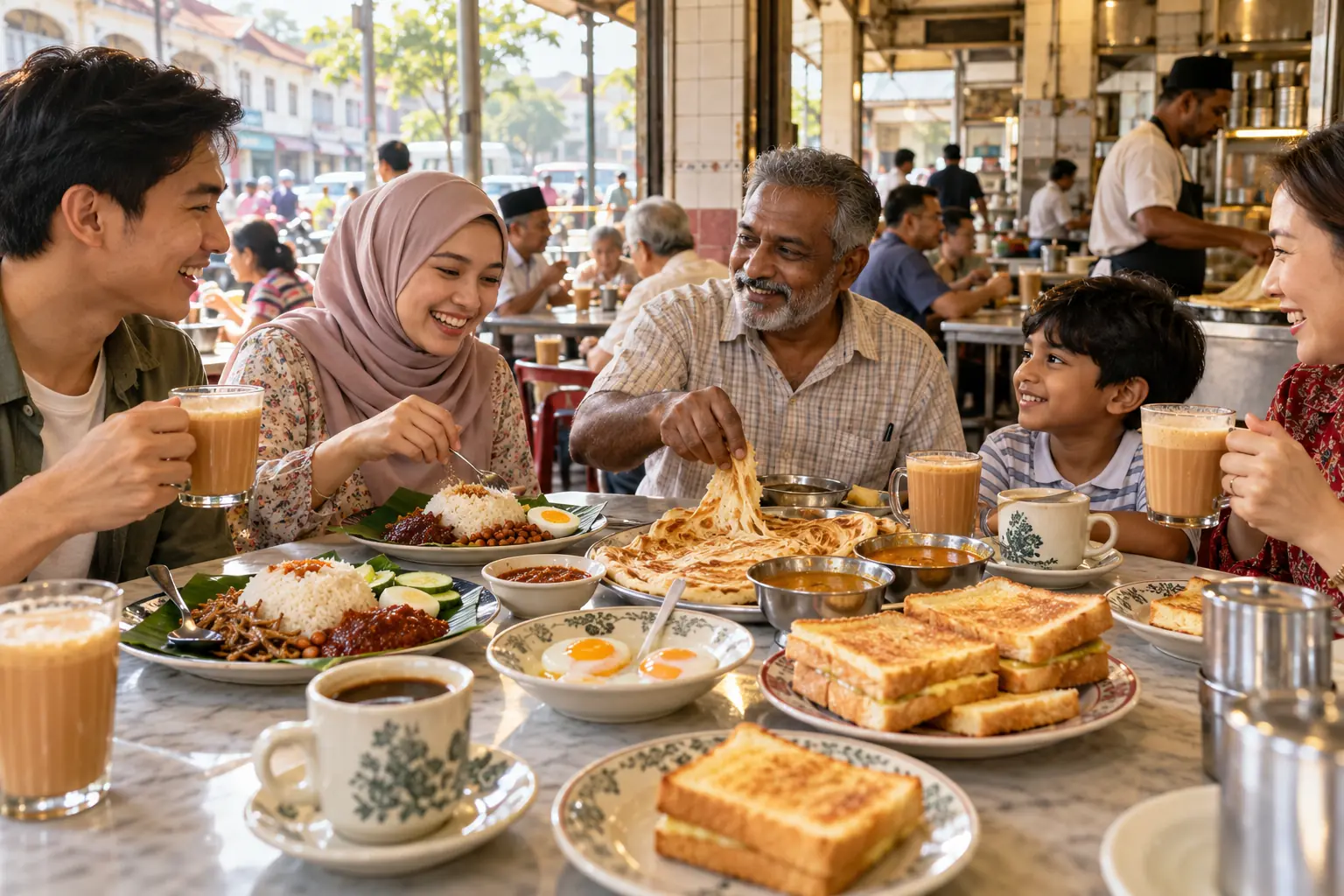
Breakfast is the meal that most reliably puts Malaysians of every background at the same table, often before seven in the morning and usually away from home.
UNESCO Intangible Cultural Heritage
Breakfast culture in Malaysia: dining experience in a multi-ethnic society
- List:
- Representative List of the Intangible Cultural Heritage of Humanity
- Reference:
- 02113
- Inscribed:
- 2024, at the 19th session of the Intergovernmental Committee in Asunción, Paraguay (2–6 December 2024)
- Submitted by:
- Malaysia (single-State nomination)
What UNESCO's own description says
- Breakfast culture plays an important role across Malaysia's multi-ethnic society and is practised in all 14 states.
- UNESCO's description names three staples: nasi lemak, roti canai and the drink teh tarik.
- It is practised in private homes and public spaces, in rural and urban areas alike.
- Malays, Chinese, Indians and other ethnic groups are all producers and consumers of these foods.
- Foods originally developed by one community are now eaten across all of them.
- They are inexpensive to produce and are described as an affordable, complete way to begin the day.
- The practice is transmitted between generations and is a source of communal pride and shared identity.
UNESCO's description names no eating-place types — no kopitiam, mamak, warung or hawker stall — and no dish beyond those three. Malaysia has exactly one food-related element on any UNESCO intangible-heritage list; no other Malaysian dish carries UNESCO status.
Verified 2026-10-10
Where Malaysians actually eat breakfast
The settings and dishes below are The True Malaysia's editorial description of everyday Malaysian breakfast, not part of the UNESCO inscription above. What people eat varies by state, community and household.
Kopitiam
A traditional coffee shop, often in a shophouse, with marble-topped tables and its own coffee and tea counter. Several independent stalls may operate inside one kopitiam.
- Kopi or kopi-o
- Teh tarik
- Kaya toast
- Soft-boiled eggs
Mamak
Indian-Muslim restaurants, many open very long hours, built around a griddle and a tea counter. The everyday setting most associated with roti canai and teh tarik.
- Roti canai
- Teh tarik
- Nasi lemak
- Mee goreng mamak
Warung and roadside stalls
Small independent stalls, frequently serving a short morning menu that sells out and closes before midday.
- Nasi lemak bungkus
- Kuih
- Nasi kerabu (east coast)
Market and hawker-centre stalls
Morning markets and hawker centres where breakfast is one of several meal services, often with the widest choice in one place.
- Noodle soups
- Rice packets
- Freshly made kuih
Breakfast is regional. The east coast eats differently from Penang, and Sabah and Sarawak differently again — treat any single list, including this one, as a starting point rather than a national menu.
Understanding the Palate
Malaysian Flavours & Ingredients
Malaysia's food traditions are shaped by Malay, Chinese, Indian, Peranakan (Baba Nyonya), Eurasian, Sabahan and Sarawakian communities, each with distinct techniques and staple ingredients. A single flavour palette does not describe all of them — recipes vary by community, household and region.
Savoury (Umami)
From soy sauce, belacan (fermented shrimp paste), dried shrimp and stock — the backbone of many Malaysian dishes.
Spicy
From fresh and dried chilies, ground into sambal or curry pastes — heat levels vary enormously by community, cook and region.
Sour
From tamarind (asam), lime and torch ginger flower — a defining feature of dishes such as assam laksa.
Sweet
From palm sugar (gula melaka), coconut milk and tropical fruit — balances heat and acidity rather than dominating a dish.
Aromatic
From lemongrass, galangal, pandan leaf, curry leaves and fresh herbs — central to the fragrance of Malay, Peranakan and Indian-Malaysian cooking.
Rich
From coconut milk (santan) and toasted coconut (kerisik), giving dishes like rendang and curry their body.
- Belacan (shrimp paste)
- Gula melaka (palm sugar)
- Tamarind (asam)
- Lemongrass
- Galangal
- Turmeric
- Pandan leaf
- Torch ginger flower (bunga kantan)
- Curry leaves
- Coconut milk (santan)
- Dried and fresh chili
- Candlenut (buah keras)
- Kaffir lime leaf
If you need less heat, ask before ordering. "Not spicy" may still contain chili or a chili-based sambal on the side.
Where Everyday Malaysia Eats
Hawker Centres, Kopitiams, Mamak Tables & Markets
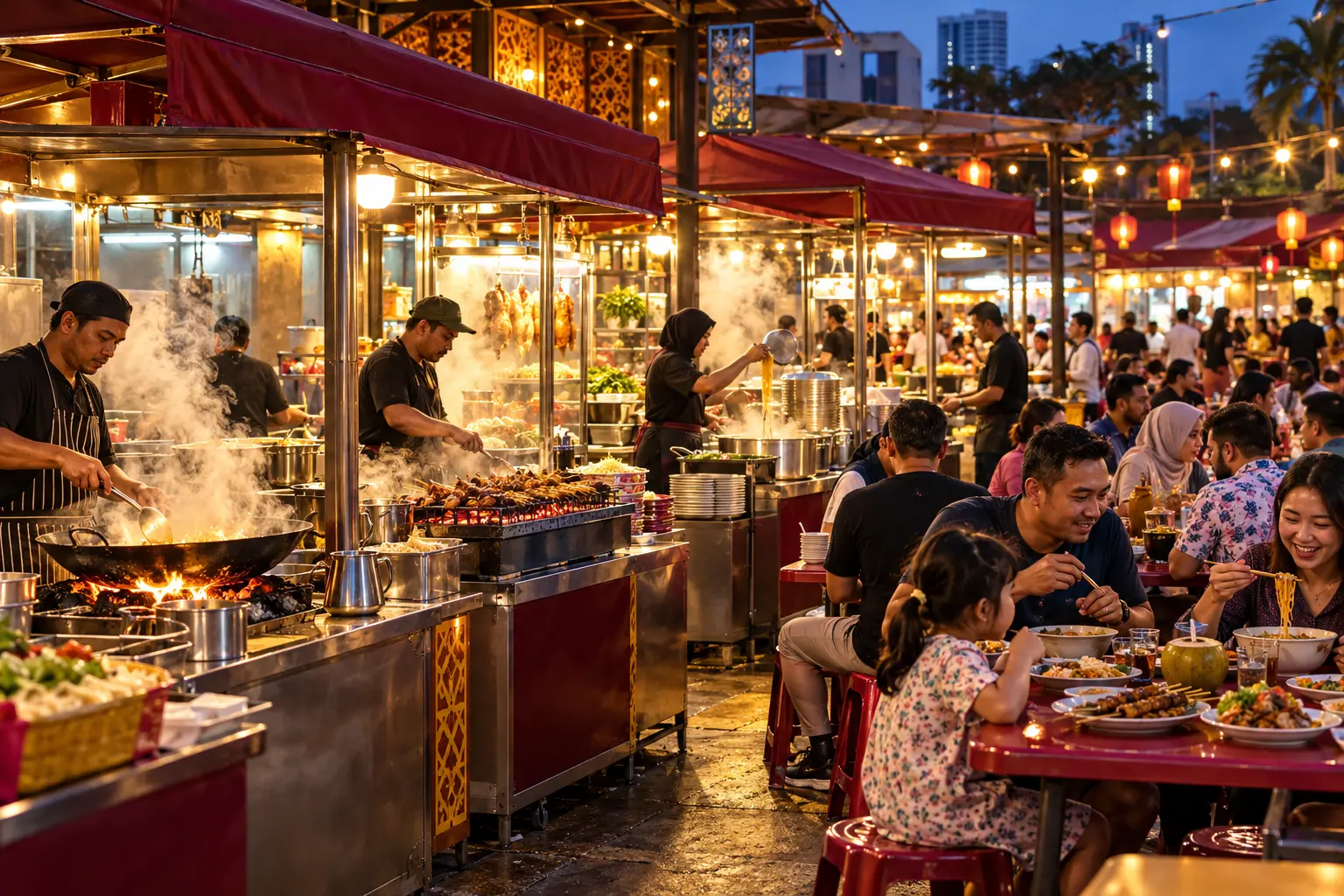
Everyday Malaysian dining runs through four overlapping settings, each with its own rhythm and role. Understanding the difference helps visitors know what to expect before they sit down.
Hawker centres and food courts
Open-air or covered clusters of independent stalls, each specialising in one or two dishes, sharing communal seating — common in cities and towns nationwide.
Kopitiams
Traditional coffee shops, historically run by Chinese-Malaysian and Hainanese operators, serving local coffee (kopi), toast with kaya (coconut jam), soft-boiled eggs and simple noodle or rice dishes, often alongside a few independent stall tenants.
Mamak stalls
Restaurants and stalls run by the Indian Muslim (mamak) community, typically open long hours, serving roti canai, nasi kandar, teh tarik and other South Indian Muslim dishes — a genuinely multicultural everyday gathering spot.
Wet markets and morning markets (pasar)
Fresh produce, meat, seafood and spice markets that also host food stalls serving breakfast dishes — a starting point for understanding where Malaysian ingredients come from.
Choose stalls with visible turnover
Ingredient freshness is easier to judge when a stall is actively cooking and serving, not simply busy or popular online.
Cash and e-wallets
Cash remains common at hawker stalls; e-wallet and QR payment acceptance varies by vendor and location.
Allergies
Shrimp paste (belacan), peanuts, shellfish and dairy appear across many everyday dishes — ask before ordering if you have an allergy.
Halal status is stall-specific
A hawker centre may host both halal-certified and non-certified stalls side by side — check each stall individually rather than assuming the whole venue is uniform.
Spice levels
You can usually request less spice, or sambal on the side — ask before the dish is cooked.
Queue etiquette
Order clearly, be ready to pay, and free up your seat once you have finished eating at busy stalls.
Opening hours vary widely
Kopitiams often open early and close by mid-afternoon; mamak stalls are frequently open very late or 24 hours — check locally rather than assuming a single pattern.
Hygiene standards vary between individual stalls and locations — busy or popular does not automatically mean higher standards, and this page does not rank or endorse specific vendors.
State by State
Regional Cuisines
Regional and territorial labels describe broad culinary traditions, not a single fixed recipe. Sabah and Sarawak are two distinct Malaysian states with their own indigenous communities and food cultures — neither is interchangeable with the other, and neither is simply "Malay food."
Northern Peninsular Malaysia (Penang, Kedah, Perlis)
Sour, spicy and noodle-forward, shaped by centuries of Chinese, Malay and South Indian Muslim (mamak) exchange, with Penang widely recognised as one of Malaysia's most concentrated food destinations.
- Assam laksa
- Char kway teow
- Nasi kandar
- Penang Hokkien mee
- Rojak
Central Peninsular Malaysia (Kuala Lumpur, Selangor, Negeri Sembilan)
Malaysia's most internationally recognised urban dining landscape, blending Malay, Chinese, Indian and contemporary fusion cooking, with Negeri Sembilan known for its distinctively spicy Minangkabau-influenced cuisine.
- Nasi lemak
- Satay
- Dim sum
- Banana leaf rice
- Masak lemak cili api (Negeri Sembilan)
Southern Peninsular Malaysia (Melaka, Johor)
Home to Peranakan (Baba Nyonya) cuisine — a fusion of Chinese and Malay culinary traditions distinctive to Melaka — as well as Portuguese-Eurasian influences and Johor's own spiced noodle traditions.
- Nyonya laksa
- Cendol
- Chicken rice balls
- Mee bandung (Johor)
- Portuguese-Eurasian seafood dishes
East Coast Peninsular Malaysia (Kelantan, Terengganu, Pahang)
Sweeter, more herb-forward Malay cuisine with strong sun-dried and fermented seafood traditions, distinct from the flavour profile found on the west coast.
- Nasi dagang
- Nasi kerabu
- Keropok lekor (fish crackers)
- Budu (fermented fish sauce)
Sabah and Sarawak
Malaysian Borneo is not a regional variation of Peninsular cooking. Sabah and Sarawak have their own ingredients, techniques and indigenous food traditions, and they differ from each other.
Sabah
Sabah
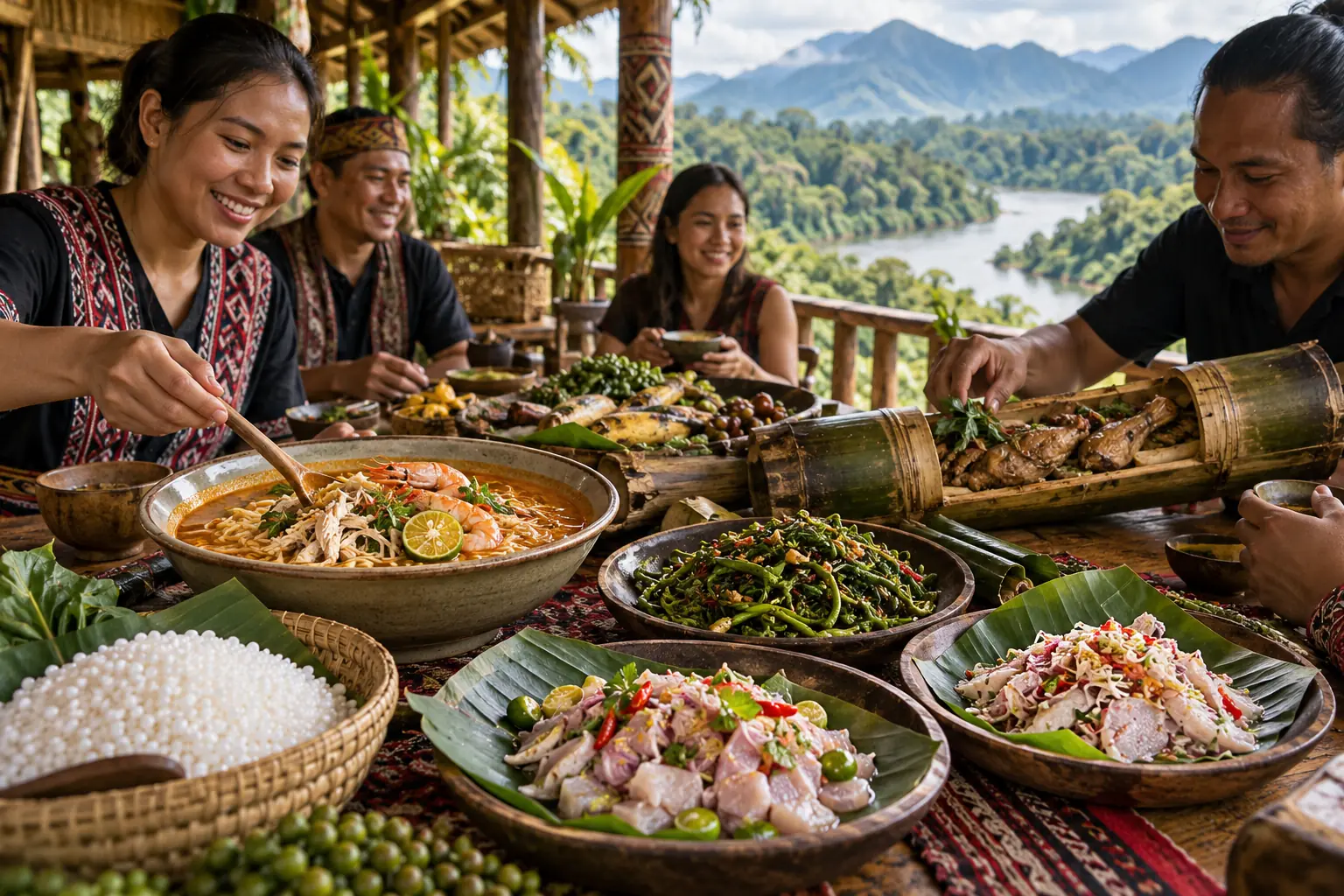
Shaped by the Kadazan-Dusun, Bajau and Murut communities alongside Malay, Chinese and other ethnic groups, Sabahan cuisine features sour, fermented and jungle-produce-driven dishes distinct from Peninsular Malaysia.
- Hinava (citrus-cured raw fish)
- Tuaran noodles
- Bosou (fermented fish or bamboo shoot)
- Sinalau bakas (smoked wild boar, in non-halal contexts)
Sarawak
Sarawak
Home to the Iban, Bidayuh, Melanau and Orang Ulu communities among others, Sarawakian cuisine is known internationally for Sarawak laksa and for its use of jungle herbs, freshwater fish and sago-based dishes from Melanau tradition.
- Sarawak laksa
- Manok pansoh (chicken cooked in bamboo)
- Umai (citrus-cured raw fish, Melanau)
- Kolo mee
From Farm to Table
The Malaysian Food Chain
Behind a plate of food is a chain of Malaysian institutions, each responsible for a different link. Knowing which body owns which question is the fastest way to get a reliable answer — and the surest way to avoid attributing something to the wrong authority.
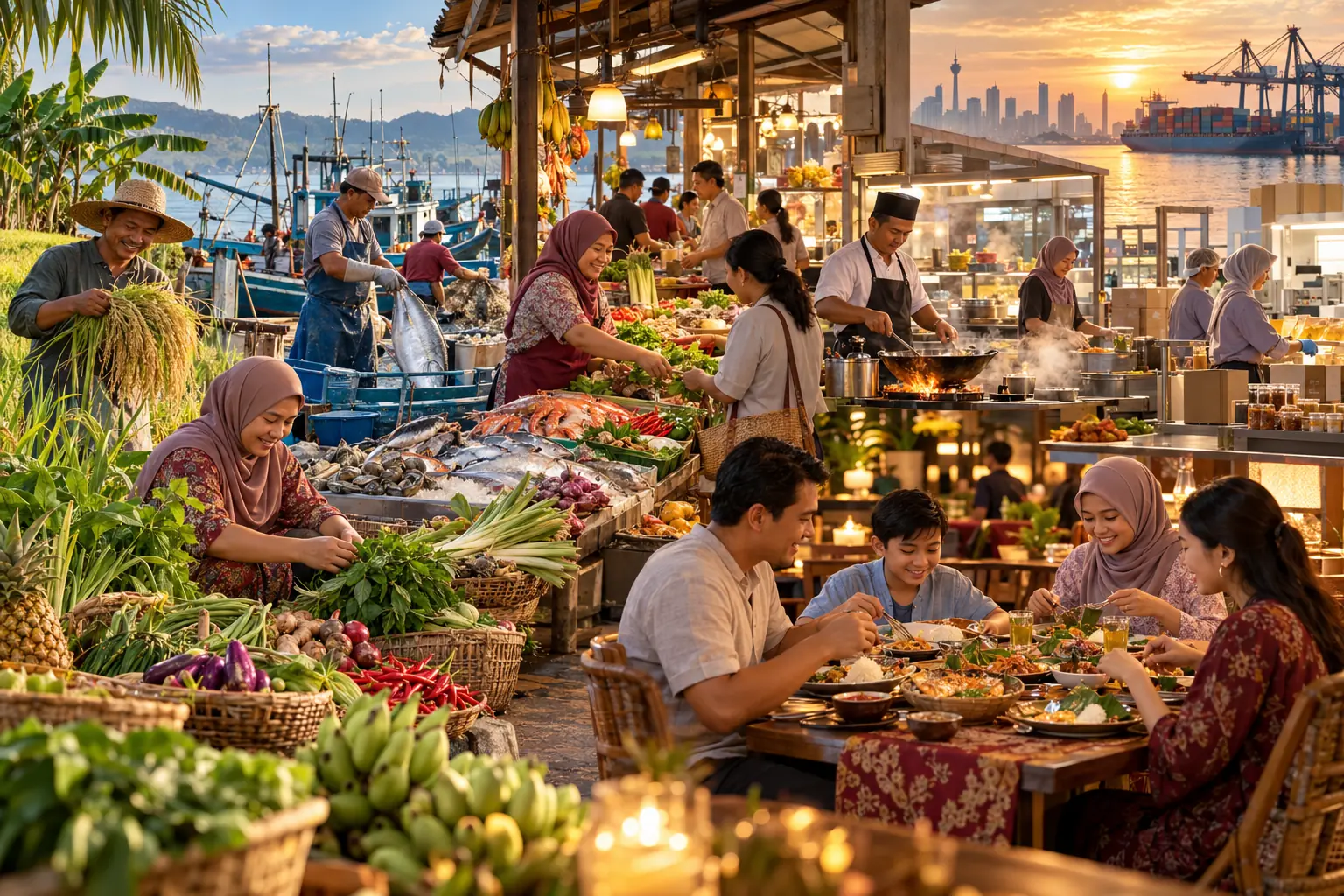
Crops and farms
Department of Agriculture Malaysia (DOA)
Agricultural extension and development, Good Agricultural Practice, crop protection, and regulatory services including the Paddy Seed Certification Scheme. Publishes the national Fruit Crop Statistics.
Official pageVerified 2026-10-10
Fisheries and aquaculture
Department of Fisheries Malaysia (DOF)
Capture fisheries, aquaculture, biosecurity and certification schemes including myGAP for the aquaculture sector and the Fish Quality Certificate required for raw-material suppliers exporting to the European Union.
Official pageVerified 2026-10-10
Fishermen and fishing communities
Malaysian Fisheries Development Authority (LKIM)
Develops the fisheries industry and fishermen's associations, runs aquaculture development projects, and issues fish exporter and importer licences.
Official pageVerified 2026-10-10
Livestock, poultry and abattoirs
Department of Veterinary Services (DVS)
Livestock industry development and animal-origin food certification — the Veterinary Health Mark for abattoirs and processing plants, Good Veterinary Hygiene Practice and myGAP for livestock farms. DVS licenses abattoirs; it does not issue halal certification.
Official pageVerified 2026-10-10
Markets and farm-to-consumer selling
Federal Agricultural Marketing Authority (FAMA)
Marketing of agri-food produce, and the operator behind Pasar Tani farmers' markets, MyFarm Outlet and other direct producer-to-consumer channels.
Official pageVerified 2026-10-10
Food safety, hygiene and labelling
Ministry of Health Malaysia — Food Safety and Quality Programme (KKM / BKKM)
Administers the Food Act 1983, the Food Regulations 1985 and the Food Hygiene Regulations 2009; regulates food labelling and advertising; registers and inspects food premises; runs the BeSS recognition for eating premises.
Official pageVerified 2026-10-10
Halal certification
Department of Islamic Development Malaysia (JAKIM)
Malaysia's federal halal authority, issuing the Sijil Pengesahan Halal Malaysia through MYeHALAL alongside state Islamic religious departments and councils, and maintaining the list of recognised foreign halal certification bodies.
Official pageVerified 2026-10-10
Food manufacturing and small enterprise
SME Corporation Malaysia (SME Corp)
Central coordinating agency for SME policy, research and business advisory services, including for food manufacturers.
Official pageVerified 2026-10-10
Food-industry investment
Malaysian Investment Development Authority (MIDA)
Investment promotion and facilitation for food processing and related manufacturing. Names livestock, farming, fisheries, fruits and vegetables, and floriculture as the major agro-food subsectors.
Official pageVerified 2026-10-10
Export and trade promotion
Malaysia External Trade Development Corporation (MATRADE)
Develops and promotes Malaysia's exports, runs exporter development and trade-information services, and organises MIHAS.
Official pageVerified 2026-10-10
One figure with its own period, from the Department of Fisheries Malaysia: in 2023 the fisheries subsector produced 1.79 million metric tonnes of edible fish, with production value rising 3.6% from RM15.9 billion to RM16.5 billion. Edible-fish output fell 5.51% from 2022. No other volume or value figure is stated on this page, because no other was confirmed with a reference period.
Where the ingredients come from
Rice
A national staple grown across Peninsular Malaysia's rice-bowl states such as Kedah and Perak.
Palm oil and coconut
Malaysia is one of the world's largest palm oil producers; coconut milk (santan) is a foundational cooking ingredient nationwide.
Tropical fruit
Extensive seasonal variety across Peninsular Malaysia, Sabah and Sarawak, including durian, rambutan and mangosteen.
Seafood
Sourced from Malaysia's Strait of Malacca, South China Sea and Bornean coastlines — sourcing and freshness vary by restaurant and season.
Spices and herbs
Lemongrass, galangal, turmeric, pandan and curry leaves are grown domestically and central to Malaysian cooking's aromatic base.
Poultry and livestock
A major domestic production category; halal-certified status of any specific meat depends on the individual supplier and slaughterhouse certification.
Imported ingredients
Some restaurants use imported beef, cheeses or specialty products as a distinct premium category — not a claim of Malaysian agricultural origin.
Imported ingredients are not automatically higher quality than local ones — they represent a different, often premium-priced category. This page does not make food-safety guarantees; confirm sourcing directly with the restaurant. See the Business pages on Agriculture and Food & Beverage for Malaysia's wider agricultural and food-production base.
From the Coast
Seafood & Coastal Tables
With coastlines on the South China Sea, the Strait of Malacca and the Sulu and Celebes Seas, Malaysia's coastal states and Borneo territories carry strong seafood traditions — from grilled stingray and sambal-based seafood dishes on the west coast to Sarawak and Sabah's own freshwater and marine specialities.
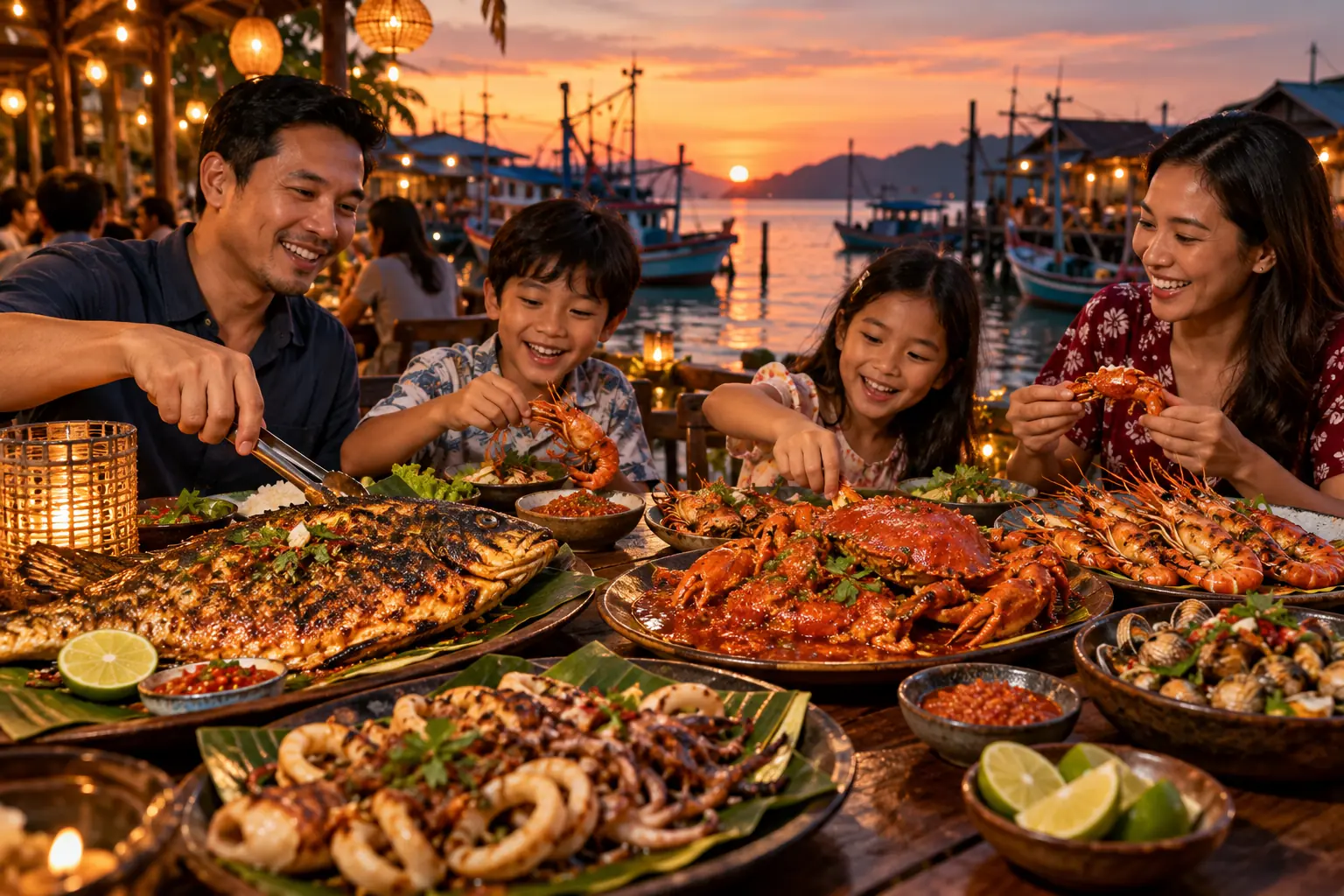
- Grilled stingray (ikan pari bakar) with sambal
- Butter prawns
- Sambal squid (sotong)
- Steamed or curried fish (ikan)
- Kerabu-style seafood salads
- Freshwater river fish dishes in Sarawak and Sabah's interior communities
Farmed in Malaysia
The Department of Fisheries Malaysia names red tilapia, catfish and giant freshwater prawn as targeted aquaculture species, and its guidance also covers giant mud crab, arowana, mahseer, red claw crayfish and marine fish. Farming systems include ponds, cages, tanks and enclosures, with cages the most commonly used.
Before you order
- Agree the price basis before ordering. Seafood is commonly sold by weight, and the price on the board may be per 100g rather than per portion.
- Ask what is actually available that day rather than ordering from a printed list — species and supply change.
- Shellfish and crustacean allergies are not covered by a dish name. Ask directly, and ask about shared frying oil and grills.
- Where halal status matters, it is the premises that is certified, not the catch. Verify the premises.
Verification required: no consumer-facing official Malaysian guidance on choosing seafood, judging freshness or handling it safely could be found on the Department of Fisheries Malaysia's own site. Its published schemes are producer- and exporter-facing. The practical points below are The True Malaysia's editorial guidance, not official advice.
Seafood sourcing, freshness and preparation vary by restaurant and season. This page does not make food-safety guarantees — confirm sourcing and preparation directly with the restaurant, and see the Food & Halal Economy section for Malaysia's wider seafood and agriculture base.
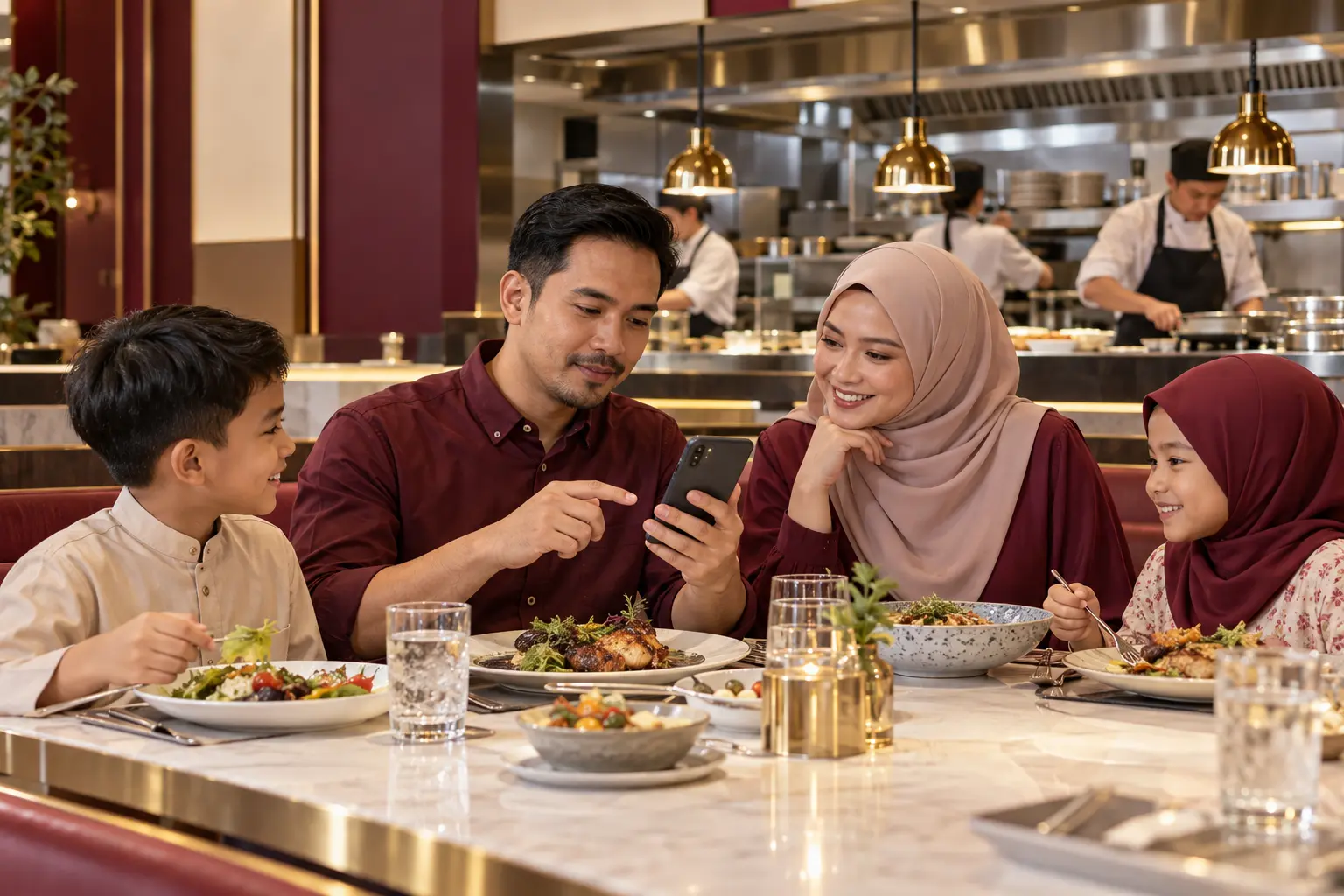
Verify, Do Not Assume
Halal Dining in Malaysia
Malaysia's halal certification system is regarded as one of the most established in the world. The Department of Islamic Development Malaysia (JAKIM), through its Halal Malaysia / MYeHALAL system, is the primary national authority for certifying and verifying halal status.
The certificate, and who issues it
Sijil Pengesahan Halal Malaysia (SPHM). JAKIM publishes no official English name for the certificate, so the Malay name is used here. Since 5 May 2025, approved applications are issued electronically as an e-Cert and printed by the holder through MYeHALAL.
Malaysian halal certification is operated jointly: JAKIM federally, together with the state Islamic religious departments (JAIN) and state Islamic religious councils (MAIN). JAKIM's own procedure names the recognised authority as JAKIM, JAIN or MAIN, whichever applies, and states that applications for the local market go to JAIN or MAIN.
JAKIM's public verification search covers consumer goods, pharmaceuticals, cosmetics and personal care, medical devices, contract manufacturing, food premises, logistics, food and beverage products, slaughterhouses, and internationally certified entries. Its certification application pages group these differently, by industry, food premises and slaughterhouse. Both are official; they are different lists on different pages and are not merged here.
The governing documents JAKIM names are MS 1500:2009 for halal food production, the Manual Prosedur Pensijilan Halal Malaysia (Domestik) 2020, the Malaysian Halal Management System 2020, and the Trade Descriptions (Certification and Marking of Halal) Order 2011.
How to check, officially
JAKIM's official online system for halal certificate applications, renewals and public verification. JAKIM's Director-General stated on 8 May 2025 that the Sijil Pengesahan Halal Malaysia (SPHM) is issued electronically (e-Cert) for applications approved from 5 May 2025, with holders printing the certificate themselves through MYeHALAL. Verification required: no official JAKIM page confirms that issued certificates carry a scannable QR code, so this page no longer states that they do.
To check a specific premises, product or slaughterhouse, search its name on the official Halal Malaysia portal's verification search, which covers certification issued by JAKIM and by state authorities as well as recognised overseas certification. The search runs on the portal itself and has no linkable result page, so search there rather than relying on a link. You can also ask the premises to show its current certificate and check the scope it covers — a certificate for one outlet or one product does not cover everything the business sells.
This links the official Foreign Halal Certification Body page rather than the dated PDF, because the PDF's filename changes with each revision.
Seven things that are not the same
JAKIM/state-authority halal-certified
The premises, product or slaughterhouse holds a current Sijil Pengesahan Halal Malaysia (SPHM) from JAKIM or an authorised state Islamic religious department — verifiable via the MYeHALAL portal.
Muslim-owned establishment
The business is owned or operated by a Muslim individual or family — not the same as holding a formal JAKIM halal certificate.
Pork-free restaurant
The restaurant does not serve pork, which is not the same as being halal-certified — alcohol use, cross-contamination and slaughter method also matter for certification.
"Muslim-friendly" self-description
A restaurant or hospitality service describes itself as accommodating Muslim diners without necessarily holding formal certification — treat as a starting point, not proof.
Generic halal symbol on signage
A halal-looking symbol displayed by a business does not by itself confirm current JAKIM certification — verify the actual certificate via MYeHALAL.
Ingredient-level halal claim
A specific ingredient or packaged product may carry halal certification independently of whether the restaurant serving it is itself certified.
“No alcohol served”
Alcohol is sold in Malaysia in licensed venues and is not part of everyday eating culture for much of the population. Halal-certified premises do not serve it, and its presence or absence is one of the things certification covers — but a venue not serving alcohol is not, by itself, certified.
"Halal-certified," "pork-free," "Muslim-owned" and "Muslim-friendly" are not interchangeable. None of them, on their own, proves current JAKIM certification — verify directly via the MYeHALAL portal or by asking the establishment for its current certificate details before dining.
Verification required: JAKIM's certification page states that the fee imposed for halal certification is valid for two years. That is a statement about the fee, not about certificate validity, and no official page consulted states a certificate validity period. Check the certificate itself or ask the premises.
Imported meat and foreign certification
JAKIM recognises foreign halal certification bodies and publishes the list of recognised bodies and authorities. Imported meat and meat products, including poultry, must be certified by a recognised body, and under the Trade Descriptions (Certification and Marking of Halal) Order 2011 imported goods may not be described as halal unless so certified. Recognition runs for two years.
Verified 2026-10-10
Muslim-friendly is not the same as certified halal
Malaysia is a Muslim-majority country with an extensive halal food infrastructure, but "Muslim-friendly" and "certified-halal" answer different questions — one is a general hospitality posture, the other is a specific, verifiable regulatory status.
- Does "Muslim-friendly" mean a restaurant is halal-certified?
- Not necessarily. "Muslim-friendly" is a general description of accommodating service, seating, or menu options — it is not a regulatory status and does not confirm JAKIM certification.
- Is every dish traditionally eaten by Malay Muslims automatically halal?
- No. A dish's cultural or ethnic association does not by itself confirm that the specific restaurant preparing it today is currently halal-certified — verify the individual establishment.
- Does a halal-certified supplier make the whole restaurant halal-certified?
- Not automatically. A restaurant using halal-certified ingredients from a certified supplier is not the same as the restaurant itself holding facility-level halal certification — both matter for full compliance.
- Can certification status change?
- Yes. Certificates have validity periods and can be suspended or revoked — always check the current status via MYeHALAL rather than relying on a certificate you saw previously or a symbol on signage.
The bodies involved
Department of Islamic Development Malaysia (JAKIM)
Malaysia's federal authority for halal certification, standards and the MYeHALAL verification system.
Useful for: Verifying a specific business, product or slaughterhouse's current halal certification status.
Official pageVerified 2026-09-24
State Islamic Religious Departments (JAIN)
Authorised, alongside JAKIM, to issue and administer halal certification at the state level in Malaysia.
Useful for: Certification queries specific to a particular state.
Verified 2026-09-24
Halal Development Corporation Berhad (HDC)
An agency under the Ministry of Investment, Trade and Industry that leads development of Malaysia's halal ecosystem. MITI announced a merger of MATRADE and HDC in October 2024 and established a pro-tem committee; as of this review no official source confirms completion or an effective date, and HDC still describes itself as a separate MITI agency.
Useful for: Businesses developing halal-certified products for export.
Official pageVerified 2026-10-10
The True Malaysia Is Not a Certification Body
The True Malaysia is not a certification authority and does not certify, verify or guarantee the halal status of any restaurant, product, dish or image on this page. Certification status can change, lapse or be suspended — always confirm current status directly through JAKIM's MYeHALAL portal or with the establishment itself before relying on it.
This page never states or implies that a specific restaurant, dish or product is halal-certified, and never reproduces or redraws a JAKIM halal logo or certificate. Photography throughout this page is editorial illustration only, not evidence of a certified establishment.
Tropical and Everyday
Fruit, Juices & Drinks
Tropical fruit is sold from roadside tables, morning markets, juice stalls and supermarkets, and is a large part of how Malaysians drink as well as eat.
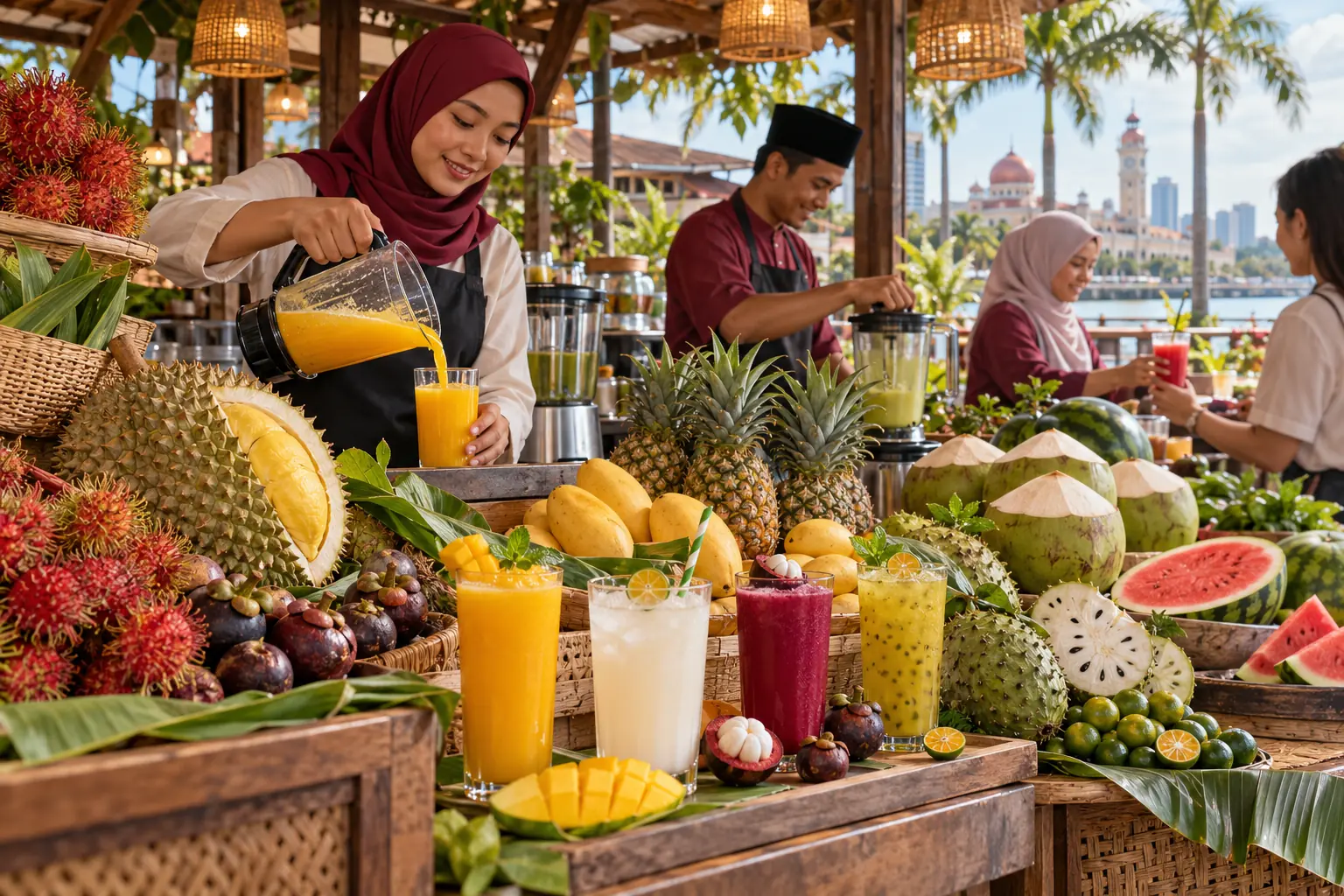
Malaysia's major fruit crops
- Durian
- Pisang (banana)
- Nanas (pineapple)
- Betik (papaya)
- Tembikai (watermelon)
- Mangga (mango)
- Manggis (mangosteen)
- Rambutan
- Nangka (jackfruit)
- Cempedak
- Ciku
- Duku
- Dokong
- Langsat
- Pulasan
- Salak
- Belimbing (starfruit)
- Jambu batu (guava)
- Limau besar (pomelo)
- Limau manis (sweet orange)
- Mata naga / pitaya (dragon fruit)
These are the 21 crops the Department of Agriculture classifies as major fruit crops in its Fruit Crop Statistics for data year 2024. The department separately lists around forty further fruit crops, including dabai, bambangan, binjai and terap.
Verification required: no official Malaysian source consulted publishes a fruit-season calendar. The Department of Agriculture's statistics separate seasonal from non-seasonal crops but give no harvest months, its own durian guidance states no season, and Tourism Malaysia publishes no season dates. This page therefore gives no durian or fruit season months. Ask locally, or check with the market or orchard directly.
The Department of Agriculture has registered durian varieties since 1934 and states that thirteen varieties are popular among Malaysian growers, without naming them on that page. Variety names in common commercial use are not the same as registered variety codes — treat a stall's label as a trade name unless you can check the official registry.
What Malaysians drink
Most everyday Malaysian drinks are non-alcoholic, sweet by default, and ordered in a shorthand that is worth learning.
Teh tarik
Black tea with condensed and evaporated milk, aerated by pouring between two vessels. Named in UNESCO's description of Malaysian breakfast culture.
Sweet by default. Ask for 'kurang manis' for less sugar.
Kopi
Local-style coffee, traditionally roasted with sugar and margarine and brewed through a cloth filter, usually served with condensed milk.
'Kopi-o' is without milk; 'kopi-o kosong' is without milk or sugar.
Milo
A malted chocolate drink served hot or iced, and a fixture of kopitiam and mamak menus.
'Milo dinosaur' adds undissolved powder on top.
Sirap bandung
Rose syrup with evaporated or condensed milk, sometimes with basil seeds.
Contains dairy.
Air kelapa
Fresh coconut water, often served in the coconut.
Usually unsweetened, but check whether syrup has been added.
Fresh fruit juices
Blended or pressed to order at juice stalls, markets and food courts, commonly watermelon, orange, sugarcane, soursop and mango.
Sugar and ice are usually added unless you ask otherwise.
Limau ais
Iced calamansi lime, tart and typically sweetened.
A common unsweetened-adjacent option; still usually contains sugar.
Sweet Things
Kuih & Desserts
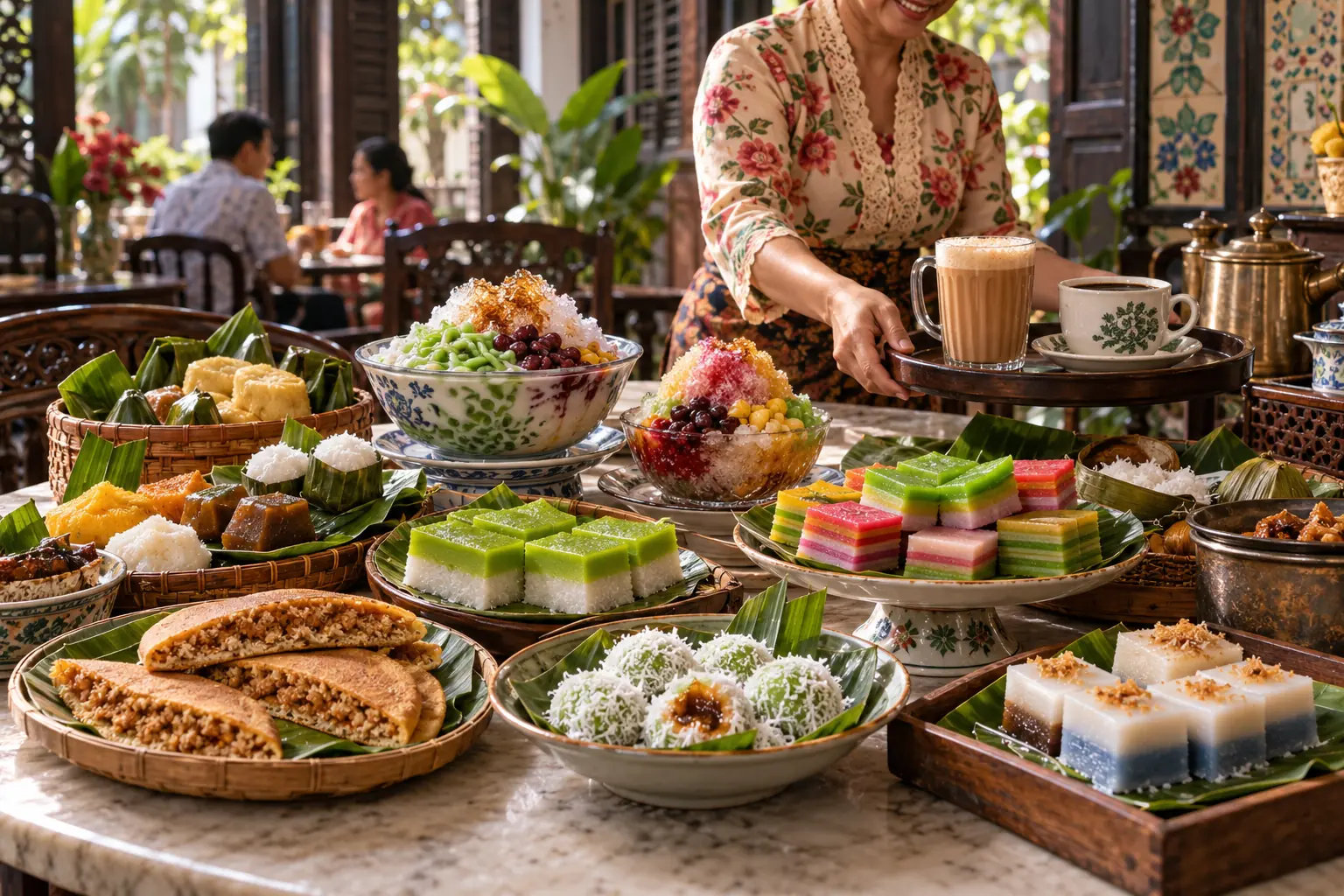
Kuih is a category rather than a dish: a very large family of small sweet and savoury items, many steamed, many built on rice flour, glutinous rice, coconut and palm sugar. They are eaten at breakfast, with afternoon tea, at celebrations and as everyday snacks.
Kuih lapis
Steamed layered cake, peeled apart layer by layer as it is eaten.
Usually built on: Rice flour, coconut milk
Seri muka
Two layers — glutinous rice beneath a pandan custard top.
Usually built on: Glutinous rice, coconut milk, pandan, egg
Ondeh-ondeh
Pandan-scented glutinous rice balls filled with palm sugar and rolled in grated coconut.
Usually built on: Glutinous rice flour, gula melaka, coconut
Kuih ketayap
Pandan crêpes rolled around sweetened grated coconut.
Usually built on: Wheat or rice flour, pandan, coconut
Apam balik
A thick folded pancake with crushed peanuts, sugar and sometimes sweetcorn.
Usually built on: Wheat flour, peanuts
Kuih talam
A two-layer steamed kuih, savoury-salted coconut over a sweet base.
Usually built on: Rice flour, coconut milk
Cold and sweet
Cendol
Shaved ice with coconut milk, palm sugar and green rice-flour strands; regional versions add red beans, glutinous rice or sweetcorn.
Ais kacang / ABC
Shaved ice over a mix that commonly includes red beans, sweetcorn, grass jelly and attap chee, finished with syrups and evaporated milk.
Bubur cha cha
Sweet potato, yam and tapioca pearls in coconut milk, served warm or cold.
Pulut hitam
Black glutinous rice porridge with coconut milk.
Ingredients vary between makers and there is rarely an ingredient list on a tray of kuih. Coconut, peanuts, glutinous rice, egg and dairy are all common; some items use gelatine. Confirm directly if you have an allergy, a dietary restriction, or need to avoid a specific ingredient.
A Multicultural Table
International & Contemporary Dining
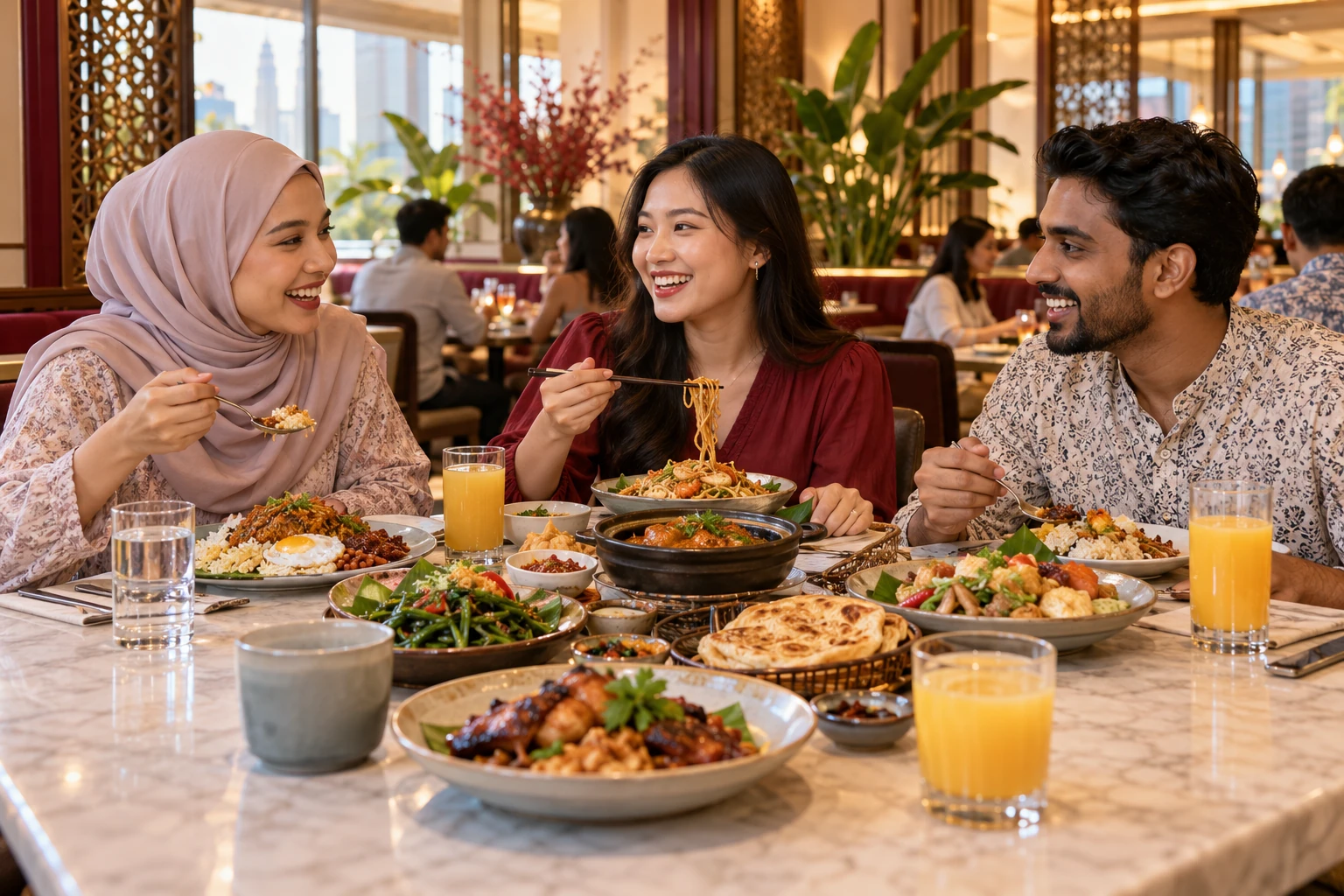
Malaysia's multicultural population and status as a regional business and travel hub support an established international dining landscape in Kuala Lumpur, Penang, Johor Bahru and other major cities — alongside the country's own long-standing multicultural cuisines.
Peranakan (Baba Nyonya)
A centuries-old fusion of Chinese and Malay culinary traditions native to Melaka and Penang's Straits Chinese communities — not an "international" import, but a distinctly Malaysian cuisine in its own right.
- Nyonya laksa
- Ayam pongteh
- Kuih (traditional sweets)
Indian-Malaysian
Deeply rooted in Malaysia's Tamil and North Indian Muslim (mamak) communities, spanning banana-leaf rice restaurants to mamak stalls.
- Banana leaf rice
- Roti canai
- Nasi kandar
- Thosai
Chinese-Malaysian
Represented through Cantonese, Hokkien, Teochew, Hainanese and Hakka regional traditions established over generations in Malaysia.
- Dim sum
- Hainanese chicken rice
- Hokkien mee
- Bak kut teh (in non-halal contexts)
Middle Eastern
A visible and growing dining category in Kuala Lumpur and other major cities, including Lebanese, Turkish, Yemeni and Gulf cuisines.
- Shawarma
- Mandi
- Kebab
- Mezze
Western and international
An established category across hotel dining, cafés and casual restaurants in Malaysia's major urban centers.
- Italian
- Japanese
- Korean
- Western café fare
Peranakan and other multicultural Malaysian cuisines are presented here as part of Malaysia's own culinary identity, not as "foreign" imports — this ordering reflects visitor navigation, not a ranking of importance or popularity.
Tradition, reimagined
Kuala Lumpur, Penang and other major Malaysian cities support a growing contemporary dining scene — chefs reinterpreting Malay, Nyonya, Chinese-Malaysian and Bornean ingredients through modern technique, alongside an established fine-dining and hotel-restaurant landscape.
- Modern Malaysian tasting menus reinterpreting traditional dishes
- Chef-led Nyonya and Peranakan revival restaurants
- Contemporary halal fine dining
- Rooftop and hotel dining with skyline views
- Farm-to-table and Malaysian-produce-forward menus
This page does not publish restaurant rankings, awards data or price information for specific venues — confirm current recognition (such as any MICHELIN Guide coverage, where it exists for Malaysia) and reservation details directly with the restaurant or the awarding body's own official source.
Eat Your Way Across Malaysia
Food Experiences by Destination
What each part of the country is known for, and how to plan around it. Associations, not exclusivity — and no individual business is named or recommended.
Peninsular Malaysia
Penang
Hawker food at its most concentrated — char kway teow, assam laksa, nasi kandar and the Chinese, Malay and Indian traditions that sit side by side in George Town.
Planning: Treat it as several meals a day in small portions. Many stalls operate within a coffee shop rather than independently, and the best-known ones keep short hours.
Peninsular Malaysia
Kuala Lumpur and the Klang Valley
The widest range in one place: mamak at every hour, hawker centres, night markets, regional restaurants from every state, and contemporary Malaysian kitchens.
Planning: Use it to try food from states you will not visit. Pasar malam (night markets) rotate between neighbourhoods by day of the week.
Peninsular Malaysia
Melaka
Peranakan cooking, and a strong association with cendol and gula melaka.
Planning: Peranakan restaurants often require booking at weekends. The historic centre is walkable.
Peninsular Malaysia
Johor
Laksa Johor, mee rebus, otak-otak and a distinct southern Malay repertoire.
Planning: Much of the best eating is in neighbourhood restaurants rather than the city centre.
Peninsular Malaysia
Kelantan and Terengganu
The east-coast repertoire — nasi kerabu, ayam percik, nasi dagang, keropok lekor — sweeter and more herb-forward than the west coast.
Planning: Mornings matter here; many specialities are breakfast and late-morning food. Check local weekend days, which differ from the rest of the country in some states.
Peninsular Malaysia
Negeri Sembilan
Minangkabau-rooted cooking, and masak lemak cili api in particular.
Planning: Expect heat from bird's-eye chilli rather than from dried chilli.
Sabah
Sabah
Seafood, hinava and the food traditions of Sabah's indigenous communities, which are distinct from Peninsular Malay cooking.
Planning: Coastal markets and night seafood markets are central. Ask about species and price basis before ordering.
Islands & Beaches in MalaysiaSarawak
Sarawak
Sarawak laksa, kolo mee, umai, midin fern and ayam pansuh cooked in bamboo.
Planning: Kuching's markets are the practical starting point. Longhouse and community food experiences should be arranged through a verified operator.
Associations, not exclusivity. A dish linked to one state is usually cooked elsewhere too, and shared traditions cross Malaysia's borders with its neighbours. Nothing here ranks places or recommends an individual business.
Go beyond the menu
- Wet markets and morning markets (pasar pagi)
- Night markets (pasar malam)
- Cooking classes
- Community and homestay-based culinary tourism
- Food festivals (including Ramadan bazaars, seasonally)
- Tea and coffee experiences at heritage kopitiams
- Spice and market tours
- Farm and orchard visits
- Verify the operator
- Confirm inclusions before booking
- Check dietary and halal suitability directly
- Ask about accessibility
- Confirm transport arrangements
- Respect market vendors and their photography preferences
Find food that fits your journey
First-Time Visitor
Start with Malaysia's iconic dishes and everyday hawker food.
Go to the sectionMuslim Traveler
Understand halal certification and Muslim-friendly dining with confidence.
Go to the sectionFamily Dining
Explore hawker centres, kopitiams and mamak stalls suited to family meals.
Go to the sectionRegional Explorer
Discover how Peninsular Malaysia, Sabah and Sarawak's cuisines differ.
Go to the sectionSeafood Lover
Discover Malaysia's coastal and Bornean seafood traditions.
Go to the sectionVegetarian or Vegan Visitor
See dish-by-dish dietary notes before you order.
Go to the sectionFine-Dining Traveler
Explore Malaysia's contemporary and modern-Malaysian dining scene.
Go to the sectionCulinary Explorer
Markets, cooking classes and food festivals, in one place.
Go to the sectionBusiness Traveler
Find hotel dining and international cuisine in Malaysia's major cities.
Go to the section
Before the First Meal
Practical Dining Guidance
A short set of things that are useful to know before the first meal, and that are easy to get wrong from outside.
Food safety is regulated, and premises are inspected
Eating premises in Malaysia are regulated by the Ministry of Health under the Food Act 1983 and the Food Hygiene Regulations 2009, whose current text dates from 19 March 2024. Premises must be registered, and district health offices inspect and enforce.
Look for BeSS, not a letter grade
The Ministry of Health's recognition for eating premises is BeSS — Bersih, Selamat dan Sihat (Clean, Safe and Healthy). It covers four criteria: keeping premises clean, providing safe food, providing healthy food, and serving portions suited to individual needs. The ministry publishes a list of recognised premises.
Allergens are declared as 'hypersensitivity'
Malaysia's official labelling terminology is hypersensitivity, not allergen. The Ministry of Health publishes a dedicated guideline on labelling ingredients that can cause hypersensitivity. Packaged food carries labelling; food cooked to order at a stall does not, so ask.
Ordering shorthand saves time
Drinks are ordered in a compact local shorthand — 'ais' for iced, 'kosong' for no sugar, 'kurang manis' for less sweet, 'o' for no milk, 'bungkus' or 'tapau' for takeaway.
Payment varies more than you expect
Many stalls take e-wallet QR payments, many take only cash, and some hawker centres settle drinks with the drink stall separately from the food stall. Carry small notes.
Opening hours are not a formality
Plenty of well-known stalls sell a fixed quantity and close when it runs out, often before noon. Some close one weekday, and hours shift during Ramadan and public holidays.
Ask before photographing people
Food and stalls are generally fine to photograph. Vendors and other diners are people — ask first, and accept no.
Spice levels are not standardised
'Not spicy' means different things in different kitchens, and sambal is usually served alongside rather than mixed in. Start with it on the side.
Verification required: no official Malaysian A/B/C hygiene grading scheme for eating premises could be confirmed. Searches of Ministry of Health national and state pages found registration, inspection and enforcement under the Food Hygiene Regulations 2009, plus the voluntary BeSS recognition — but no letter-grade system. If you have seen a graded certificate displayed, treat it as a state or local-authority scheme and check with that authority rather than assuming a national grade.
Official food-safety resources
Ministry of Health Malaysia — Food Safety and Quality Programme (BKKM)
Administers Malaysia's food safety, hygiene, labelling and advertising law, and publishes the official guidelines.
Official pageVerified 2026-10-10
BeSS recognition for food premises
The Ministry of Health's Bersih, Selamat dan Sihat recognition scheme for eating premises, with a published list of recognised holders.
Official pageVerified 2026-10-10
Food labelling guidelines
Official labelling guidance, including the guideline on labelling food ingredients that can cause hypersensitivity.
Official pageVerified 2026-10-10
A verified eating-places directory
Coming SoonThe True Malaysia does not yet publish a directory of named restaurants, stalls or halal-certified premises. Building one honestly means holding, for every entry, a current certificate reference with its scope and an owner responsible for rechecking it — and we do not. Rather than publish a list that would go stale silently, this section links you to the official searches that are always current.
Beyond the Table
Malaysia's Food & Halal Industry
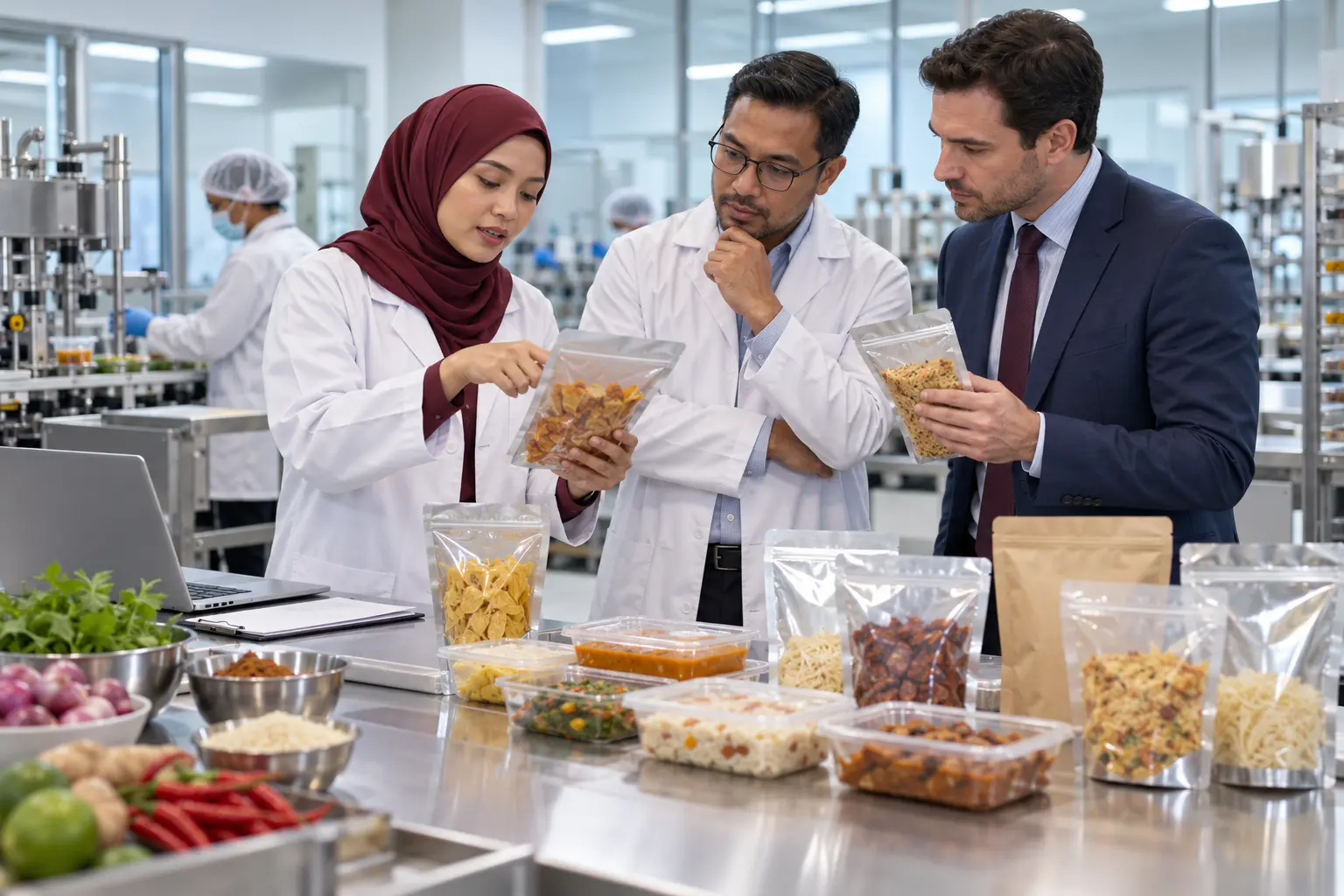
Food in Malaysia is an export sector as well as a culture. These are the institutions, the one dated investment figure confirmed for this page, and the trade event the sector organises around.
Beyond the Table
Malaysia's Food & Halal Industry
Food in Malaysia is an export sector as well as a culture. These are the institutions, the one dated investment figure confirmed for this page, and the trade event the sector organises around.
RM68.52 Billion in Halal Exports (2025)
Malaysia's halal exports were reported at RM68.52 billion in 2025, representing approximately 4.3% of the country's total exports, per Malaysian government-linked reporting.
MATRADE and HDC Now Integrated
In October 2024, Halal Development Corporation (HDC) was merged into the Malaysia External Trade Development Corporation (MATRADE) under the Ministry of Investment, Trade and Industry (MITI), combining halal-industry expertise with MATRADE's global trade-office network.
A Regional Halal Hub Ambition
Malaysia positions itself as a global halal hub, hosting the annual Malaysia International Halal Showcase (MIHAS) trade exhibition to connect halal producers with international buyers.
MIDA reports total approved investments of RM6.1 billion in food processing for 2024, split 65.6% domestic (RM4.0 billion) and 34.4% foreign (RM2.1 billion), and eight approved animal-feed projects worth RM228.6 million in the same year. These are approvals for 2024, not realised expenditure and not a current-year figure.
Figures above are reported by government-linked and industry sources and represent Malaysia's national halal trade activity, not a claim about any specific product's certification status.
MIHAS — Malaysia International Halal Showcase
Past editionOrganised by MATRADE. MATRADE appointed ES Exhibition Sdn Bhd as event management company for a five-year term covering 2026 to 2030.
The 22nd edition ran 23–26 September 2026 at MITEC, Kuala Lumpur — trade days 23–25 September, public day 26 September.
No dates for a later edition are officially announced. Check the organiser rather than assuming an annual slot.
Verified 2026-10-10
Organizations behind the ecosystem
Department of Islamic Development Malaysia (JAKIM)
Malaysia's federal halal certification and verification authority, operating the MYeHALAL portal.
Useful for: Verifying halal certification status of any Malaysian business, product or slaughterhouse.
Official pageVerified 2026-09-24
Malaysia External Trade Development Corporation (MATRADE)
Malaysia's national trade promotion agency, whose stated mission is to develop and promote Malaysia's exports to the world. It organises MIHAS. A merger with HDC was announced by MITI in October 2024 but is not confirmed complete.
Useful for: Halal and food exporters seeking market access support.
Official pageVerified 2026-10-10
Ministry of Investment, Trade and Industry (MITI)
The parent ministry overseeing Malaysia's trade and halal-industry policy, including MATRADE.
Useful for: Understanding Malaysia's halal and trade policy structure.
Official pageVerified 2026-09-24
Ministry of Health Malaysia — Food Safety and Quality Division
Oversees food safety regulation, labelling and quality standards for food businesses in Malaysia.
Useful for: Food businesses navigating safety and labelling requirements.
Official pageVerified 2026-09-24
Tourism Malaysia
Malaysia's national tourism promotion board, publishing official destination and food-culture content.
Useful for: Visitors researching Malaysian food destinations and culinary events.
Official pageVerified 2026-09-24
The True Malaysia does not represent, act on behalf of, or speak for any organization above. Official names, roles and websites are shown as published — confirm current procedures and certification status directly with each body, especially JAKIM, before acting.
Related business routes
Verified & Dated
Sources & Verification
Every source above was checked against current, primary or official material where available. No individual restaurant is named, addressed, ranked or marked as halal-certified anywhere on this page — halal status is verified only through JAKIM's own MYeHALAL portal, checked directly by the visitor.
Halal certification and verification (2)
- Halal Malaysia / MYeHALAL Portal
JAKIM — Department of Islamic Development Malaysia · Ongoing · accessed 24 September 2026
Supports: JAKIM's role as Malaysia's national halal certification and verification authority, and the MYeHALAL digital certification system.
Limitation: Individual restaurant- or product-level certification status must be checked case by case on the portal, not assumed from this page.
- Malaysia's Halal Certification Goes Fully Digital
The Halal Times · 2025 · accessed 24 September 2026
Supports: The May 2025 transition to fully digital MYeHALAL certificate processing.
Limitation: Secondary industry-media report, cross-checked against JAKIM's own portal description.
Iconic dishes and food culture (4)
- Malaysian Food: 52 Top Picks You Shouldn't Miss
Tourism Malaysia · Ongoing · accessed 24 September 2026
Supports: General descriptions of nasi lemak, satay and cendol.
Limitation: Editorial tourism-board content, not a scientific or statistical source.
- A Gastronomic Journey through Penang's Culinary Gems
Tourism Malaysia · Ongoing · accessed 24 September 2026
Supports: Descriptions of char kway teow, assam laksa and nasi kandar and their Penang association.
Limitation: Editorial tourism-board content.
- 20 Awesome and True Malaysian Breakfast
Tourism Malaysia · Ongoing · accessed 24 September 2026
Supports: Description of roti canai and its mamak culinary association.
Limitation: Editorial tourism-board content.
- Lunch Like A True Malaysian
Tourism Malaysia · Ongoing · accessed 24 September 2026
Supports: Description of beef rendang and its festive-occasion association.
Limitation: Editorial tourism-board content.
Food and halal economy (3)
- Reporting on Malaysia's 2025 halal export figures and HDC export-growth targets
Bernama (Malaysian National News Agency) · 2025 · accessed 24 September 2026
Supports: RM68.52 billion 2025 halal export figure (~4.3% of total exports) and HDC's exporter-growth target.
Limitation: Secondary news-agency reporting citing government-linked figures; treated as reported, not as a primary government publication.
- MATRADE Merges With HDC To Form A Stronger Halal Trade And Industry Ecosystem
Halal Development Corporation (HDC) · October 2024 · accessed 24 September 2026
Supports: The October 2024 MATRADE–HDC merger and HDC's continuing halal-industry mandate under MITI.
Limitation: Institutional press release; organisational structure may continue to evolve.
- Malaysia Powers Halal Trade Growth with MIHAS Knowledge Hub 2025
MATRADE · 2025 · accessed 24 September 2026
Supports: MATRADE's role in halal trade promotion and the MIHAS exhibition.
Limitation: Institutional press release.
Visitor guidance (1)
- Editorial guidance compiled for this page
The True Malaysia · 24 September 2026 · accessed 24 September 2026
Supports: Practical visitor notices on hawker culture, halal verification, and dietary/allergen guidance.
Limitation: General orientation only, not food-safety, medical, religious or legal advice — always confirm specifics with the vendor, restaurant, JAKIM or the relevant official body directly.
Added in the 10 October 2026 expansion (18)
- Breakfast culture in Malaysia: dining experience in a multi-ethnic society (ref. 02113)
UNESCO · Inscribed 2024, 19.COM · accessed 2026-10-10
Supports: The element's official name, list, reference number, inscription session, and the three foods UNESCO's own description names.
Limitation: UNESCO prints no day-level inscription date and names no venue types or further dishes.
- Decision 19.COM 7.b.47
UNESCO · 2024 · accessed 2026-10-10
Supports: The Committee's decision to inscribe, the session and the submitting State.
Limitation: Gives the session year and location, not an exact day.
- Halal Malaysia Portal
JAKIM · Latest dated item 24 April 2025 · accessed 2026-10-10
Supports: MYeHALAL as the official system, the public verification search and its categories, and JAKIM's contact details.
Limitation: The verification search is JavaScript-driven with no linkable result URL; only the portal homepage can be linked.
- Media statement on electronic issuance of the Sijil Pengesahan Halal Malaysia (e-Cert)
JAKIM · 8 May 2025 · accessed 2026-10-10
Supports: The certificate's official Malay name and electronic issuance from 5 May 2025.
Limitation: States nothing about a QR code or a certificate validity period.
- Recognised Foreign Halal Certification Bodies
JAKIM · List effective 21 August 2026 · accessed 2026-10-10
Supports: Recognition of foreign bodies, the two-year recognition period, and the imported-meat rule under the Trade Descriptions Order 2011.
Limitation: The list itself is a dated PDF whose filename changes each revision; the landing page is linked instead.
- Food Safety and Quality Programme
Ministry of Health Malaysia · Most recent dated item October 2026 · accessed 2026-10-10
Supports: The ministry's role in food safety, hygiene, labelling and premises, and the legislation it administers.
Limitation: The site shows no overall last-updated date; guideline PDFs could not be opened from this environment.
- BeSS recognition for food premises
Ministry of Health Malaysia · Guideline edition 2024 · accessed 2026-10-10
Supports: BeSS as the official eating-premises recognition, its full name and its four criteria.
Limitation: Scoring thresholds and validity period are not stated on any page consulted.
- Food labelling guidelines, including labelling of ingredients that can cause hypersensitivity
Ministry of Health Malaysia · Hypersensitivity guideline uploaded 30 October 2025 · accessed 2026-10-10
Supports: That allergen declaration is regulated, and that Malaysia's official term is hypersensitivity.
Limitation: The guideline PDF was not opened, so no Malaysian allergen list is reproduced on this page.
- Fruit Crop Statistics, data year 2024
Department of Agriculture Malaysia · Data year 2024 · accessed 2026-10-10
Supports: The 21 crops classified as major fruit crops.
Limitation: Separates seasonal from non-seasonal crops but publishes no harvest months, so no season calendar is given here.
- Durian extension guidance
Department of Agriculture Malaysia · Updated 2 July 2024 · accessed 2026-10-10
Supports: Variety registration since 1934 and that thirteen varieties are popular among growers.
Limitation: Does not name the varieties and states no season.
- Fisheries industry scenario
Department of Fisheries Malaysia · Updated 1 July 2024 · accessed 2026-10-10
Supports: 2023 edible-fish production of 1.79 million metric tonnes and production value rising to RM16.5 billion.
Limitation: Some figures on the page are inside an image and were not used.
- Aquaculture FAQ
Department of Fisheries Malaysia · Updated 15 January 2025 · accessed 2026-10-10
Supports: Targeted aquaculture species and culture systems.
Limitation: No consumer-facing seafood guidance is published.
- Certification schemes
Department of Veterinary Services · Section updated 2018; application page updated 10 March 2026 · accessed 2026-10-10
Supports: The Veterinary Health Mark, GVHP and myGAP for animal-origin food.
Limitation: DVS pages state no halal mandate for DVS itself; halal certification is JAKIM's with state authorities.
- FAMA background and corporate information
Federal Agricultural Marketing Authority · No update date shown · accessed 2026-10-10
Supports: FAMA's remit and the Pasar Tani and MyFarm Outlet channels.
Limitation: A market-information menu exists but rendered empty; no FAMA price publication is claimed here.
- MATRADE appoints new event management team for MIHAS
MATRADE · 17 March 2026 · accessed 2026-10-10
Supports: MATRADE as MIHAS organiser and the ES Exhibition appointment for 2026 to 2030.
Limitation: Announces no edition dates beyond 2026.
- MIHAS 2026
MIHAS / ES Exhibition · Release dated 8 July 2026 · accessed 2026-10-10
Supports: The 2026 edition's dates, venue and trade/public day split.
Limitation: No later edition is announced.
- Food technology, agriculture and food processing
MIDA · Modified 8 April 2025 · accessed 2026-10-10
Supports: 2024 approved investment in food processing and the animal-feed project figures.
Limitation: Other figures on the page carry no reference period and were not used.
- MITI statement on the MATRADE–HDC merger
Halal Development Corporation / MITI · Posted 28 October 2024 · accessed 2026-10-10
Supports: That a merger was announced in October 2024 and a pro-tem committee established.
Limitation: No official source confirms completion or an effective date; HDC still describes itself as a separate MITI agency.
What this page could not verify
Stated plainly rather than filled in. Each of these is a gap in the official record as consulted on 10 October 2026, not an omission of something known.
- No official Malaysian fruit or durian season calendar is published, so this page gives none.
- No official A/B/C hygiene grading scheme for eating premises could be confirmed; BeSS is the recognition that exists.
- JAKIM states a two-year validity for the certification fee, not for the certificate. Certificate validity is unconfirmed.
- No official source confirms that Malaysian halal certificates carry a scannable QR code.
- The MATRADE–HDC merger is announced but not confirmed complete.
- Malaysia's hypersensitivity labelling guideline exists but its contents were not read, so no Malaysian allergen list is reproduced here.
- No consumer-facing official seafood guidance from the Department of Fisheries Malaysia could be found.
- The Department of National Heritage's own breakfast-culture inventory document blocks automated access and has not been read; it is likely the best Malaysian source for which dishes the national inventory names.
One Malaysian Table, Ready to Explore
From a hawker stall in Penang to a JAKIM-certified restaurant in Kuala Lumpur, Malaysia's food culture rewards curiosity — and a moment of verification before you dine.