

THE TRUE MALAYSIA | MANUFACTURING & MATERIALS
Chemicals, Petrochemicals & Plastics in Malaysia
Understand the materials ecosystem behind manufacturing in Malaysia — from industrial feedstocks and chemical production to polymers, specialty formulations, plastics conversion and circular material pathways. Explore capabilities, locations and the practical checks needed for sourcing or investment.
The True Malaysia is an independent information platform. Every official resource linked here is an editorial referral. None implies a partnership, an endorsement, a certification check or an approval, and no company, association, agency or university on this page has endorsed The True Malaysia.
English is this page's source language. Publisher names, company names, URLs, scheme names and check dates are held in their original form in both languages.
Researched and checked: 2026-10-12
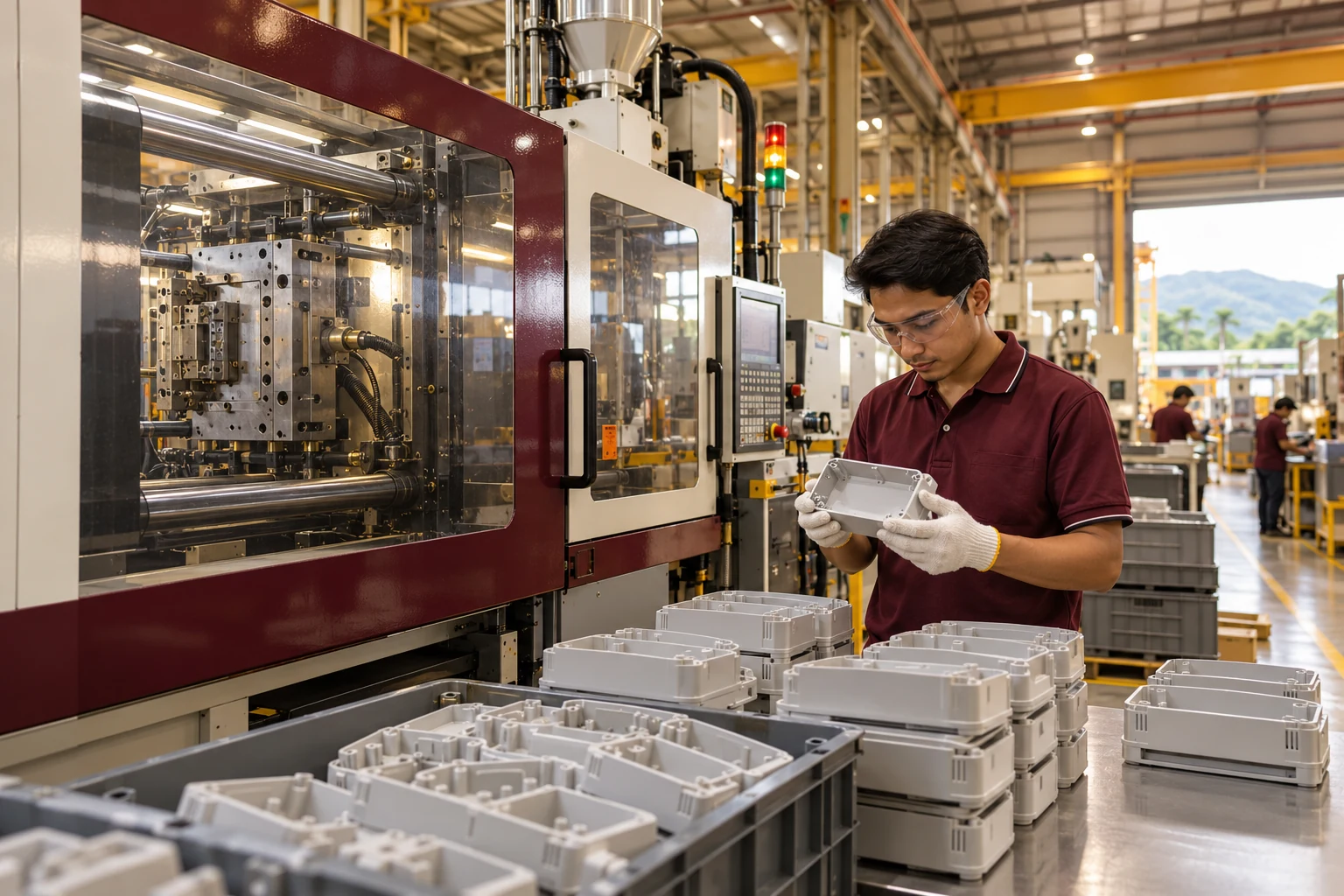
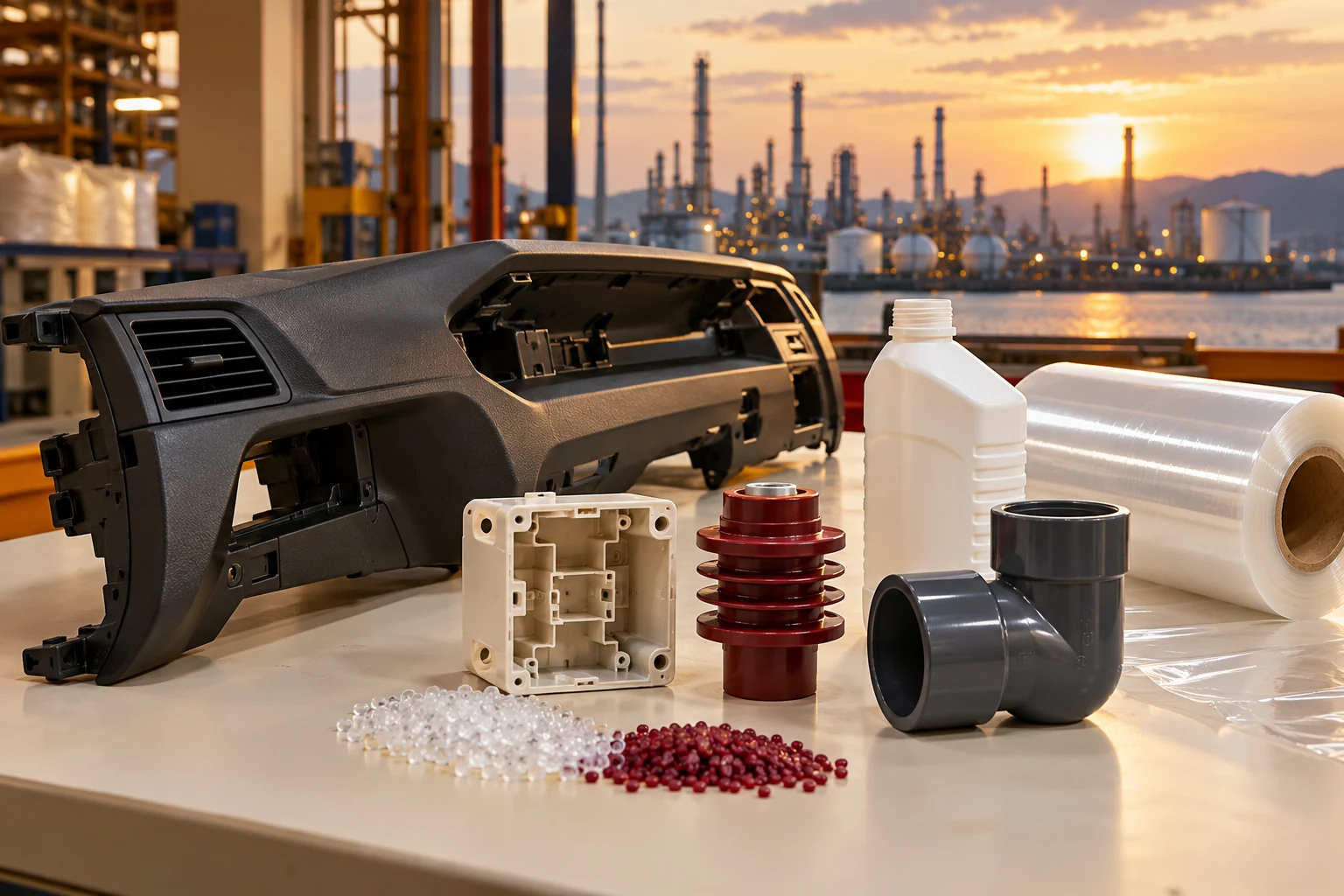
Every image on this page is a generated illustrative scene. None depicts a verified supplier facility, and none is evidence of capacity, certification or regulatory compliance.
Sector overview
One label, several different industries
Malaysia's materials ecosystem spans several distinct manufacturing activities. Chemical producers supply building blocks and functional ingredients. Polymer producers and compounders supply material grades. Converters shape those materials into components, films, containers and other products. Engineering, testing, utilities and logistics support all of it. Treating these as one interchangeable sector is the most common and most expensive mistake a brief can make.
Chemical production
Base chemicals, intermediates and functional ingredients, produced at a specified grade and purity. MIDA maintains separate industry resources for chemical products, petroleum products and oleochemicals — separate categories, not interchangeable statistical sectors.
Polymers & conversion
Resin production, compounding and the conversion processes that turn material into parts, film, sheet and containers. A resin sold in Malaysia was not necessarily made in Malaysia, and a family name is not a grade.
Specialist materials & services
Coatings, adhesives, surfactants and additive packages, plus the testing, engineering, utilities and logistics that industrial projects depend on. Oleochemicals sit here too, as oil- and fat-derived chemistry with its own feedstock base.
The useful starting point is your application. Define what the material must do, the specification you need, the market you intend to serve and the evidence you require from a supplier. A broad industry label cannot replace a technical brief — and a company appearing in an industry category is not evidence that it makes what you need, at the grade you need, in Malaysia.
Policy context: CIR 2030
Policy targetMITI launched the Chemical Industry Roadmap 2030 in 2023, setting out a direction for the sector alongside NIMP 2030. Everything the roadmap contains is a policy target. A target is not an achieved result, not a committed budget and not an entitlement — and nothing in it makes a particular project eligible for anything.
The roadmap booklet itself could not be retrieved during this research, so nothing is quoted from it. The launch announcement is used instead, and the PDF stays on the recheck list.
No market size, growth rate, export value, plant capacity or supplier count appears anywhere on this page. The research behind it supplies none, and inventing one would be worse than leaving it out.
Value chain
Seven stages, and why the boundaries matter
Each stage below does something specific, buys from the stage before it and answers to different requirements. Open a stage to see what happens there, what goes in and out, who buys from it, the first question worth asking and the availability caveat that applies.
Stage 1 / 7
Feedstocks
- What happens
- Securing the gas, refinery streams, oils and fats, imported inputs or recovered material a process runs on.
- Typical inputs
- Natural gas and NGLs, refinery and naphtha streams, imported intermediates, palm-derived oils and fats, recovered polymers.
- Typical outputs
- A contracted, specified and deliverable input stream.
- Who buys from this stage
- Chemical producers, resin producers, compounders, oleochemical plants, recyclers.
- First buyer question
- Is the required quality and supply arrangement available for this project, in writing?
- Availability caveat
- A national resource being present in Malaysia does not mean a particular site has access to it. Refinery fuels are not the same thing as petrochemical feedstocks.
Stage 2 / 7
Base chemicals
- What happens
- Producing the fundamental chemical building blocks that later stages consume.
- Typical inputs
- Feedstock streams and process utilities.
- Typical outputs
- Olefin and aromatic families, methanol, ammonia and similar first-stage products, as educational categories.
- Who buys from this stage
- Intermediate producers, polymer producers, fertiliser and specialty manufacturers.
- First buyer question
- Which exact product, purity and delivery form is offered, and from which producing site?
- Availability caveat
- Olefins and aromatics are different families with different routes and uses. A company listing a category is not evidence that every product in it is made in Malaysia.
Stage 3 / 7
Intermediates
- What happens
- Converting base chemicals into the inputs that later chemical or material processes need.
- Typical inputs
- Base chemicals, catalysts, process additives.
- Typical outputs
- Glycols, oxides, acids, alcohols and similar intermediate families, as educational categories.
- Who buys from this stage
- Resin producers, formulators, specialty chemical manufacturers.
- First buyer question
- What specification and consistency evidence supports qualification of this intermediate?
- Availability caveat
- An intermediate's name does not fix its purity, isomer profile or impurity limits. Those come from the specification, not the category.
Stage 4 / 7
Polymers & specialist formulations
- What happens
- Making base resins, and making products designed to perform a specific technical function.
- Typical inputs
- Monomers and intermediates, additives, functional ingredients.
- Typical outputs
- Base resins by family and grade; coatings, adhesives, surfactants and additive packages.
- Who buys from this stage
- Compounders, converters, coating and adhesive users, formulated-product manufacturers.
- First buyer question
- Which grade or formulation fits this application, and what evidence supports it?
- Availability caveat
- A base resin is not a compound, and a family name is not a grade. Two grades in one family can behave very differently in processing and in use.
Stage 5 / 7
Compounding & conversion
- What happens
- Modifying material properties, then shaping the material into components, films, containers or parts.
- Typical inputs
- Base resins, masterbatch, additives, reinforcement, recovered material where qualified.
- Typical outputs
- Compounds, moulded parts, extruded profiles, film and sheet, blow-moulded containers.
- Who buys from this stage
- Packaging, automotive, electrical and electronics, construction, healthcare and consumer manufacturers.
- First buyer question
- Can the process meet the tolerances, volume and approval requirements this part needs?
- Availability caveat
- Compounding modifies material; conversion shapes it. A business may do one or several. Converting is not resin production, and a moulded sample is not an approved production part until it is assessed against agreed criteria.
Stage 6 / 7
Finished applications
- What happens
- Using the material in industrial or consumer goods, under the requirements of the end market.
- Typical inputs
- Qualified components, compounds and formulated products.
- Typical outputs
- Packaging, vehicle parts, electrical assemblies, building products, agricultural inputs, healthcare and personal-care goods.
- Who buys from this stage
- Brand owners, OEMs, contractors, distributors, retailers.
- First buyer question
- Which product and destination-market requirements apply, and who is responsible for proving them?
- Availability caveat
- Food-contact, medical, drinking-water and flame-retardant uses are regulated by end-use rules, not by the material family. Nothing on this page establishes such an approval.
Stage 7 / 7
Collection & recovery
- What happens
- Collecting, sorting and processing the material streams that an actual route can accept.
- Typical inputs
- Post-industrial and post-consumer material, sorted by type and condition.
- Typical outputs
- Flake, regrind and recyclate where a route exists and the quality is proven.
- Who buys from this stage
- Compounders, converters and brand owners with recovered-content requirements.
- First buyer question
- What actual recovery pathway and traceability evidence exists for this material, today?
- Availability caveat
- Mechanical reprocessing, chemical recycling and energy recovery are different pathways. Energy recovery is not recycled feedstock, an announcement is not an operating plant, and theoretical recyclability is not access to a working local route.
Distinctions worth keeping straight
- Refinery fuels are not petrochemical feedstocks. They come out of the same industry and serve entirely different purposes.
- Olefins and aromatics are different chemical families, with different production routes and different downstream uses.
- A base resin is not a compound. Compounding changes properties; the resin is the starting material.
- Converting is not resin production. A converter buys material and shapes it.
- Oleochemicals are based on oils and fats. Sharing an application with a petroleum-derived product does not make them petroleum-derived.
- Energy recovery is not material recycling. Burning a material for energy does not return it to the material stream.
Feedstocks & infrastructure
What a plant actually runs on
Feedstock is a contract and a specification before it is a resource. Malaysia has gas, refinery streams, palm-derived oils and fats, port infrastructure and industrial parks — none of which tells you whether a particular site can get the input your process needs, at the quality it needs, when it needs it. The table below is the shape of that conversation.

| Input category | Typical role | Sourcing questions | Required infrastructure | Key risk |
|---|---|---|---|---|
| Natural gas & NGLs | Process input and energy source for several chemical routes. | Which supply agreement covers this site? What specification, pressure and interruption terms apply? | Pipeline or terminal connection, metering, on-site handling, back-up arrangements. | Access is site-specific and contractual. National resource presence proves nothing about a particular plot. |
| Refinery & naphtha streams | Feedstock for base-chemical production, distinct from refinery fuel products. | Which exact stream, from which refinery, under what offtake arrangement and quality window? | Pipeline or tankage, blending and storage, laboratory for incoming checks. | Stream composition varies with refinery operation. A fuel-grade product is not a petrochemical feedstock. |
| Imported intermediates | Inputs not produced locally, or not produced at the required grade. | What is the classification, origin, documentation and lead time? Who clears and stores it? | Port access, bonded or licensed storage, customs clearance, inland transport. | Classification, origin rules and permits are shipment-specific. Dangerous-goods treatment depends on the product and the transport mode. |
| Palm-derived oleochemical inputs | Oil- and fat-based inputs for oleochemical and formulated-product routes. | Which oil or fraction, which specification, which traceability scheme, and verified by whom? | Heated or specialised storage, quality laboratory, handling that preserves specification. | Renewable origin is not a lifecycle outcome, and a certification scheme covers only its own defined scope. |
| Recovered polymers | Secondary material input where a collection and reprocessing route genuinely exists. | Which stream and source, what contamination limits, what batch traceability, and what end-use restrictions? | Sorting and washing, reprocessing, storage that keeps streams separated, testing. | A finished polymer and plastic waste carry different commercial and regulatory treatment. Supply consistency is the usual constraint. |
| Process utilities | Power, steam, cooling and process water, industrial gases, effluent treatment. | What capacity is contracted, what reliability is committed, and what happens on interruption? | Grid and steam connections, water intake and treatment, effluent handling, standby capacity. | Capacity cannot be inferred from a nearby port, pipeline or industrial park. It has to be confirmed with the operator. |
No reserve figure, price, domestic-versus-import share or guaranteed availability appears here, because none was verified. Ask for the supply agreement, the quality specification, the storage arrangement, the utility reliability commitment and the transport plan — in writing, for the actual site.
A finished polymer and plastic waste are different things commercially and in law. If recovered material is part of your input plan, treat it as its own feedstock category with its own documentation, not as a cheaper version of virgin resin.
Segments
Eight ways into the sector
Each card opens a section further down this page — these are topics, not eight separate unfinished pages. Start with the one closest to what you are buying, making or planning.
- Base & intermediate chemicalsUnderstand building blocks, specifications and the inputs behind downstream manufacturing.FeedstocksIntermediatesSpecificationsRead the section
- Polymers & resinsCompare resin families and grades against the performance your application requires.ResinsGradesMaterialsRead the section
- Specialty chemicals & formulationsExplore functional ingredients, coatings, adhesives and application-led formulations.AdditivesFormulationPerformanceRead the section
- Plastics compounding & conversionConnect material grades to moulding, extrusion and finished product requirements.CompoundsMouldingConversionRead the section
- Oleochemicals & bio-based inputsExplore oil- and fat-derived chemistry alongside product-specific evidence and sourcing.OleochemicalsInputsTraceabilityRead the section
- Testing & responsible productionPlan quality evidence, product stewardship and relevant operational requirements.TestingQualityStewardshipRead the section
- Circular polymers & recoveryAssess recovered materials, recycling pathways and evidence behind circular claims.RecoveryRecyclingEvidenceRead the section
- Utilities & supply-chain servicesEvaluate the infrastructure and services needed to support an industrial project.UtilitiesLogisticsServicesRead the section






Segment
Base & intermediate chemicals
Begin with chemical identity, purity, specification and intended use. Suppliers operate at different stages of the chain, so a product catalogue is only a starting point: a company may produce a chemical, blend it, import it or resell it, and those are four different relationships with four different answers about change control.
Confirm the precise grade, its manufacturing origin, the delivery form and the supporting documentation before comparing quotations. Two quotations for the same chemical name are not comparable until you know they are the same grade from the same kind of source. Agree who provides application support, and how any change to specification or producing origin is communicated to you.
PETRONAS Chemicals Group publishes its portfolio under its own headings — olefins, glycols and derivatives, methanol and aromatics, ammonia and fertilisers, and specialty chemicals. Those are that company's categories, useful for orientation. They are not a statement that every derivative in a category is available from every site, and they are not a national production list.
Educational categories only. Nothing here states that a specific chemical or grade is produced in Malaysia; that is a question for the producer, answered with a specification and a producing site.
Segment
Polymers & resins
A polymer family name does not identify the right grade. Two grades within the same family can behave very differently during processing and in use — melt flow, density, impact behaviour, additive package and thermal history all move independently of the family label.
Compare the properties relevant to your product, then validate a sample against your own acceptance criteria before anything is treated as qualified. Resin availability, stock status and local manufacturing are three separate questions, and a positive answer to one tells you nothing about the others. Ask for evidence rather than assuming a resin sold in Malaysia was made here.
The table below is a general orientation to material families and the questions each one raises. It is deliberately not extended into food-contact, medical, flame-retardant or environmental approvals, because those depend on product-specific evidence that no material-family table can carry.
Material families: a general orientation
Common application examples and the questions each family raises. Read this as a map of what to ask, not as a list of what is made in Malaysia or what is approved for a regulated use.
| Material family | Common application examples | What to verify |
|---|---|---|
| PE | Films, bottles and pipes, depending on grade. | Density and grade, processing behaviour, application performance. |
| PP | Moulded parts, fibres and packaging. | Grade, thermal and mechanical performance, processing requirements. |
| PET | Containers and polyester applications. | Intended grade, moisture and process needs, application evidence. |
| PVC | Pipes, profiles and formulated products. | Compound composition, additives, end-use suitability. |
| PS | Selected rigid packaging and moulded products. | Grade, impact behaviour, intended application. |
| Engineering polymers & compounds | More demanding mechanical, thermal or electrical applications. | Exact formulation, properties, testing and qualification. |
Do not extend this table into food-contact, medical, flame-retardant or environmental approvals without product-specific evidence for the actual grade.
General material families, not verified Malaysian manufacturing claims and not recommendations for any regulated use.
Segment
Specialty chemicals & formulations
Functional ingredients and formulated products should be selected around their performance in the finished application, not around a price per kilogram. A coating, adhesive, surfactant or additive package needs compatibility with everything else in the system, stability over its real shelf life, application trials under your conditions, and a supplier who can support the product technically when something behaves unexpectedly.
Define the test method and the acceptance criteria with qualified technical teams before samples arrive, so the trial produces a decision rather than an opinion. Keep product documentation and change-control responsibilities explicit: a reformulation you were not told about is indistinguishable from a process problem you cannot find.
This page does not provide synthesis routes, mixing instructions or operational recipes. Those belong with qualified engineering and technical teams working on your actual product and plant.
No formulation, synthesis or processing instruction is published here, by design.
Segment
Plastics compounding & conversion
Compounding modifies materials — additives, masterbatch, reinforcement, recovered content where it is qualified. Conversion shapes them: injection moulding, extrusion, blow moulding, film and sheet production. A business may specialise in one stage or perform several, and knowing which matters when something goes wrong.
When qualifying a converter, agree the resin grade, the tooling arrangements and who owns the tool, the tolerances that actually matter, the production volume and its variability, the sample programme and the material traceability you will need. Review how the supplier controls changes in materials and processes, because an uncontrolled change is the most common cause of a part that passed last year and fails now.
A moulded sample should be assessed against agreed requirements before it is treated as an approved production part. Cycle capacity, approval samples and first-article evidence are separate commitments; a quotation covering one does not cover the others.
Tooling, tolerance and capacity terms are commercial matters between you and the supplier. Nothing here states what any Malaysian converter can do.
Segment
Oleochemicals & bio-based inputs
Oil- and fat-derived chemical pathways overlap with petroleum-based chemistry in some applications, but their feedstock origins differ, and so does their documentation. Fatty acids, fatty alcohols, glycerine and their derivatives are distinct product families with distinct specifications — not a renewable substitute label applied to a petroleum product.
MIDA maintains an oleochemicals industry resource, which is the right place to start for industry orientation. Buyers should then identify the exact product and function they need rather than equating renewable origin with an environmental outcome. Renewable origin is not proof of lower lifecycle impact, and it is not proof of compostability.
Personal care and functional-ingredient applications are a natural destination for this chemistry. Any bio-based, certified or lifecycle claim needs evidence appropriate to the specific product and its supply chain — the scheme, the certified site, the chain of custody and the boundary of the claim.
Renewable feedstock origin is a sourcing fact, not an environmental claim. The two are frequently conflated and should not be.
Downstream demand
Who buys these materials, and what they ask for
Materials are qualified by the industry that uses them. Each row below pairs a typical material function with the requirement a buyer in that industry brings and the qualification work that sits behind it. None of these examples is an assurance of medical, food-contact or other regulated approval.
| Industry | Example material function | Buyer requirement | Qualification consideration |
|---|---|---|---|
| Packaging & FMCG | Barrier, strength, sealability, printability and pack integrity. | Shelf life, fill-line performance, pack format and retail presentation. | Product-contact suitability, migration evidence where relevant, and line trials — none of which follow from the resin family alone. |
| Automotive & mobility | Weight reduction, impact and thermal performance, sealing, electrical insulation. | Dimensional stability, approved materials lists, batch consistency, documentation. | Customer-specific approval, part submission evidence and change control, usually to the buyer's own procedure. |
| Electrical & electronics | Insulation, flame behaviour, dimensional precision, thermal management. | Grade-level properties, restricted-substance compliance for the destination market, traceability. | Product-level testing and declarations. Restricted-substance rules belong to the destination market, not to Malaysian law. |
| Construction & infrastructure | Pipes and profiles, waterproofing, coatings, adhesives, insulation. | Durability, dimensional standards, fire behaviour, installed performance. | Applicable product standards and third-party assessment for the intended use; drinking-water contact is a separate regulated question. |
| Agriculture | Films, irrigation components, containers, crop-input formulations. | Weathering and UV performance, crop safety, handling and disposal route. | Crop-input products are regulated in their own right; material performance is only part of the evidence. |
| Healthcare | Device components, packaging, single-use items, fluid handling. | Biocompatibility where relevant, cleanliness, sterilisation compatibility, full traceability. | Regulated by medical-device and health-product rules. Nothing on this page establishes a medical approval for any material. |
| Personal care | Surfactants, emollients, functional ingredients, pack materials. | Ingredient specification, stability, sensory performance, labelling compliance. | Cosmetic and personal-care notification requirements apply to the finished product, separately from the ingredient's own documentation. |
Food-contact, medical, drinking-water and flame-retardant uses are regulated by their own rules. Nothing on this page establishes such an approval for any material or supplier.
Supplier services around the material
Most industrial material decisions also need machinery, control systems, testing, maintenance, utilities and logistics. These are separate suppliers with separate scopes.
Machinery & tooling
Moulds, dies, extrusion and moulding equipment, plus the tooling ownership and maintenance terms that go with them.
Automation & control
Instrumentation, process control, data capture and the integration work that makes them usable.
Testing & analysis
Material identification, property testing and batch analysis — with the laboratory's accreditation scope checked against what you need.
Maintenance & engineering
Mechanical, electrical and process engineering support, shutdown planning and spares.
Utilities & treatment
Industrial gases, power and steam, water supply and effluent treatment, each contracted in its own right.
Logistics & storage
Bulk and packed transport, tank and warehouse storage, and the documentation each product and mode requires.
Related sectors on this site
Only sectors with a completed page are linked. The others are still in preparation and are shown on the Business page as Coming soon, with no stand-in page behind them.
Industrial geography
Selected locations
Selected locations, each resting on a company's own published description of itself. This is not an exhaustive or ranked national list, and no map with invented coordinates is drawn. Sabah, Sarawak, Labuan and other states appear here only when a current source verifies the relevant activity — none did in this research round.
Kertih / Kerteh
Terengganu
- Basis
- PETRONAS Chemicals Group's own website identifies chemical operations at Kertih.
- Still to verify
- The exact operating entity, the products and the current site relationship all need verification before a detailed plant entry is published.
Gebeng / Kuantan
Pahang
- Basis
- BASF PETRONAS Chemicals identifies its integrated site in Gebeng in its own description of itself.
- Still to verify
- Location and product descriptions are kept inside that company's own published scope; its current product list needs checking before anything more specific is stated.
Pengerang
Johor
- Basis
- PETRONAS Chemicals Group's company history and operations resources identify petrochemical activity here.
- Still to verify
- Those are historical milestones. Current capacity and project status need a fresh check and are not stated here.
Site assessment checklist
The same eight questions decide whether a location works for a chemical or plastics project, whatever the brochure says about the park.
- Land-use suitability for the actual activity, not for industry in general
- Feedstock connection — contracted, specified and physically deliverable
- Port and inland transport access for the real inbound and outbound flows
- Utilities: power, steam, process and cooling water, industrial gases
- Waste handling, effluent treatment and scheduled-waste arrangements
- Workforce availability for the specific technical roles the process needs
- Federal, state and local approvals, which are separate from each other
- Community and environmental considerations, assessed for the site and activity
No capacity, vacancy, rent or utility-availability claim is made for any location on this page. Those require direct evidence for the specific site, obtained from the operator and the relevant authorities.
Manufacturers & discovery
Two seed profiles, and how to find the rest
Both profiles below are built only from each company's own website, and both are editorial references rather than supplier recommendations. There is no large directory here: inventing one to fill the layout would be worse than a short honest list.
PETRONAS Chemicals Group
Publishes its portfolio under its own headings: olefins, glycols and derivatives, polymers, methanol and aromatics, ammonia and fertilisers, and specialty chemicals. Its company pages name Malaysian locations including Kertih and Pengerang.
- Scope limit
- The group's sites and capacities include overseas operations. Those totals are never national Malaysian figures, and the milestones on its company page are historical announcements rather than present-tense plant status.
- Checked
- 2026-10-12
BASF PETRONAS Chemicals
Describes an integrated chemical site in Gebeng, Pahang, and publishes its own product listing.
- Scope limit
- Descriptions here stay inside the company's own published scope. Exact product and grade availability has to be confirmed with the company for a real enquiry.
- Checked
- 2026-10-12
Discovery resources
Industry associations are the practical route to member companies. Use them to build a shortlist, then verify each company directly.
Membership or a directory listing does not guarantee competence, grade availability, capacity or regulatory approval. No corporate logo is reproduced on this page and no image is identified as any company's plant. Additional companies require direct, current verification before they appear here.
Sourcing & procurement
Build the brief before you ask for a price
Your enquiry should describe material identity, grade, intended use, key properties, quantity, delivery form, destination market and timeline. Attach an agreed technical specification where one exists. Then ask the supplier for the relevant technical data, the SDS, batch documentation, traceability and application support — and confirm which documents apply to the product and which tests are still needed.
Sourcing checklist
- Chemical or material identity, and a CAS identifier where one applies
- Grade, and the intended use the grade has to suit
- Specifications, with the properties that actually matter named
- Required quantity, delivery form and packaging
- Sample and testing plan, with acceptance criteria agreed in advance
- SDS, technical data sheet and COA — requested as the separate documents they are
- Origin, lead time and traceability
- Change control: who tells you when the specification or producing site changes
- Your own certification requirements, and the destination market's
Four documents, four different jobs
These are routinely treated as interchangeable. They are not, and the difference matters when something fails.
| Document | What it covers | What it does not cover |
|---|---|---|
| Safety data sheet (SDS) | Hazards, safe handling, storage, exposure controls and emergency information. | Performance, batch results, or any kind of regulatory approval. |
| Technical data sheet (TDS) | Typical performance properties and processing guidance for a grade. | The specific batch you receive, or hazard communication. |
| Certificate of analysis (COA) | Test results for one batch, for the tests actually listed on it. | Anything not tested, and it is not a universal safety approval. |
| Certification | Only what its own defined scope says it covers. | Products, sites or claims outside that scope. A management-system certificate is not a product approval. |
Who you are actually buying from
The same product can reach you through six different kinds of company. Each controls something different, which decides who can answer when a specification changes.
| Role | What they do | What they control |
|---|---|---|
| Producer | Manufactures the chemical or resin. | The product specification and any change to it. |
| Authorised distributor | Sells and stocks another company's product. | Stock, packing and delivery — not the specification. |
| Formulator | Blends a product designed for a function. | The formulation, and the application support that goes with it. |
| Compounder | Modifies material properties with additives and reinforcement. | The compound recipe and its consistency. |
| Converter | Shapes material into parts, film, sheet or containers. | Process, tooling and dimensional outcome. |
| Recycler | Collects, sorts and reprocesses eligible streams. | Input stream selection, contamination limits and traceability. |
Treat commercial specifications as part of your enquiry, not as public page content. No company on this page is endorsed, and no listing implies a quotation will follow.
Trade & market access
Classification, origin and use — per shipment
Chemicals, polymers and articles are classified by what they actually are, not by the industry they belong to. Composition, form, origin, destination and intended use all affect the outcome, and the outcome changes per shipment.
- HS classification depends on composition and form. A chapter family is broad orientation, never a definitive classification for your product.
- Origin rules and preference eligibility are separate from classification, and are determined per consignment against the applicable agreement.
- Dangerous-goods classification and transport documentation depend on the specific product and the mode of transport. Not all chemicals are dangerous goods, and not all plastic materials are harmless.
- Destination-market requirements such as restricted-substance rules and buyer specifications are not Malaysian law, and Malaysian requirements are not automatically satisfied by meeting them.
- Use qualified logistics partners and the official transport rules. No generic compliance certificate covers a product range.
No tariff rate, duty outcome, preference or classification is stated anywhere on this page. The current official Customs, MITI and MATRADE resources still have to be verified — they are on the recheck list below — and Malaysia's verified trade and agreement data lives on the pages that already carry it, never copied from another country's dataset.
Investment pathways
Opportunity themes and a six-step route
The themes below are directions worth examining, not promises of returns or indications of approval. The six steps are the order in which the expensive questions are usually best answered.
Project concepts
Specialty formulations
Application-led products where technical support and formulation capability carry the value.
Higher-value compounds
Compounding that moves beyond commodity grades into specified performance.
Precision plastics conversion
Tight-tolerance conversion for industries that qualify parts formally.
Material testing and R&D
Testing, method development and application work that buyers currently source elsewhere.
Industrial services
Engineering, maintenance, instrumentation and utilities support around existing industrial clusters.
Credible recycling projects
Recovery with a real stream, real offtake and traceability that stands up to a buyer's audit.
Six-step journey
Step 1 / 6
Define the process and product
Fix what is being made, at what grade, for which market. Everything downstream depends on this being specific.
Step 2 / 6
Verify commercial and feedstock requirements
Confirm demand, input specification and a real supply arrangement — not a resource that exists somewhere in the country.
Step 3 / 6
Shortlist sites and utilities
Test candidate sites against the checklist above: feedstock connection, utilities, waste handling, transport, approvals.
Step 4 / 6
Consult MIDA and the competent authorities
Take the actual project to the agencies, because scheme conditions and permit requirements apply to projects, not to sectors.
Step 5 / 6
Assess project economics and technical workforce
Model the real cost of utilities, logistics, compliance and the specific technical roles the process needs.
Step 6 / 6
Validate permits and implementation
Confirm federal, state and local approvals before committing, and keep the implementation sequence tied to them.
CIR 2030 and NIMP 2030 are policy context. Scheme conditions change, apply to projects rather than sectors, and are decided by the competent authorities. No tax holiday, ownership entitlement, licence exemption or eligibility is offered or implied here, and any public programme or project is described by its actual status — announced, target or operating — not upgraded to the next one.
Regulation
Who regulates what, and where the overlaps are
No single agency regulates all chemicals, and no single licence covers every activity. Responsibilities overlap and depend on the product, the process and the location. The matrix below is an orientation to the bodies involved and, as importantly, to what each one does not cover.
| Authority | Scope | What it does not settle |
|---|---|---|
| MIDA and MITI CHM01 — MIDA (opens in a new tab)CHM06 — MITI (opens in a new tab) | Investment facilitation, industry policy and the published sector resources used throughout this page. CIR 2030 and NIMP 2030 sit here as policy context. | Policy direction and facilitation are not permits. No incentive, ownership entitlement or licence outcome follows automatically from a sector fitting a roadmap. |
| DOSH CHM12 — DOSH (opens in a new tab)CHM14 — DOSH (opens in a new tab) | Occupational safety and health, chemical hazard communication and workplace chemical exposure. CLASS 2013 and USECHH 2000 are the starting topics, and DOSH publishes a USECHH self-assessment checklist. | This build did not read the current CLASS text in full — the historical page redirected to a login screen — so no specific CLASS obligation is stated here. Classification, labelling and exposure duties depend on the actual substance and workplace. |
| Department of Environment (DOE) CHM15 — Department of Environment Malaysia (DOE) (opens in a new tab)CHM16 — Department of Environment Malaysia (DOE) (opens in a new tab) | Environmental requirements, emissions and effluent, and scheduled wastes, which have their own regulations. | Requirements depend on the activity and the site. Environmental assessment thresholds, licence conditions and waste categories are not generic, and no disposal permission is implied here. |
| Royal Malaysian Customs | Classification, duty treatment and clearance of imported and exported chemicals, polymers and articles. | Classification and origin are shipment-specific and depend on composition and use. No tariff outcome, preference or duty rate is stated anywhere on this page. The current official resource still has to be verified — see the research-gap list. |
| Standards Malaysia and SIRIM | National standardisation, accreditation and testing functions. | Specific service and accreditation scope was not verified in this build, so none is described. Accreditation covers a defined scope; it is not a general guarantee of a laboratory's competence for your test. |
| End-use regulators | Food contact, medical devices and health products, drinking water, crop inputs, cosmetics and other regulated applications, each with its own authority. | Responsibilities overlap and depend on product, process and location. No single agency regulates all chemicals, and no licence covers every activity. |
CLASS 2013 and USECHH 2000 are the starting topics for workplace chemical obligations. The historical CLASS page redirected to a login screen during this research, so this page states no specific CLASS obligation and does not present that link as a public resource. Accessible current DOSH text and the relevant amendments have to be read before anything specific is published.
Federal requirements are separate from state and local approvals. A federal clearance does not stand in for a local one, and environmental assessment, emissions, effluent and scheduled-waste duties depend on the activity and the site.
No Thai authority, incentive or regime appears on this page. Malaysia's environmental regulator is the Department of Environment (DOE), which is a different body from Thailand's Department of Employment despite the similar abbreviation.
Quality & responsible production
Plan the evidence before the samples arrive
Technical data, safety data and batch results serve different purposes and are not interchangeable. Specify which properties need testing, who performs the tests, and which acceptance criteria apply, before material is on its way. Where accredited laboratory work is needed, check the accreditation scope covers your actual test method — accreditation is scope-bound, not a general statement of competence.
Supplier certifications can support qualification, but a voluntary management-system certificate is not a product approval and does not establish that every product from that site is suitable for every application. Laboratory accreditation, management-system certification and mandatory product requirements are three different things.
Operational planning sits alongside this: chemical inventory and compatibility, containment, exposure control, process safety, training, emergency planning, pellet-loss prevention and waste management. Those are design and engineering subjects. Exact mixing, processing, storage design and emergency-response procedures need qualified engineering review for the actual site, and are not published here.
Property, evidence, and who verifies it
A buyer-oriented view: for each property or risk, the evidence worth asking for and the party who can actually confirm it.
| Property or risk | Evidence to request | Party to verify |
|---|---|---|
| Resin identity and grade | Technical data sheet naming the exact grade, plus the producing site. | The producer, confirmed by you against the grade you specified. |
| Batch conformity | Certificate of analysis for the delivered batch, against an agreed test list. | The supplier issues it; you confirm the tests on it are the ones that matter. |
| Traceability | Batch records linking delivered material to its production or recovery route. | The supplier, with the chain of custody named rather than assumed. |
| Laboratory competence | Accreditation certificate with its scope attached. | The accreditation body's own listing, for the specific test method. |
| Recycled-content claims | Traceability documentation plus the certification scheme's defined scope. | The scheme owner and the certified site, not the trading company. |
| Hazard communication | Safety data sheet for the actual product, in the applicable format. | The supplier, with the sheet checked for the substance you are receiving. |
Operational planning subjects
High-level subjects that a chemical or plastics operation has to plan for. Each needs qualified engineering input for the actual site; none is specified here.
- Chemical inventory and compatibility
- Containment and secondary containment
- Exposure control and monitoring
- Process safety and change management
- Training and competence records
- Emergency planning with the relevant authorities
- Pellet-loss prevention and housekeeping
- Waste segregation, storage and documented disposal routes
No ISO, GMP or other certification is claimed for any company on this page, and no certificate is treated as evidence of product suitability.
Circular materials
Recovered content, and the evidence behind a claim
Recovered feedstock has to be assessed for both provenance and performance. Confirm the material stream, the traceability, the quality controls and any end-use restriction that applies. Mechanical reprocessing, chemical recycling and energy recovery are distinct pathways with distinct outputs — and energy recovery does not produce recycled feedstock.
A planned or announced recycling investment is not an operating supply source. Announcements, construction, pilots and operating plants are four different states, and a sourcing decision needs to know which one it is dealing with. A material's theoretical recyclability is also different from access to a functioning local collection and reprocessing route for your product, in your market.
Claims should be bounded. Recovered content, bio-based content, recyclability, biodegradability and compostability mean different things and need different evidence; using them loosely is the fastest route to a claim that cannot be defended.
Five terms that are not synonyms
Circular claims fail most often because two of these terms were used as if they meant the same thing.
| Term | What it actually means |
|---|---|
| Recovered content | Material that came from a recovery stream, in a stated proportion, with traceability behind it. |
| Bio-based content | Material derived from biological feedstock. A separate question from recovery, and not an environmental outcome on its own. |
| Recyclability | A property of the material and design. It says nothing about whether a local route can actually accept the product. |
| Biodegradability | Breakdown under defined conditions, which must be stated. Not a general disposal permission. |
| Compostability | Conformity to a specific standard and facility type. Industrial and home composting are different claims. |
Evidence hierarchy
Work through these in order. A claim that skips a step is a claim that cannot be defended when a buyer audits it.
- Material specification — what the recovered material actually is, by grade and property
- Chain of custody — which documented route links the claim to a real stream
- Actual collection and reprocessing route — operating today, not announced
- Performance validation — tested against your acceptance criteria, in your process
- A clearly bounded claim — stating what is covered, for which product, and what is not
No blanket green, zero-waste, carbon-neutral, recyclable or compostable claim appears on this page, for any material or company.
Segment
Utilities & supply-chain services
Industrial projects depend on far more than production equipment. Water, power, steam, industrial gases, storage, effluent treatment, maintenance and logistics all affect location choice and operating cost, and each is contracted separately with its own reliability terms.
Ask for project-specific service arrangements and technical specifications rather than area-level assurances. Do not infer available capacity from the presence of a nearby port, pipeline or industrial park: capacity is allocated, and the only reliable answer comes from the operator for your connection point and your load.
Supply services are a distinct business from chemical production. A capable engineering, testing or logistics partner is not a material supplier, and a material supplier is not a substitute for project engineering.
No utility capacity, tariff, rent or vacancy figure is stated for any location on this page.
Talent & research
The roles a materials operation runs on
Chemical and plastics operations are staffed by specific technical roles, and a project plan that does not name them tends to discover them late. No graduate count, workforce ranking or availability claim is made here, because none was verified.
Chemical & process engineer
Process design, operation, troubleshooting and scale-up, with safety integrated rather than added afterwards.
Chemist
Synthesis and formulation work, analytical methods, and the specification work behind a product.
Materials & polymer specialist
Grade selection, property testing and failure analysis across resin and compound families.
Laboratory analyst
Routine and method testing, calibration, and the record-keeping that makes results usable.
EHS specialist
Chemical hazard communication, exposure control, waste handling and emergency planning.
Instrumentation technician
Field instruments, control loops and the maintenance that keeps process data trustworthy.
Toolmaker & conversion specialist
Mould and die work, process setting, and the practical side of holding a tolerance.
Supply-chain & regulatory roles
Classification, documentation, import and export control, and product stewardship.
Research starting points
Two official university pages, listed for their published academic scope. Neither is an offer of testing, collaboration, placement or commercial access, and neither institution has endorsed The True Malaysia.
UTM — Department of Chemical Engineering
- Relevance
- Chemical and energy engineering teaching and research, as published by the faculty.
- Scope limit
- Listed as a research starting point. No testing service, placement, partnership or commercial access is implied, and the university has not endorsed The True Malaysia.
USM — Polymer Engineering programme
- Relevance
- Polymer engineering teaching and research, as published by the school.
- Scope limit
- Programme context only. Any service, collaboration or access would have to be verified on the institution's own current pages.
Associations & events
Industry bodies, and honest event guidance
Two industry bodies and one voluntary initiative, each described from its own official page.
Malaysian Plastics Manufacturers Association (MPMA)
- Purpose
- Industry association for plastics manufacturers, and a discovery route to member companies.
- What it does not mean
- Membership or a directory listing does not guarantee competence, grade availability, capacity or regulatory approval.
Chemical Industries Council of Malaysia (CICM)
- Purpose
- Industry council for the chemical sector, with industry context and member discovery.
- What it does not mean
- Industry context only. Council membership is not a licence and not a supplier endorsement.
Responsible Care (hosted by CICM)
- Purpose
- A voluntary industry initiative on health, safety, environment and product stewardship.
- What it does not mean
- An initiative, not a regulatory licence and not blanket compliance certification. Participation proves participation.
No dated events are listed
Retrieval limitedThis research round verified no current event edition with an organiser-confirmed date and venue, so no event card is shown. A fabricated or recycled exhibition listing would be worse than none, and relabelling a past Malaysian edition as upcoming would be worse still. Use the association calendars above for current editions, and the preparation points below for whichever event you attend.
Preparation points
- Decide before you go whether you are sourcing material, finding a converter, or scoping a project — the questions are different
- Bring the specification, not the product category: grade, properties, quantity and destination market
- Ask every promising contact which stage of the chain they actually operate at, and where
- Collect documents rather than promises: technical data sheet, SDS, and a sample commitment in writing
- Check association calendars directly with CICM and MPMA for current, organiser-confirmed editions
Enquiry
Build your chemicals or materials brief
Tell us the material, application or investment activity you want to explore in Malaysia. A clear starting brief helps identify relevant resources and the next questions to resolve.
This builder runs entirely in your browser. Nothing is sent anywhere, nothing is stored on a server and no submission is simulated. Fill it in, copy or download the text, and send it from your own email to the supplier, association or agency you choose.
Build your chemicals or materials brief
No name, company, email, phone or address field appears here. Add your own contact details in the email you send, not in this builder.
Your brief
Fill in a field above to build your brief.
Prepared with The True Malaysia. Please confirm product identity, grade, producing site, applicable documentation and current regulatory requirements directly — this brief is an enquiry, not a specification or an order.
Eight questions worth settling early
What is the difference between a chemical producer and a plastics converter?
A producer makes the chemical or resin and controls its specification. A converter buys material and shapes it into a part, film, sheet or container, controlling the process and the dimensions rather than the material recipe. A compounder sits between them, modifying material properties. When a specification changes, only the party that controls it can explain the change — which is why knowing the role matters more than knowing the company name.
Read the sectionAre all material grades made in Malaysia?
No, and nothing on this page suggests otherwise. A company selling a product in Malaysia does not establish Malaysian production of that grade — material may be produced here, imported, blended or resold. Ask for the producing site by name, and treat local availability, stock status and local manufacturing as three separate questions.
Read the sectionWhat documents should I request?
A technical data sheet for the grade's performance, a safety data sheet for hazards and handling, a certificate of analysis for the delivered batch against an agreed test list, and traceability records linking the material to its production or recovery route. Request them as four separate documents, because each covers something the others do not.
Read the sectionHow do I qualify a material for food or medical use?
Through the end-use regulatory pathway for that product, with product-specific evidence — not through the material family and not through a supplier's management-system certificate. Identify the applicable regulator and requirement for your product and market first, then work backwards to the material evidence that pathway demands. Nothing on this page establishes a food-contact or medical approval.
Read the sectionHow do I choose a manufacturing location?
Against the actual project, using the eight-point checklist in the Locations section: land-use suitability, feedstock connection, port and inland access, utilities, waste handling, workforce, approvals at federal, state and local level, and community and environmental considerations. The presence of a nearby port, pipeline or industrial park says nothing about allocated capacity for your connection.
Read the sectionWhat should I confirm about incentives?
The current conditions, with MIDA and the competent authorities, for your actual project. Scheme conditions change and apply to projects rather than to sectors. No incentive, tax holiday, ownership entitlement or licence exemption follows automatically from a project belonging to this sector, and nothing on this page offers one.
Read the sectionHow should recycled-content claims be checked?
Work down the evidence hierarchy: the material specification, the documented chain of custody, the collection and reprocessing route that is operating today, performance validation in your own process, and a claim bounded to what is actually covered. An announcement is not an operating plant, and energy recovery is not recycled feedstock.
Read the sectionWhere do I verify occupational and environmental obligations?
With DOSH for workplace chemical safety and hazard communication, and with the Department of Environment for environmental requirements and scheduled wastes — then with the relevant state and local authorities, which are separate. CLASS 2013 and USECHH 2000 are the starting topics; the current accessible official texts and their amendments are what obligations are actually read from.
Read the section
Sources & methodology
Every source, with its scope and its limits
One functional reference and twenty-one official Malaysian sources, each with the publisher, the page, what it supports and the date it was checked. Where retrieval was incomplete or blocked, the record says so rather than implying a full read.
- REF01Functional reference
The True Thailand
Chemicals, Petrochemicals & Plastics in Thailand
- What it supports
- Functional coverage and interaction reference only. No Thai figure, plant claim, authority or incentive is carried over to Malaysia.
- Checked
- 2026-10-12
- CHM01Official source
MIDA
Chemicals & Advanced Materials industry gateway
- What it supports
- Broad industry context and links to the agency's own sector resources. It is not evidence that any particular grade is produced in Malaysia.
- Checked
- 2026-10-12
- CHM02Official source
MIDA
Petroleum Products
- What it supports
- Petroleum and petrochemical industry context. Each claim keeps its own sector scope and period; petroleum products are not the same category as chemicals or plastic products.
- Checked
- 2026-10-12
- CHM03Official source
MIDA
Plastic Products
- What it supports
- Plastics and downstream industrial context. It does not prove local supply of any specific resin grade.
- Checked
- 2026-10-12
- CHM04Official sourceRetrieval limited
MIDA
Chemical and Chemical Products
- What it supports
- Official industry research lead for the chemicals category.
- Retrieval limited
- Retrieved as a research lead. Detailed claims must be verified against the current page before anything is published from it.
- Checked
- 2026-10-12
- CHM05Official sourceRetrieval limited
MIDA
Oleochemicals
- What it supports
- Oil- and fat-derived chemistry as a distinct industry category. It is not proof of petroleum origin and not proof of any universal environmental benefit.
- Retrieval limited
- Retrieved as an official industry research lead.
- Checked
- 2026-10-12
- CHM06Official source
MITI
Chemical Industry Roadmap 2030 launch, 4 August 2023
- What it supports
- That CIR 2030 was launched in 2023, and the policy direction announced with it. Everything in it is a policy target, not an achieved result.
- Checked
- 2026-10-12
- CHM07Official sourceRetrieval limited
MITI
Chemical Industry Roadmap 2030 booklet (PDF)
- What it supports
- The roadmap document itself, once it can be read.
- Retrieval limited
- The PDF was located but retrieval failed during research. This build does not claim the full document was reviewed, and quotes nothing from it. The launch announcement (CHM06) is used instead.
- Checked
- 2026-10-12
- CHM08Official source
PETRONAS Chemicals Group
Our Company
- What it supports
- The group's own product categories and the Malaysian locations it names. Group-wide sites and capacities include overseas operations and are never relabelled as Malaysian national totals. Milestones on that page are historical announcements, not present-tense plant status.
- Checked
- 2026-10-12
- CHM09Official source
PETRONAS Chemicals Group
Business gateway
- What it supports
- Category navigation for specialty chemicals, olefins, glycols and derivatives, polymers, methanol and aromatics, and ammonia and fertilisers — as that company's own portfolio headings.
- Checked
- 2026-10-12
- CHM10Official source
BASF PETRONAS Chemicals
Company and site gateway
- What it supports
- That company's own description of its integrated site in Gebeng, Pahang.
- Checked
- 2026-10-12
- CHM11Official sourceRetrieval limited
BASF PETRONAS Chemicals
Products
- What it supports
- The product headings that company publishes for itself.
- Retrieval limited
- Retrieved. Exact product and grade information must be verified on the current page before any supplier profile states it.
- Checked
- 2026-10-12
- CHM12Official source
DOSH
Chemical Information Management System (CIMS)
- What it supports
- That an official chemical-information portal exists and where it is. It is a starting point for CLASS research, not proof of any particular legal condition.
- Checked
- 2026-10-12
- CHM13Official sourceRetrieval limited
DOSH
CLASS Regulations 2013 — historical page
- What it supports
- Nothing that this build publishes.
- Retrieval limited
- Opening this link redirected to a login page. It is NOT shown on the page as a public resource, and this build does not claim the current CLASS text was read in full. Specific obligations need accessible current DOSH text and its amendments.
- Checked
- 2026-10-12
- CHM14Official source
DOSH
Self-assessment checklist, USECHH Regulations 2000 (January 2025)
- What it supports
- That an official self-assessment checklist for USECHH 2000 is published and downloadable. Applicable requirements and current texts still have to be confirmed with DOSH for an actual site.
- Checked
- 2026-10-12
- CHM15Official source
Department of Environment Malaysia (DOE)
Regulations index
- What it supports
- The official Malaysian environmental regulation index. This is the Malaysian DOE, not Thailand's Department of Employment.
- Checked
- 2026-10-12
- CHM16Official source
Department of Environment Malaysia (DOE)
Environmental Quality (Scheduled Wastes) Regulations 2005
- What it supports
- That scheduled wastes are governed by their own regulations and where the official resource is. The relevant waste category and current legal text depend on the actual activity; no generic disposal permission is published here.
- Checked
- 2026-10-12
- CHM17Official source
Malaysian Plastics Manufacturers Association (MPMA)
About us
- What it supports
- That the association exists and what it says it does. An industry discovery resource, not supplier approval.
- Checked
- 2026-10-12
- CHM18Official source
Chemical Industries Council of Malaysia (CICM)
Introduction
- What it supports
- That the council exists and its stated purpose. Used for industry context only.
- Checked
- 2026-10-12
- CHM19Official source
Chemical Industries Council of Malaysia (CICM)
Responsible Care
- What it supports
- That Responsible Care is an industry initiative hosted by CICM. Participation in it is not a regulatory licence and not blanket compliance certification.
- Checked
- 2026-10-12
- CHM20Official sourceRetrieval limited
Universiti Teknologi Malaysia (UTM)
Department of Chemical Engineering
- What it supports
- The department's existence and its published academic scope.
- Retrieval limited
- Retrieved at faculty-page level. Any commercial testing or collaboration service would have to be verified on the department's own current pages. The university has not endorsed The True Malaysia.
- Checked
- 2026-10-12
- CHM21Official sourceRetrieval limited
Universiti Sains Malaysia (USM)
Polymer Engineering programme
- What it supports
- The programme's existence and its published academic scope.
- Retrieval limited
- Retrieved at programme-page level. Relevant programme context only, not an institutional endorsement and not an offer of testing, placement or partnership.
- Checked
- 2026-10-12
The functional reference was inspected for coverage and interaction ideas only. No figure, plant claim, authority or incentive from it appears on this page.
What is not on this page yet
The research register's own list of remaining checks, published rather than hidden. Each item has to be sourced before anything on it appears here.
- Any market size, growth rate, export value, plant capacity, feedstock volume or supplier count. The pack supplies none, and none is shown.
- Current exact Customs, MITI and MATRADE trade resources, product-specific HS classification and origin rules.
- Manufacturing licensing, incentive scheme conditions, state and local requirements, and current permits for a real project.
- Current accessible CLASS and USECHH legal text, including amendments, and the environmental conditions that apply to a specific activity and site.
- Standards Malaysia and SIRIM service and accreditation scope, before any detailed standards or testing claim.
- Specific trade-event editions, confirmed with their organisers. No future event date was approved in this pack.
- Any additional company, plant, statistical snapshot or case-study result.
Method
Records were transcribed from the owner's handover pack and kept in a single data module, so every figure, citation and caveat on the page has one place it comes from. Where the pack recorded a limit — a blocked page, a lead-level retrieval, an unverified scope — that limit is carried onto the page beside the record instead of being resolved by assumption. Nothing was added from memory.
Publication status
This page is complete as researched but is not yet released for indexing. It carries noindex, it is absent from the sitemap, and its card on the Business page stays Coming soon until the production build runs on a networked machine and the outstanding source checks above are closed.
Every image on this page is a generated illustrative scene. None depicts a verified supplier facility, and none is evidence of capacity, certification or regulatory compliance.