
MALAYSIA BUSINESS SECTORS
Seafood & Aquaculture Malaysia
Explore Malaysia's capture fisheries, fish farming, seafood processing and trade. Discover product categories, compare dated data and reach the right industry or official resource for your next step.
The True Malaysia is an independent information platform. Institutions, company examples and agreement resources listed here are editorial referrals — none implies a partnership, an endorsement, a certificate check or a supplier approval.
English is this page's source language. Figures, source titles, table references, publisher names, URLs, periods and verification wording are held in their original form in both languages.
Researched and checked: 2026-10-12
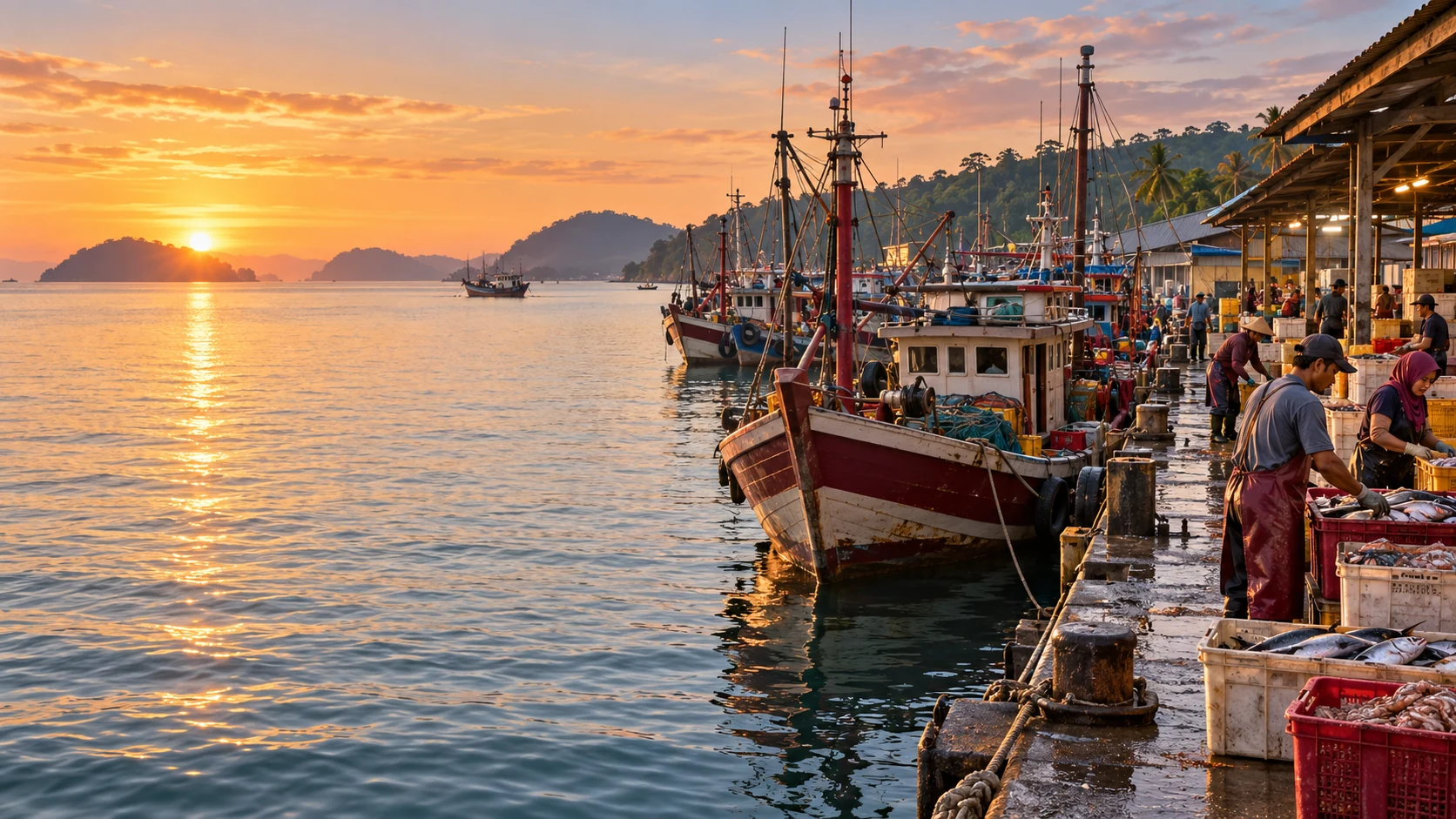
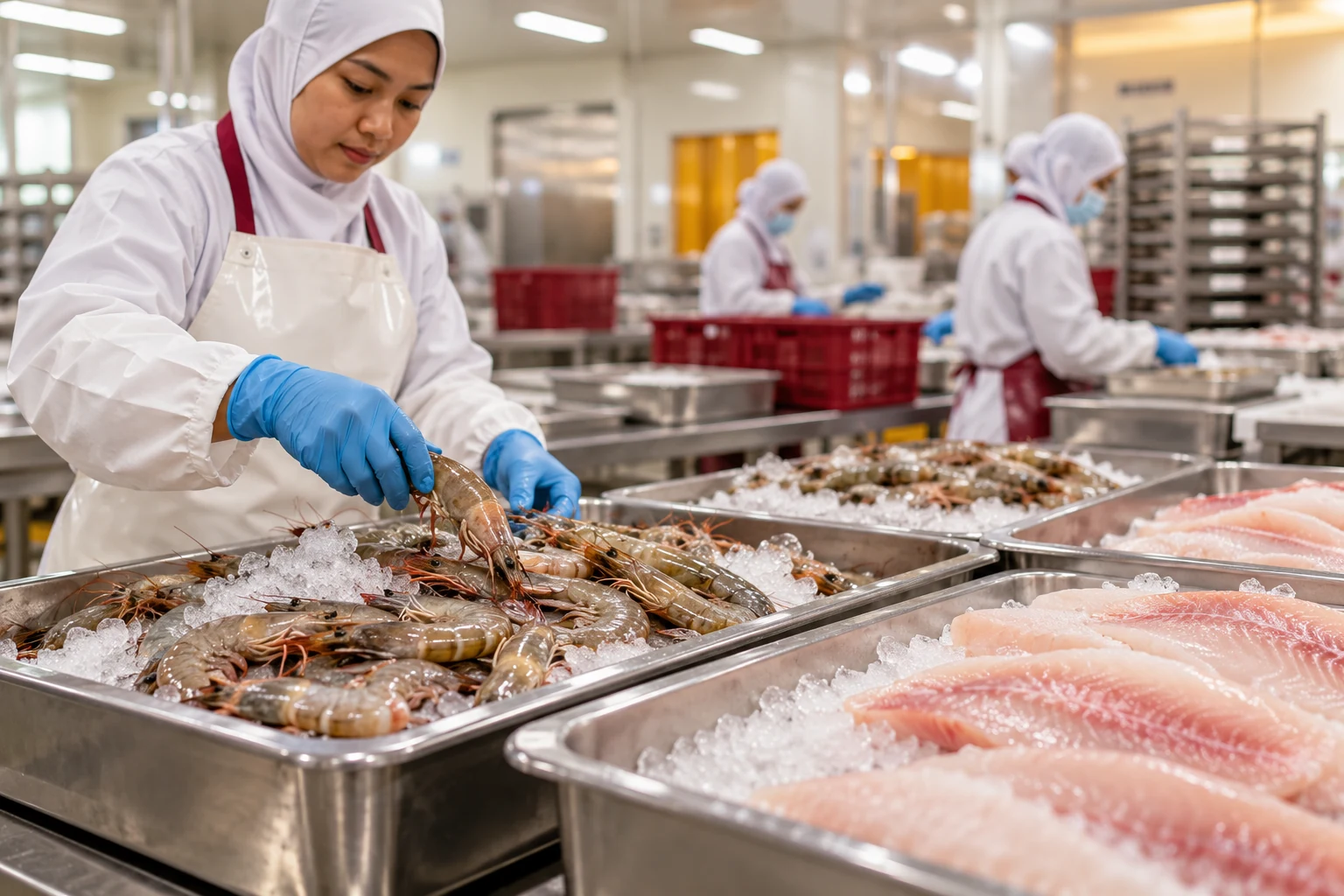
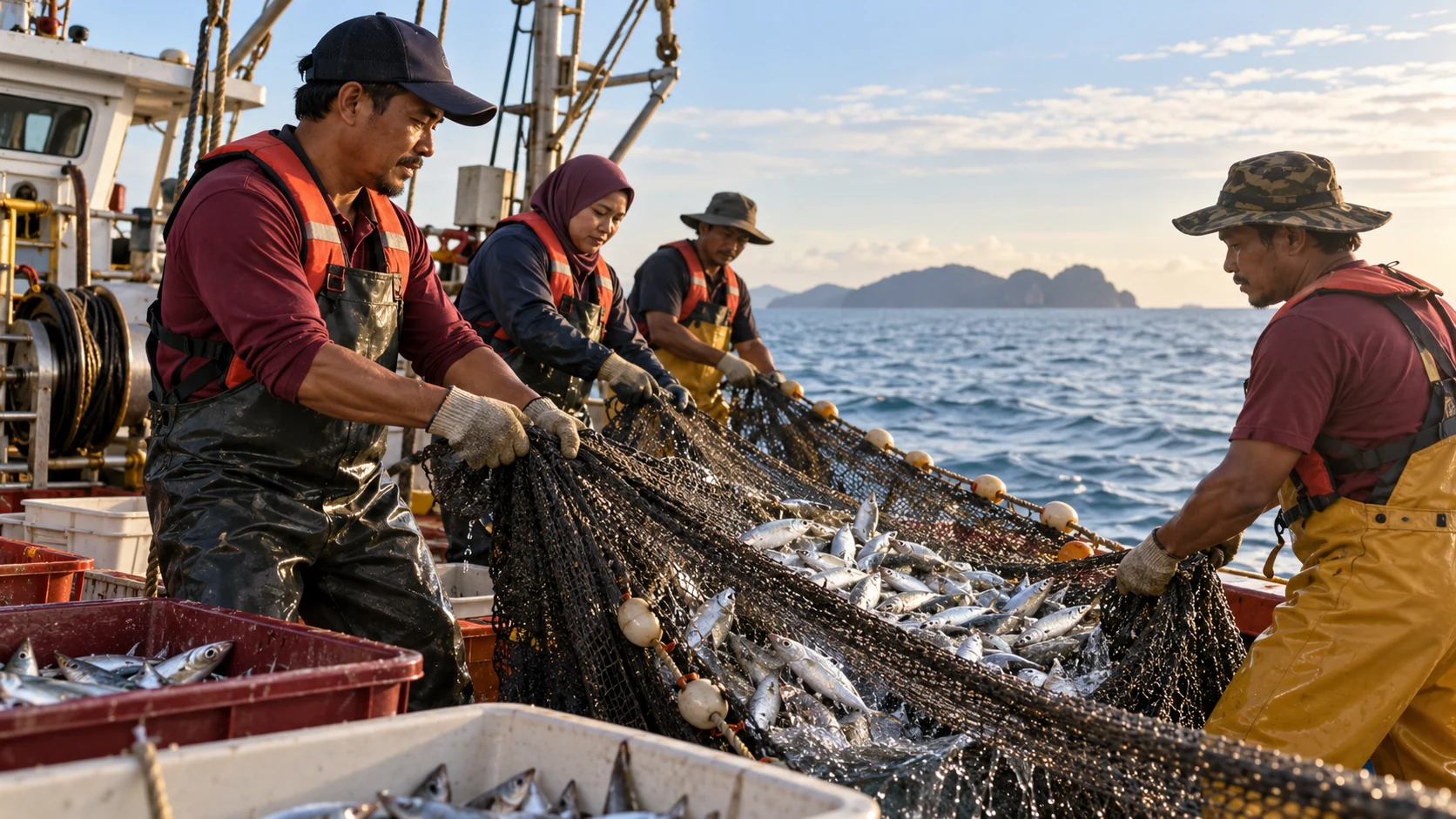
Every photograph on this page is an editorial illustration of a generic activity or product group. None documents a named farm, factory, port or company, and none is a scientific species identification plate.
Start Here
From waters and farms to buyers
Malaysia's fisheries economy connects marine and inland capture, freshwater and coastal aquaculture, landing and handling services, processing, distribution and trade. The statistics on this page describe different parts of that chain rather than one interchangeable seafood market size.
Capture fisheries
Catch landed from marine and inland fishing activity. Marine landings stay separate from farm production throughout this page.
Aquaculture
Cultivated aquatic products from ponds, cages and tanks, together with mollusc and seaweed systems. Seaweed materially affects the reported tonnage.
Processing and trade
Fish, shrimp, molluscs and prepared products serve different buyers and handling requirements. The published trade basket also includes non-food and upstream items.
Dated Measures
Production snapshot
Six figures from the 2025 fisheries tables, each with its own definition and table reference. They describe different activities and are not interchangeable.
| Indicator | Period | Value | Definition | Source |
|---|---|---|---|---|
| Marine capture landings | 2025 | 1,393,398 tonnes | All national marine landing categories; not aquaculture | 2. JADUAL PENDARATAN IKAN 2025 .pdf, Table 4.2 |
| Inland capture landings | 2025 | 9,912.19 tonnes | Inland capture only; excludes farmed freshwater output | 5. JADUAL PERIKANAN DARAT 2025.pdf, Table 33.1 |
| Reported aquaculture production | 2025 | 500,155.54 tonnes | Includes 212026.25 wet-weight tonnes of seaweed; not fish-only | 6. JADUAL AKUAKULTUR 2025.pdf, Table 14.1 |
| Cultivated seaweed | 2025 | 212,026.25 wet-weight tonnes | Seaweed is included in the reported aquaculture total | Table 14.1 / 28.2 |
| Freshwater aquaculture production | 2025 | 115,107.42 tonnes | DOF Table 14.1 freshwater subtotal | Table 14.1 |
| Aquaculture wholesale value | 2025 | RM4,414,022,080 | Wholesale value, not retail sales, exports or GDP; source RM thousand converted to MYR | Table 14.2 |
What the aquaculture total actually contains
The reported aquaculture figure includes wet-weight seaweed. Subtracting the seaweed component gives a remainder this page labels as derived — and that remainder is aquatic-animal production, not a finfish-only measure. The three numbers are always shown together so none of them can be quoted alone as Malaysia's fish output.
500,155.54
Reported aquaculture production
212,026.25
Cultivated seaweed
288,129.29
Aquaculture excluding seaweed
Derived
Capture is not farming. Marine landings, inland capture and aquaculture are three separate measures and are never added into one production figure.
These are 2025 production figures. The trade figures further down the page are 2024 and come from a different publication. The two are never combined into one annual snapshot.
What to Specify
Fish, shellfish and product explorer
Eleven product groups and the question that usually decides the conversation. These cards are not a scientific identification guide, not a species-level production ranking and not a claim that every product is locally farmed.
Showing 11 of 11 product groups.
Shrimp and prawns
Malaysia-facing terminology
Udang; tiger and whiteleg shrimp are documented marine farm categories [SEA04]
Whole, peeled, deveined, frozen and prepared; specify species, size/count, treatment and net weight
Illustrative product group; not a scientific species identification plate
Tilapia
Malaysia-facing terminology
Tilapia
Whole or fillet; define actual variety, size and freshwater farming source
Illustrative product group; not a scientific species identification plate
Freshwater and river catfish
Malaysia-facing terminology
Keli / patin are separate statistical categories
Whole, portions and prepared; specify species rather than ordering generic “catfish”
Illustrative product group; not a scientific species identification plate
Seabass
Malaysia-facing terminology
Siakap
Whole and fillets; specify source, size, harvest condition and cold-chain needs
Illustrative product group; not a scientific species identification plate
Grouper
Malaysia-facing terminology
Kerapu groups in DOF aquaculture tables [SEA01]
Live, chilled and frozen; confirm exact species, lawful sourcing and handling requirements
Illustrative product group; not a scientific species identification plate
Tuna and tuna-like groups
Malaysia-facing terminology
DOSM’s tuna basket covers multiple groups [SEA03]
Chilled/frozen whole fish, portions and prepared products; verify species and catch documentation
Illustrative product group; not a scientific species identification plate
Mackerel and pelagic fish
Malaysia-facing terminology
Source groups include kembong/pelaling and tenggiri [SEA03]
Whole, frozen or processed; verify the exact species and buyer pack
Illustrative product group; not a scientific species identification plate
Squid and cuttlefish
Malaysia-facing terminology
Sotong: source grouping differs from exact biological names
Whole, cleaned, tubes, rings and prepared products; define species, cleaning and size
Illustrative product group; not a scientific species identification plate
Crab
Malaysia-facing terminology
Ketam; marine and mud-crab products require exact identification
Live, chilled, frozen and meat; specify species, grade and extraction method
Illustrative product group; not a scientific species identification plate
Molluscs and bivalves
Malaysia-facing terminology
Kerang, siput sudu and tiram appear in DOF farm tables [SEA01]
In-shell and meat formats; confirm harvest area, testing and handling controls
Illustrative product group; not a scientific species identification plate
Seaweed
Malaysia-facing terminology
Rumpai laut
Wet, dried and ingredient applications; specify species, moisture, cleanliness and intended use
Illustrative product group; not a scientific species identification plate
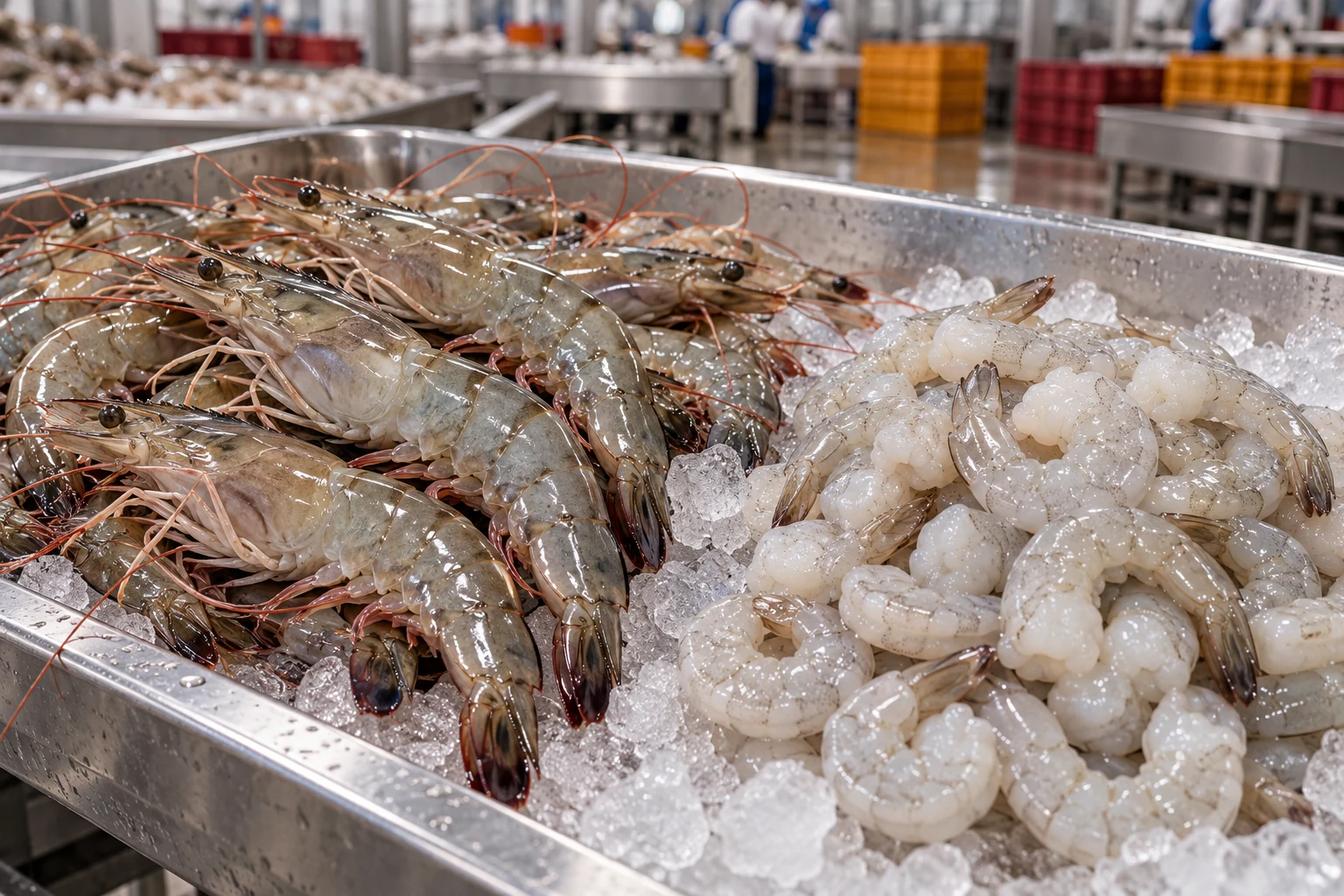


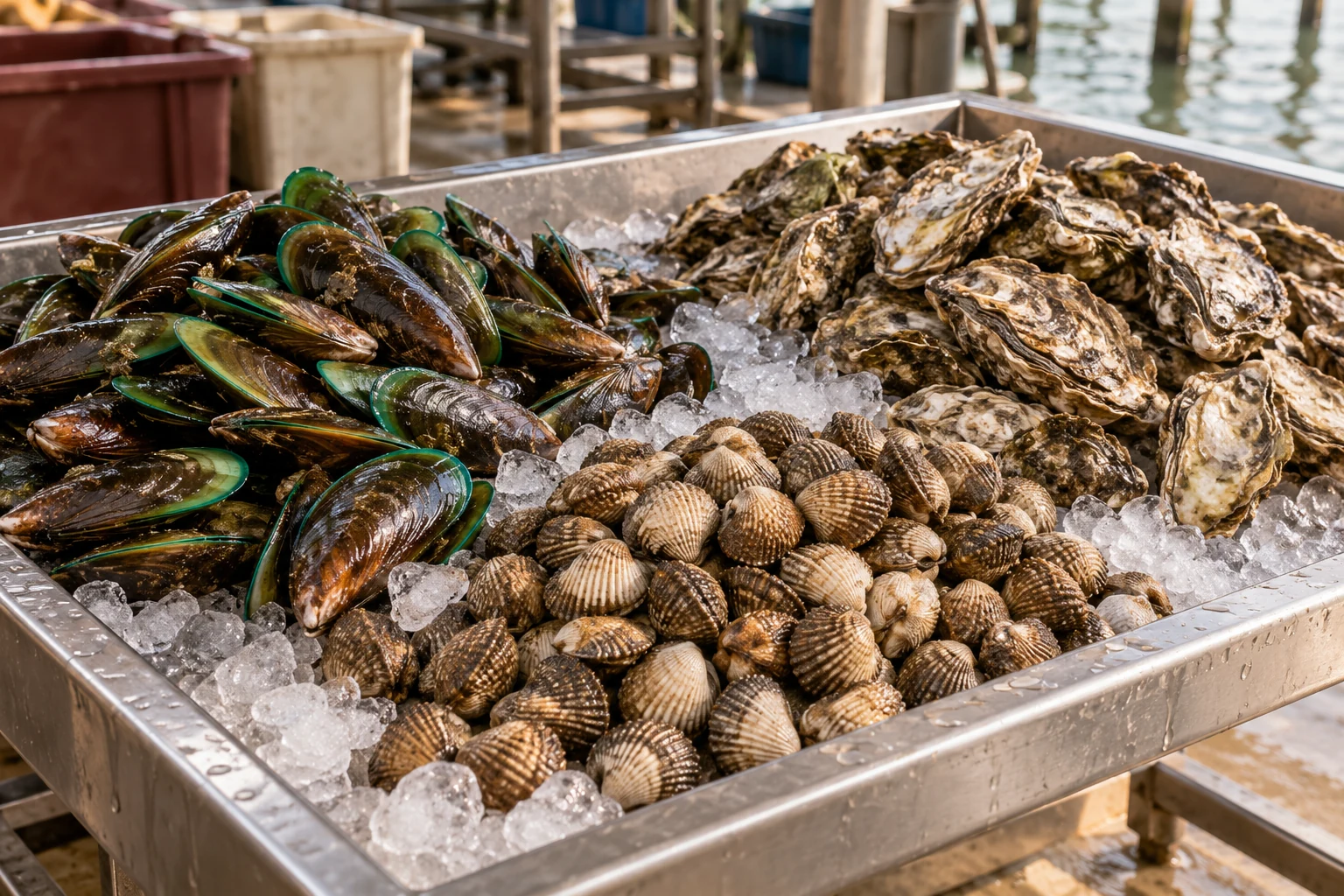
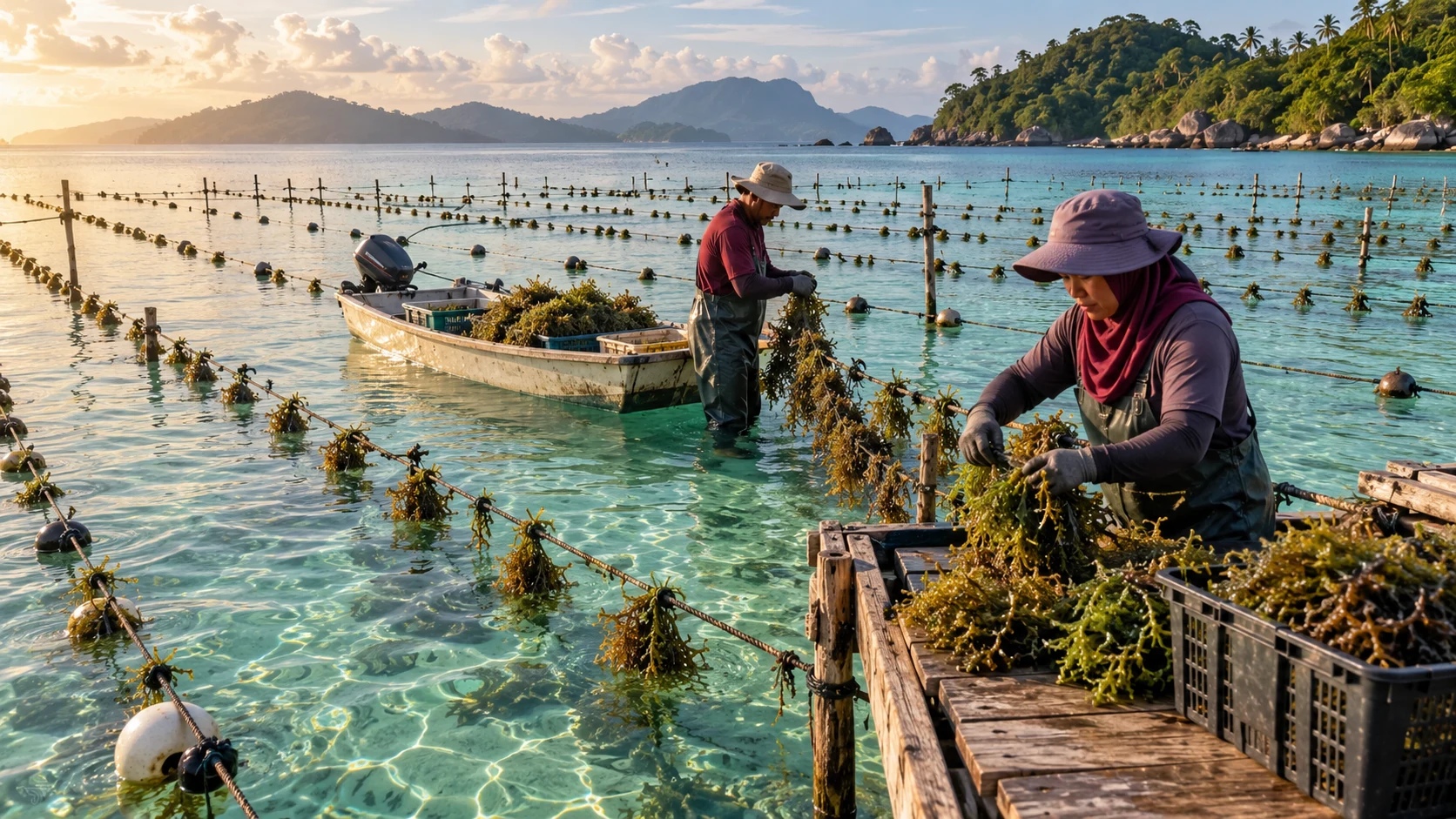
Source group labels are not biological synonyms. The mackerel, tuna, sotong and sardine/selayang baskets each cover more than one species, and “Sardine / Selayang” is a statistical label rather than a universal name. Confirm the scientific species and the actual origin before a transaction.
Pomfret, torpedo scad, threadfin bream, red snapper, stingray and the sardine/selayang group appear in the consumption table further down. Sea cucumber, cockle, mussel and oyster categories also appear in the published aquaculture reporting. They are covered there rather than given an invented image and scientific name here.
Systems
Aquaculture systems and upstream supply
Five things to settle before comparing farms or suppliers. Success depends on the actual site and its operating controls, not on the system type.
Pond production
Check the water source, stocking plan, seed, feed, water monitoring and effluent arrangement. Shrimp and fish systems differ.
Marine and freshwater cages
Confirm site permission, carrying capacity, water quality, operational access and weather exposure with the relevant local authority. An attractive coastline carries no implied entitlement to use it.
Hatcheries and seed
Ask about broodstock, health documentation, batch traceability, transport and acclimation. An SPF claim covers the documented pathogens and that batch — it is not a guarantee against all disease.
Feed and fish health
Compare the feed specification for the exact life stage and species. Take veterinary and technical guidance rather than copying a dosage or expecting a health outcome.
Technology
The June 2026 shrimp-sector release discusses recirculating aquaculture systems, connected water monitoring and specific-pathogen-free development. These are technology directions, not equipment performance or return guarantees.
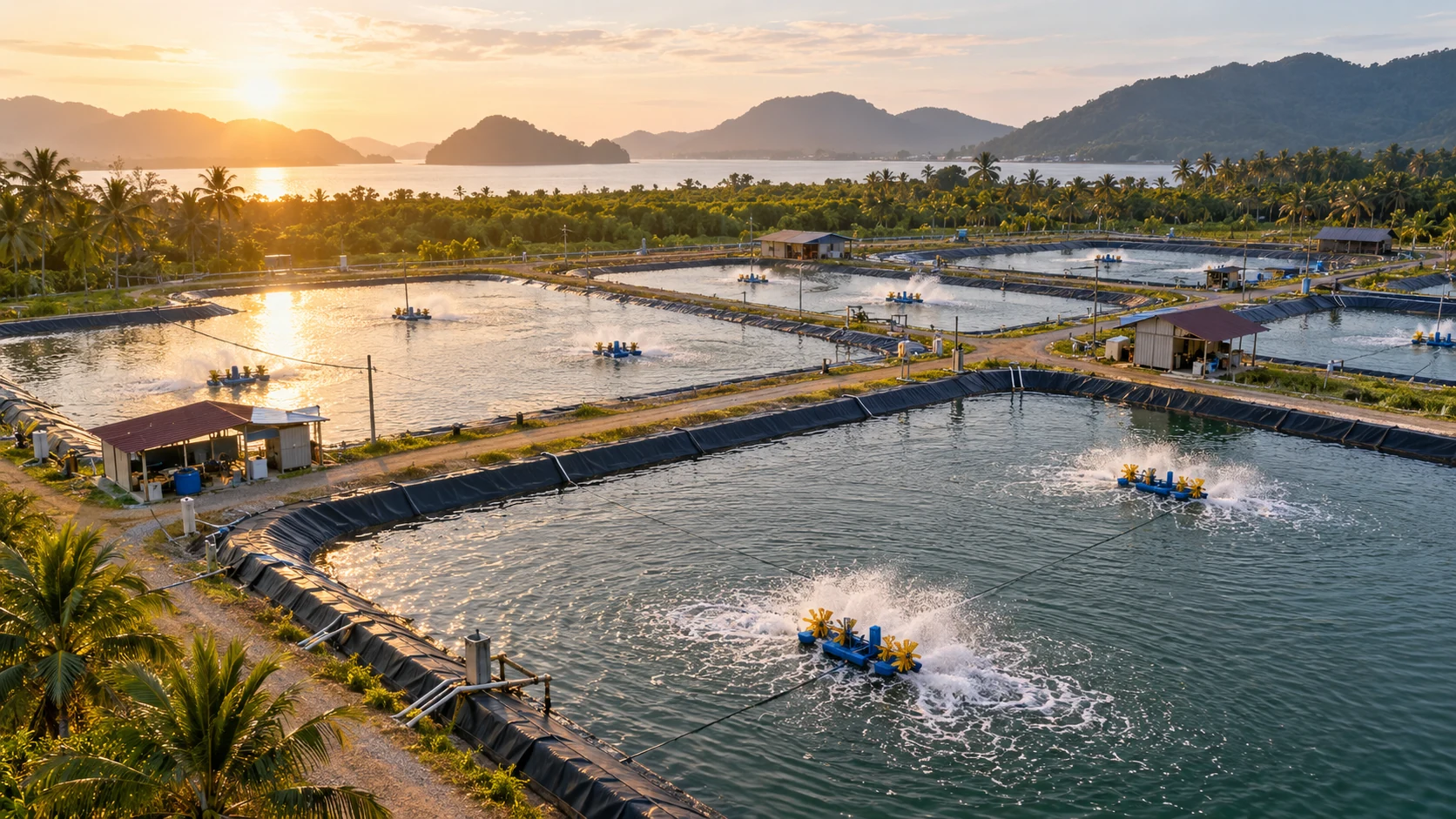
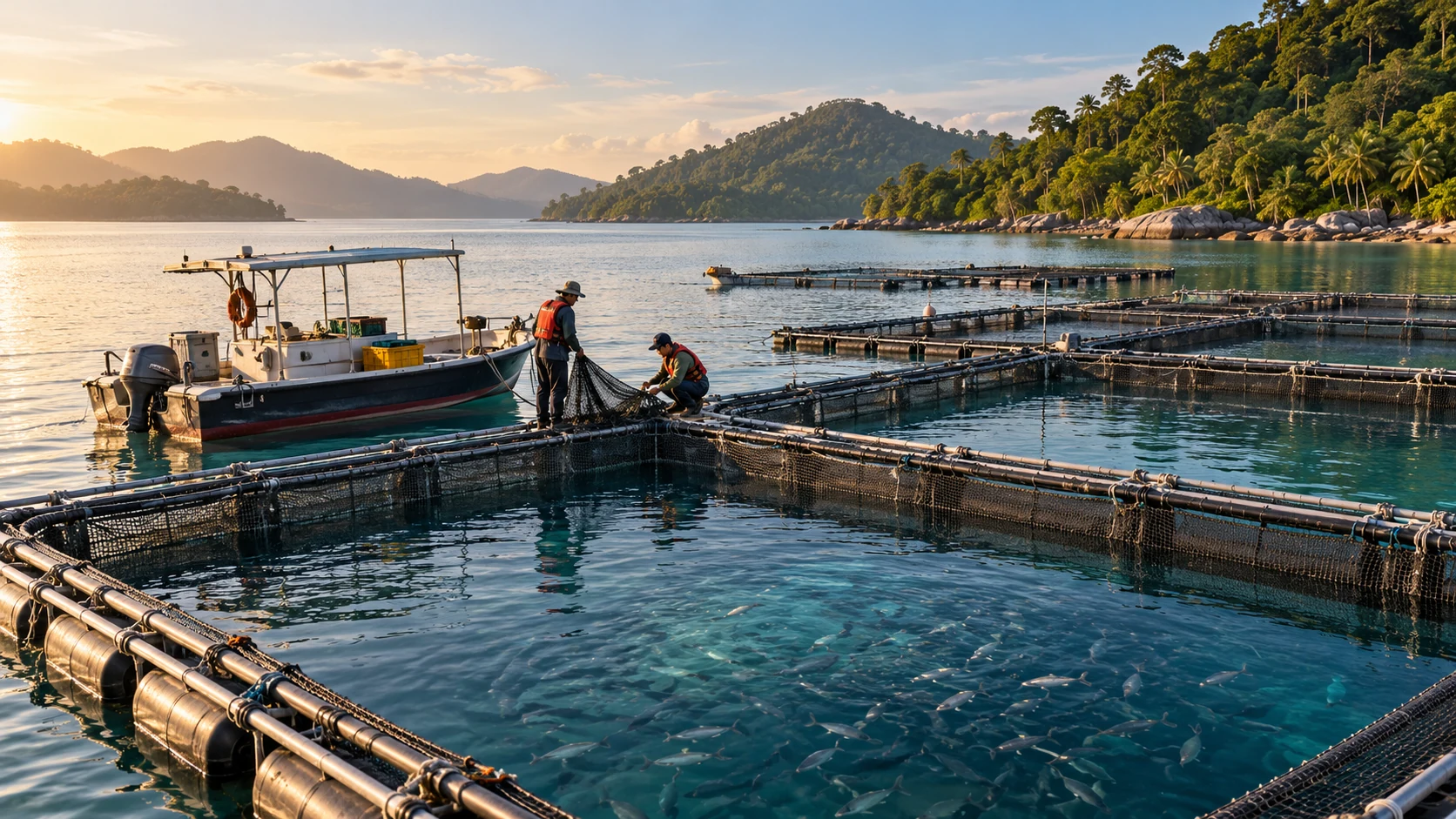
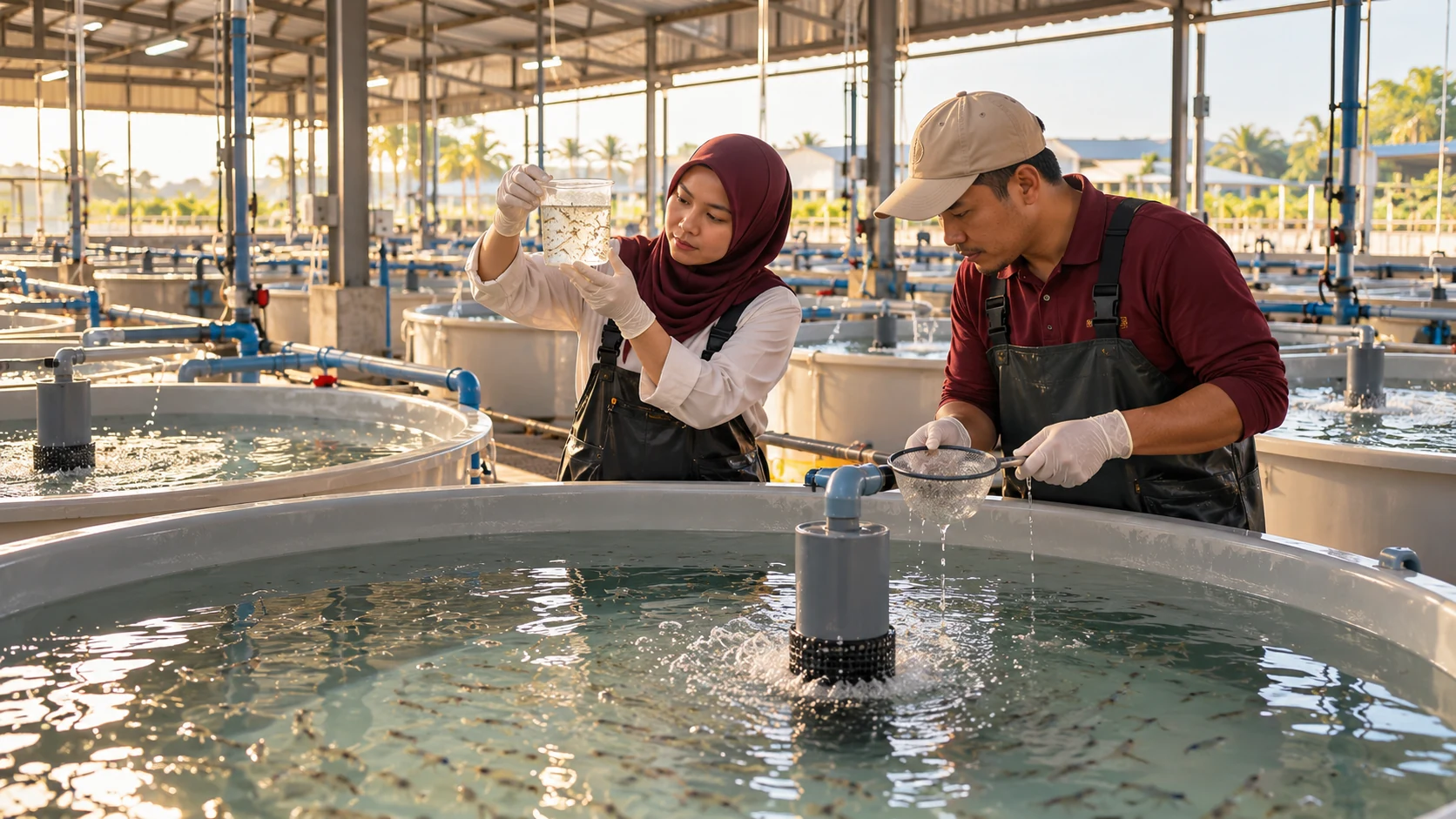
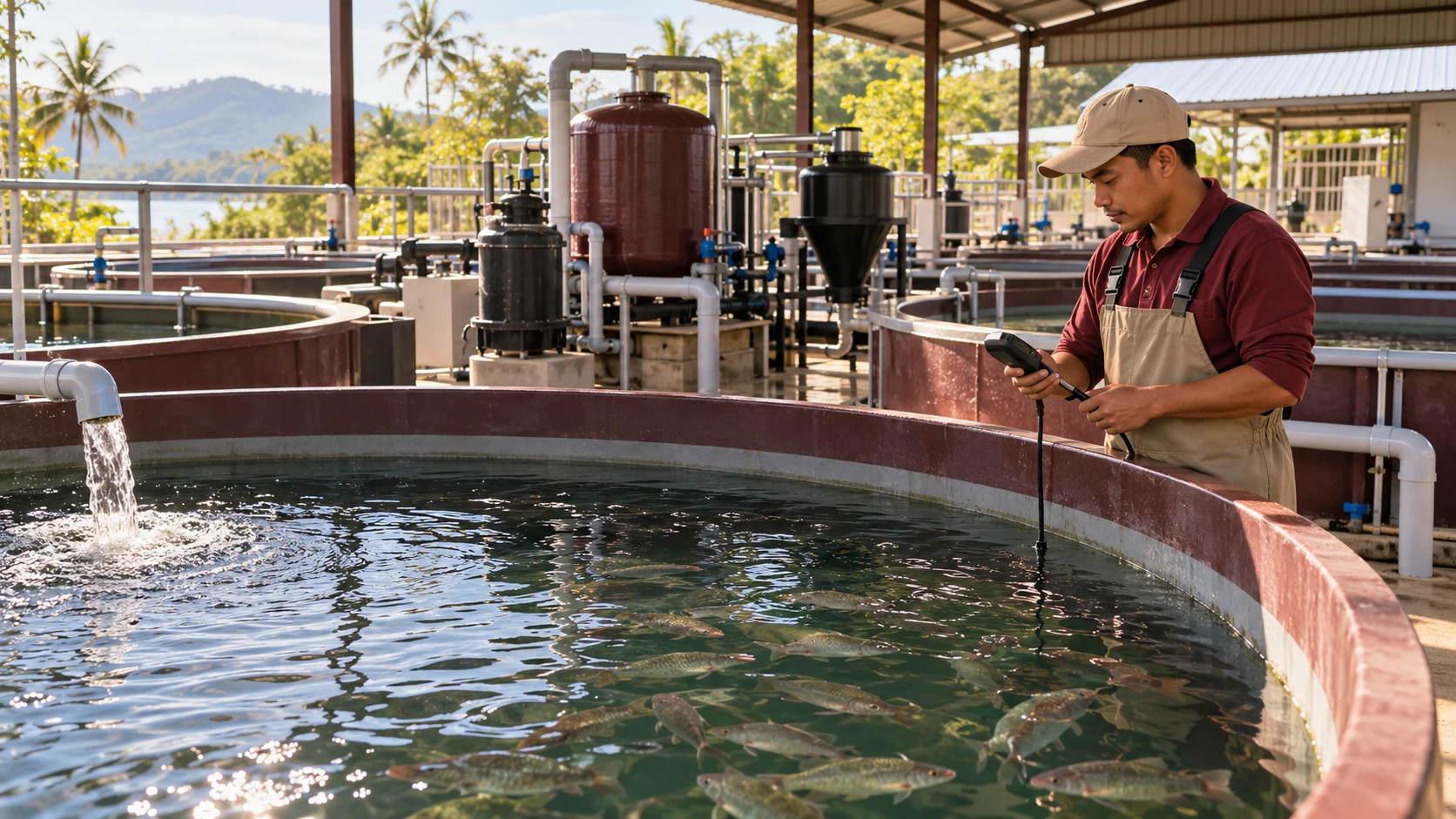
The one farmed-shrimp figure, and its scope
Farmed marine shrimp production was reported as 57,047.80 tonnes in 2025, matching the combined tiger and whiteleg rows in the 2025 aquaculture table. It is narrower than the combined shrimp supply category used in the consumption table below, so the two are not compared.
SEA01 — DOF Malaysia — Original archive downloaded; marine landings Table 4.2, inland landings Table 33.1, aquaculture Tables 14.1/14.2/14.10/14.13/28.2 (opens in a new tab)SEA04 — DOF / Department of Information official release — 2024/2025 farmed marine shrimp volume/wholesale value; whiteleg and tiger shrimp; RAS/IoT/SPF orientation (opens in a new tab)
Three abbreviations used above
- RAS:
- Recirculating aquaculture system.
- IoT:
- Connected monitoring devices.
- SPF:
- Specific-pathogen-free, for the stated organisms and testing scope only.
Domestic Demand
What is available for Malaysian consumers?
Per-capita consumption here measures the amount of food available per person per year through supply-and-utilisation accounts. It is an apparent availability measure, not a survey of what each person eats.

| Category | Source label | Production | Imports | Exports | Availability |
|---|---|---|---|---|---|
| Pomfret | Bawal | 21,272.3 | 6,956.9 | 269.4 | 0.8 |
| Torpedo scad | Cencaru | 33,559.5 | 1,142.4 | 2,173.4 | 1 |
| Freshwater catfish | Keli | 46,533.6 | 7,553 | 327.3 | 1.6 |
| Threadfin bream | Kerisi | 46,085.2 | 37.7 | 10.4 | 1.3 |
| Crab | Ketam | 15,286.8 | 5,488.6 | 5,265.7 | 0.3 |
| Mackerel | Grouped source label | 146,916.1 | 58,781.3 | 11,439.7 | 5.6 |
| Red snapper | Ikan merah | 14,651.2 | 219.9 | 61.2 | 0.4 |
| Stingray | Pari | 12,930.6 | 1,973.7 | 109.1 | 0.4 |
| River catfish | Patin | 18,993.6 | 1.2 | — | 0.6 |
| Sardine | Selayang: DOSM statistical label | 87,936 | 17,701.6 | 280.3 | 3 |
| Seabass | Siakap | 62,631.6 | 1,320.9 | 9,007.5 | 1.6 |
| Cuttlefish | Sotong: source group label | 68,247.3 | 59,008.2 | 40,502.6 | 2.5 |
| Tilapia | Tilapia | 33,559.5 | 1,942.2 | 629 | 1 |
| Tuna | Grouped source label | 80,390.6 | 1,957.6 | 14,558.9 | 1.9 |
| Shrimp | Udang: combined group | 142,677.7 | 45,197.5 | 30,215.1 | 4 |
Production / Imports / Exports: tonnes · Availability: kg/person/year · 2025
A dash is the source's own missing value and is kept as missing. It is never read as zero.
These are selected categories. Adding the fifteen availability figures does not give Malaysia's total fish consumption, and no such total is offered here.
Domestic buyer pathways to investigate
- Wet-market and wholesale buyers
- Supermarkets
- Restaurants and institutional kitchens
- Processors
- E-commerce and specialist distributors
Qualification depends on species, price and grade, pack, remaining shelf life and delivery conditions. This is editorial buyer segmentation, not a measured market share.
Trade
Trade intelligence
The published 2024 basket is broader than edible seafood. Reading it as a seafood export total is the most common mistake this section exists to prevent.
Processing and value-added products
Agree the product form before comparing offers. Whole chilled fish, frozen fillets, cleaned squid, peeled shrimp, cooked products and prepared seafood have different yields, handling needs and buyer specifications.
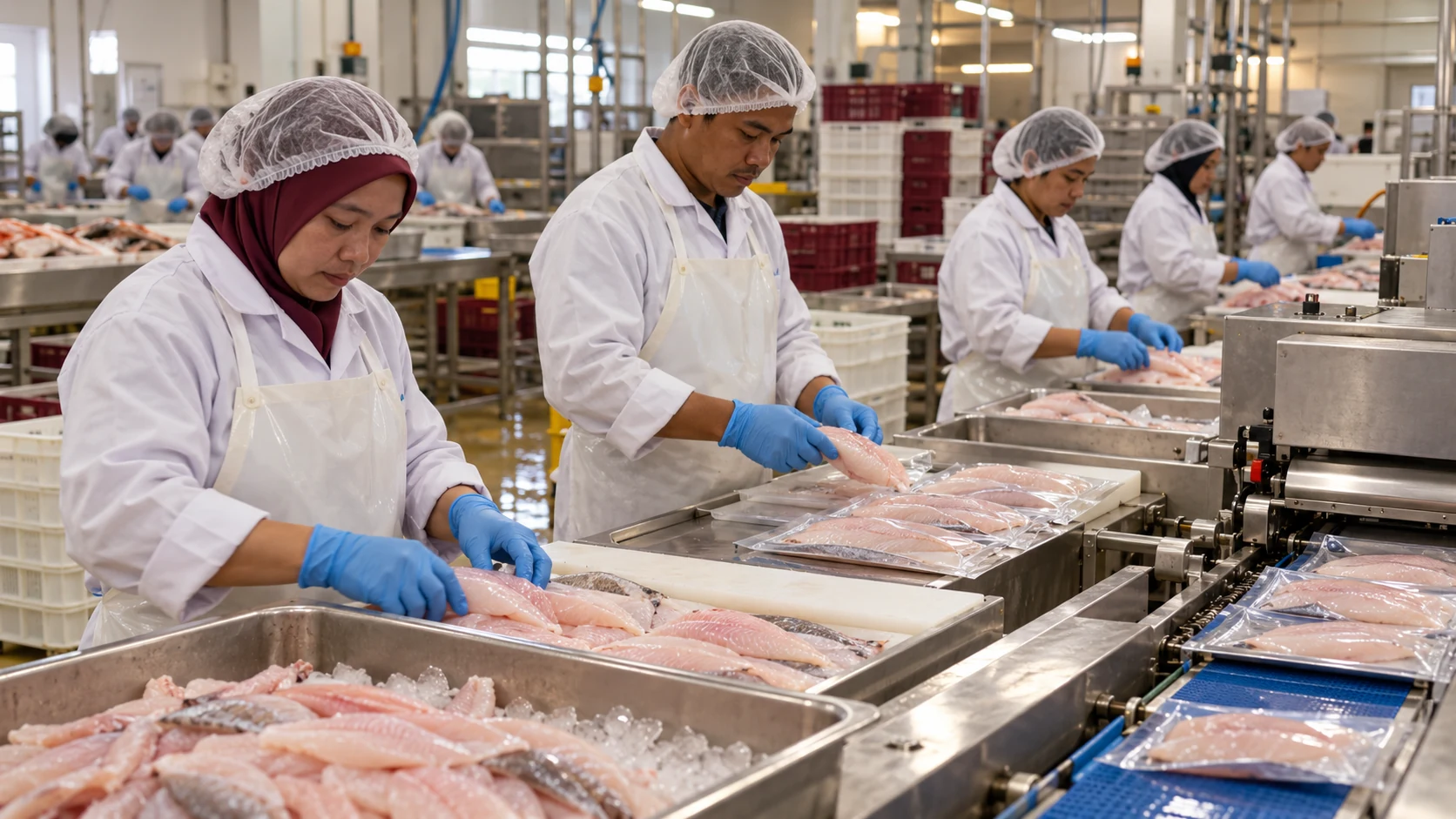
Settle all of this in writing
- Processing method
- Glazing
- Additives and treatments
- Net versus gross weight
- Trim and yield
- Pack format
- Allergens
- Shelf life
- Temperature controls
Individually quick frozen describes a freezing format. It is not a certification and not a guarantee of product quality.
Private-label development should define recipe and product ownership, artwork, label responsibility, minimum order, testing, traceability and acceptance criteria. No company on this page has a verified universal minimum order, lead time or blanket private-label offer.
Broad fishery-commodity basket, 2024
| Measure | Quantity | Value |
|---|---|---|
| Exports | 403,006.7 tonnes | RM4,389.92 million |
| Imports | 662,183.77 tonnes | RM6,577.33 million |
The value basket includes ornamental fish, fishmeal, aquatic plants, seaweed and miscellaneous categories. The published tonne totals already exclude ornamental fish, which is measured in pieces. These are not strict edible-seafood totals, not aquaculture sales and not export quantities of domestically farmed fish.
The twelve published categories
| Publisher's category | Export quantity | Export value | Import quantity | Import value |
|---|---|---|---|---|
| Shrimps, prawns, live, fresh or chilled, frozen | 31,876.22 | RM846.97 million | 42,589.49 | RM669.17 million |
| Fish, fresh or chilled, frozen | 88,872.14 | RM586.83 million | 225,279.87 | RM2,151.28 million |
| Fish, prepared or preserved, n.e.s | 43,152.84 | RM770.76 million | 41,167.92 | RM448.37 million |
| Live fish | 1,849.91 | RM24.78 million | 415 | RM13.62 million |
| Crustaceans molluscs and other aquatic invertebrates, live, fresh or chilled, frozen | 57,431.88 | RM820.71 million | 89,982.31 | RM1,255.84 million |
| Crustaceans, molluscs and other aquatic invertebrates, prepared or preserved, n.e.s. | 7,257.31 | RM219.73 million | 41,491.97 | RM296.6 million |
| Fish fillets & other fish meat, fresh or chilled, frozen (incl. other than fresh or chilled, frozen) | 14,880.99 | RM196.63 million | 73,295.61 | RM775.47 million |
| Fish meal unfit for human consumptionFishmeal is published as unfit for human consumption. | 100,615.27 | RM555.41 million | 90,252.76 | RM488.35 million |
| Aquatic PlantsAquatic plants and seaweed are kept apart from fish. | 41,678.1 | RM103.22 million | 5,162.04 | RM31.74 million |
| SeaweedsAquatic plants and seaweed are kept apart from fish. | 1,615.97 | RM23.43 million | 2,084.77 | RM110.2 million |
| Others | 13,776.06 | RM175.25 million | 50,462.01 | RM274.92 million |
Export quantity / Import quantity: tonnes · 2024
Ornamental fish is counted in pieces and is shown separately below the tonne rows, so it can never be read as part of a tonne total.
| Publisher's category | Export quantity | Export value | Import quantity | Import value |
|---|---|---|---|---|
| Ornamental fish pieces | 33,129,001 | RM66.21 million | 55,923,087 | RM61.76 million |
“n.e.s.” means not elsewhere specified in the source classification. These are publisher categories, not species-level totals, and no single HS code is assigned to them here.
The 2025 selected-fisheries table uses a different commodity basis. The two series are not joined to infer growth.
Cold chain and export logistics
Protect product condition from landing or harvest through storage, processing and dispatch. Agree the buyer's temperature range, monitoring method, pack protection, remaining shelf life and receiving checks.
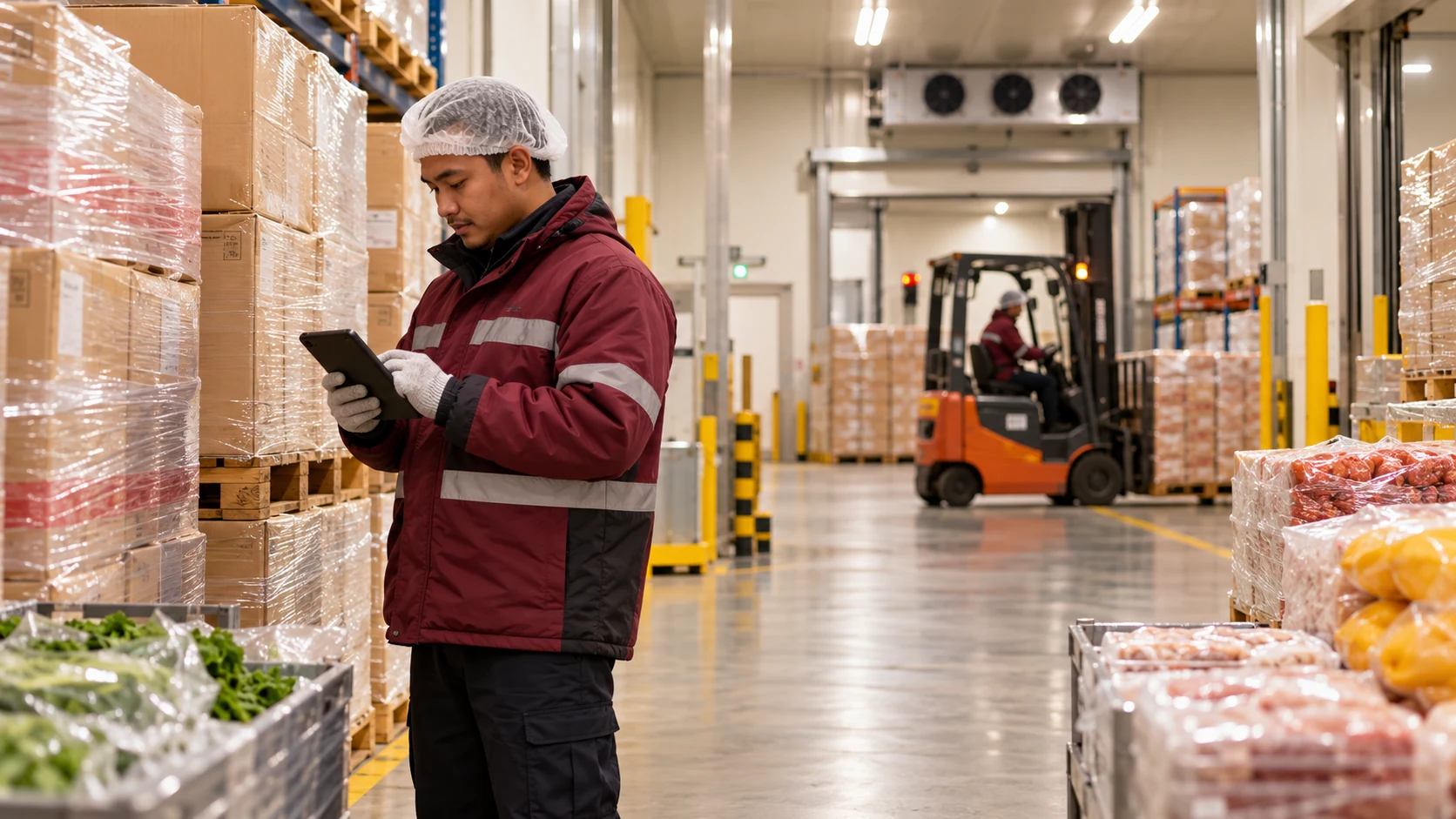

Establish responsibility before shipment
- Icing, chilling or freezing
- Temperature logs
- Cold-store handling
- Loading
- Transit contingency
- Inspection
- Rejected goods
Live animals require species-specific transport and welfare planning. A normal refrigerated shipment does not meet every live-fish requirement.
Destinations
Export destinations and import origins, 2024
Every row below refers to the whole fishery-commodity basket. None is a shrimp-, tuna- or grouper-only country ranking, and the origin of an import says nothing about what Malaysia produces.
Export destinations
| Partner | 2024 value | Share |
|---|---|---|
| China | RM1,432.59 million | 32.6% |
| Singapura / Singapore | RM880.91 million | 20.1% |
| Thailand | RM282.04 million | 6.4% |
| Hong Kong | RM197.12 million | 4.5% |
| Taiwan | RM188.29 million | 4.3% |
| Australia | RM186.19 million | 4.2% |
| Korea | RM185.24 million | 4.2% |
| Turki / Turkey | RM178.86 million | 4.1% |
| Kesatuan Eropah / European Union Aggregate | RM114.32 million | 2.6% |
| Negara Lain / Others Residual | RM744.35 million | 17% |
Import origins
| Partner | 2024 value | Share |
|---|---|---|
| China | RM1,447.65 million | 22% |
| Vietnam | RM934.76 million | 14.2% |
| Thailand | RM872.21 million | 13.3% |
| Indonesia | RM819.82 million | 12.5% |
| India | RM380.79 million | 5.8% |
| Norway | RM265.95 million | 4% |
| Japan | RM183.67 million | 2.8% |
| Oman | RM183.1 million | 2.8% |
| Kesatuan Eropah / European Union Aggregate | RM101.23 million | 1.5% |
| Negara Lain / Others Residual | RM1,388.15 million | 21.1% |
The European Union row is an aggregate of member states, and “Others” is the residual after the named partners. Neither is a single country, and both are flagged in the table.
Market Access
Trade agreements and market access
Seventeen official MITI agreement resources, each checked on 12 October 2026. Seafood treatment depends on the species and product form, the classification, the destination schedule, the origin rule and the required proof — never on a sector-level badge.

A practical shipment sequence
- Specify the product and its HS classification.
- Confirm admissibility and facility requirements for the destination.
- Check the relevant tariff schedule and the origin rule.
- Prepare the required origin proof.
- Confirm health, catch, permit and importer documents.
- Calculate remaining taxes and logistics.
MEEPA is shown as signed, not active
Malaysia–EFTA is labelled signed, with entry into force not established by the MITI page checked on 12 October 2026. No tariff benefit is advertised under it.
Showing 17 of 17 agreement resources.
ATIGA / ASEAN Free Trade Area
SEA-FTA01Regional
Status on the checked page: MITI resource page read; product treatment and current schedules require shipment-specific check
What to confirm for a shipment: Specify species/product form and HS code; verify schedule, origin rule and origin proof. FTA preferences do not remove sanitary or permit requirements.
ASEAN–Australia–New Zealand (AANZFTA)
SEA-FTA02Regional
Status on the checked page: MITI resource page read; product treatment and current schedules require shipment-specific check
What to confirm for a shipment: Specify species/product form and HS code; verify schedule, origin rule and origin proof. FTA preferences do not remove sanitary or permit requirements.
ASEAN–China (ACFTA)
SEA-FTA03Regional
Status on the checked page: MITI resource page read; product treatment and current schedules require shipment-specific check
What to confirm for a shipment: Specify species/product form and HS code; verify schedule, origin rule and origin proof. FTA preferences do not remove sanitary or permit requirements.
ASEAN–India (AIFTA)
SEA-FTA04Regional
Status on the checked page: MITI resource page read; product treatment and current schedules require shipment-specific check
What to confirm for a shipment: Specify species/product form and HS code; verify schedule, origin rule and origin proof. FTA preferences do not remove sanitary or permit requirements.
ASEAN–Japan (AJCEP)
SEA-FTA05Regional
Status on the checked page: MITI resource page read; product treatment and current schedules require shipment-specific check
What to confirm for a shipment: Specify species/product form and HS code; verify schedule, origin rule and origin proof. FTA preferences do not remove sanitary or permit requirements.
ASEAN–Korea (AKFTA)
SEA-FTA06Regional
Status on the checked page: MITI resource page read; product treatment and current schedules require shipment-specific check
What to confirm for a shipment: Specify species/product form and HS code; verify schedule, origin rule and origin proof. FTA preferences do not remove sanitary or permit requirements.
ASEAN–Hong Kong, China (AHKFTA)
SEA-FTA07Regional
Status on the checked page: MITI resource page read; product treatment and current schedules require shipment-specific check
What to confirm for a shipment: Specify species/product form and HS code; verify schedule, origin rule and origin proof. FTA preferences do not remove sanitary or permit requirements.
RCEP
SEA-FTA08Regional
Status on the checked page: MITI resource page read; product treatment and current schedules require shipment-specific check
What to confirm for a shipment: Specify species/product form and HS code; verify schedule, origin rule and origin proof. FTA preferences do not remove sanitary or permit requirements.
CPTPP
SEA-FTA09Plurilateral
Status on the checked page: MITI records Malaysia entry into force 29 November 2022; current party/schedule coverage needs shipment-specific check
What to confirm for a shipment: Specify species/product form and HS code; verify schedule, origin rule and origin proof. FTA preferences do not remove sanitary or permit requirements.
Malaysia–Australia (MAFTA)
SEA-FTA10Bilateral
Status on the checked page: MITI resource page read; product treatment and current schedules require shipment-specific check
What to confirm for a shipment: Specify species/product form and HS code; verify schedule, origin rule and origin proof. FTA preferences do not remove sanitary or permit requirements.
Malaysia–Chile (MCFTA)
SEA-FTA11Bilateral
Status on the checked page: MITI resource page read; product treatment and current schedules require shipment-specific check
What to confirm for a shipment: Specify species/product form and HS code; verify schedule, origin rule and origin proof. FTA preferences do not remove sanitary or permit requirements.
Malaysia–India (MICECA)
SEA-FTA12Bilateral
Status on the checked page: MITI resource page read; product treatment and current schedules require shipment-specific check
What to confirm for a shipment: Specify species/product form and HS code; verify schedule, origin rule and origin proof. FTA preferences do not remove sanitary or permit requirements.
Malaysia–Japan (MJEPA)
SEA-FTA13Bilateral
Status on the checked page: MITI resource page read; product treatment and current schedules require shipment-specific check
What to confirm for a shipment: Specify species/product form and HS code; verify schedule, origin rule and origin proof. FTA preferences do not remove sanitary or permit requirements.
Malaysia–New Zealand (MNZFTA)
SEA-FTA14Bilateral
Status on the checked page: MITI resource page read; product treatment and current schedules require shipment-specific check
What to confirm for a shipment: Specify species/product form and HS code; verify schedule, origin rule and origin proof. FTA preferences do not remove sanitary or permit requirements.
Malaysia–Pakistan (MPCEPA)
SEA-FTA15Bilateral
Status on the checked page: MITI resource page read; product treatment and current schedules require shipment-specific check
What to confirm for a shipment: Specify species/product form and HS code; verify schedule, origin rule and origin proof. FTA preferences do not remove sanitary or permit requirements.
Malaysia–Türkiye (MTFTA)
SEA-FTA16Bilateral
Status on the checked page: MITI resource page read; product treatment and current schedules require shipment-specific check
What to confirm for a shipment: Specify species/product form and HS code; verify schedule, origin rule and origin proof. FTA preferences do not remove sanitary or permit requirements.
Malaysia–EFTA (MEEPA)
SEA-FTA17Signed agreement; not displayed as an active preference
Status on the checked page: Signed 23 June 2025; checked MITI page records entry into force N/A; do not claim an active preference
What to confirm for a shipment: Specify species/product form and HS code; verify schedule, origin rule and origin proof. FTA preferences do not remove sanitary or permit requirements.
An FTA preference does not replace sanitary, animal-health, traceability or import-permit conditions.
Geography
Regional production and sourcing
Eight selected state records of reported aquaculture output, including seaweed. This is a selection drawn from the published table, not a complete state ranking.
| State | Reported aquaculture | of which seaweed | How to read it |
|---|---|---|---|
| Sabah | 221,776.1 | 212,003 | Seaweed-dominated reported aquaculture total; do not compare this with fish-only state output |
| Perak | 79,873.87 | 0 | Freshwater and brackishwater systems; official state sourcing resource |
| Pulau Pinang | 64,596.17 | 20.88 | Pond and marine cage aquaculture systems |
| Kedah | 31,639.31 | 0 | Pond and other culture systems |
| Johor | 28,974.92 | 1.9 | Mixed freshwater/brackishwater systems |
| Selangor | 22,134.78 | 0.47 | Freshwater and brackishwater systems |
| Pahang | 14,308.17 | 0 | Freshwater cages and other culture systems |
| Sarawak | 13,525.46 | 0 | Freshwater and marine resources; confirm the relevant local authority |
tonnes · 2025
Sabah's total is heavily influenced by wet-weight seaweed, so it is not comparable with a fish-only state output. Perak and Penang have different culture-system mixes. Compare the actual product and system before choosing a sourcing region.
For the East Coast, Johor and East Malaysia, use the appropriate state fisheries resources and verify the supplier's actual premises.
No generated map is shown. An output figure does not indicate an available farm site or an investment permit, and placing an illustration on a map would imply a precision this page does not have.
Rules
Policy, licensing and public support
Eight resource areas, each a starting point rather than a determination. Freshwater, marine and East Malaysian arrangements can involve different authorities.
| Policy or resource | How to use it | Source |
|---|---|---|
| National Agrofood Policy / DAN 2.0, 2021–2030 | Fisheries and aquaculture sit within the policy's agrofood development scope. Policy targets are not achieved outputs. | SEA17 — DOF — DAN 2.0 2021–2030 and fisheries climate action plan 2024–2030 listed; expired 2021–2025 plan not presented as new (opens in a new tab)SEA18 — KPKM — NAP/DAN 2.0 policy includes fisheries/aquaculture; resilient, technology-enabled agrofood orientation (opens in a new tab) |
| Fisheries climate action plan, 2024–2030 | Listed as an official resource. Its detailed measures were not independently extracted for this page. | |
| Fisheries Act 1985 [Act 317] and amendments | The core legal resource. Confirm the current consolidated text and the relevant regulations before an operating decision. | |
| Capture-fisheries licensing | The official vessel, eLogbook and licensing pathway. No fishing right is guaranteed by it. | SEA10 — DOF — Vessel licensing, eLogbook and related official resource (opens in a new tab) |
| Aquaculture licensing | Identify the state, location and system first, then approach the competent authority. | |
| Import, export and disease controls | Product- and species-specific restrictions and documents, including listed 2024 amendments. Obtain the current conditions. | SEA08 — DOF — Import/export disease controls and prohibited-species rules, including listed 2024 amendments (opens in a new tab)SEA11 — DOF — Product/species-specific export orientation; importing-country conditions must be confirmed (opens in a new tab) |
| Endangered aquatic species | Act 686 and the relevant species controls. No permission is inferred from a product name. | |
| LKIM development and community programmes | Official resources for infrastructure, markets, development and fishermen institutions. Verify current availability and eligibility. | SEA19 — LKIM — Fisheries development, landing facilities, markets, cold storage and community resources (opens in a new tab)SEA20 — LKIM — National/state/area fishermen association discovery resource (opens in a new tab) |
Project review questions
- Lawful site and water access
- Fishery or aquaculture licence or registration
- Seed and species controls
- Environmental requirements
- Biosecurity
- Employee safety
- Landing and processing arrangements
- Destination-market conditions
These are due-diligence questions, not a legal conclusion about a specific project. Sabah and Sarawak deserve their own referral paths; the peninsula's procedure is not a universal permit checklist, and no claim is made that a Malaysian seafood activity receives a subsidy or a tax holiday.
Assurance
Standards, certification and assurance
Six kinds of check, each with its own authority and its own scope. None is interchangeable with another.

myGAP aquaculture
The scheme page and a dated premises register. Verify the exact farm, its registration or certificate number, the activity and the validity. The general scheme page includes older standard references, so confirm the applicable current edition before building a compliance checklist.
myGMP feed and fishmeal
The listing carries older certificate periods despite some active labels. It is not evidence that those certificates remain valid today, and it is not interchangeable with processing GMP.
Fish Quality Certification
An EU-linked supply-chain assurance framework. Its discussion of events in 2008 is historical and is not published here as a current blanket EU-ban claim. Confirm current product and facility conditions with the relevant authorities.
Food safety
HACCP, GMP and MeSTI resources for the relevant processing activity. Assess the exact facility and scope; no sector-wide compliance claim follows from the scheme existing.
Halal
Check ingredients, processing, premises and certificate scope where halal assurance is required. The presence of fish, or a general halal claim, is not proof of a packaged product's current certification.
Testing
The laboratory directory and the relevant accreditation resources. Confirm the actual analytical scope and the accreditation before commissioning work.
Buyer-requested schemes such as ASC, BAP, MSC or BRCGS can be added only with verified issuer resources and supplier-specific evidence. Nothing on this page establishes that a listed supplier holds any of them, and no certificate mark or logo is reproduced.
Provenance
Traceability, responsible sourcing and IUU
IUU means illegal, unreported and unregulated fishing. For a purchase, connect the supplier, the species, the source vessel or farm, the harvest or landing record, the processing lot and the shipment documents.
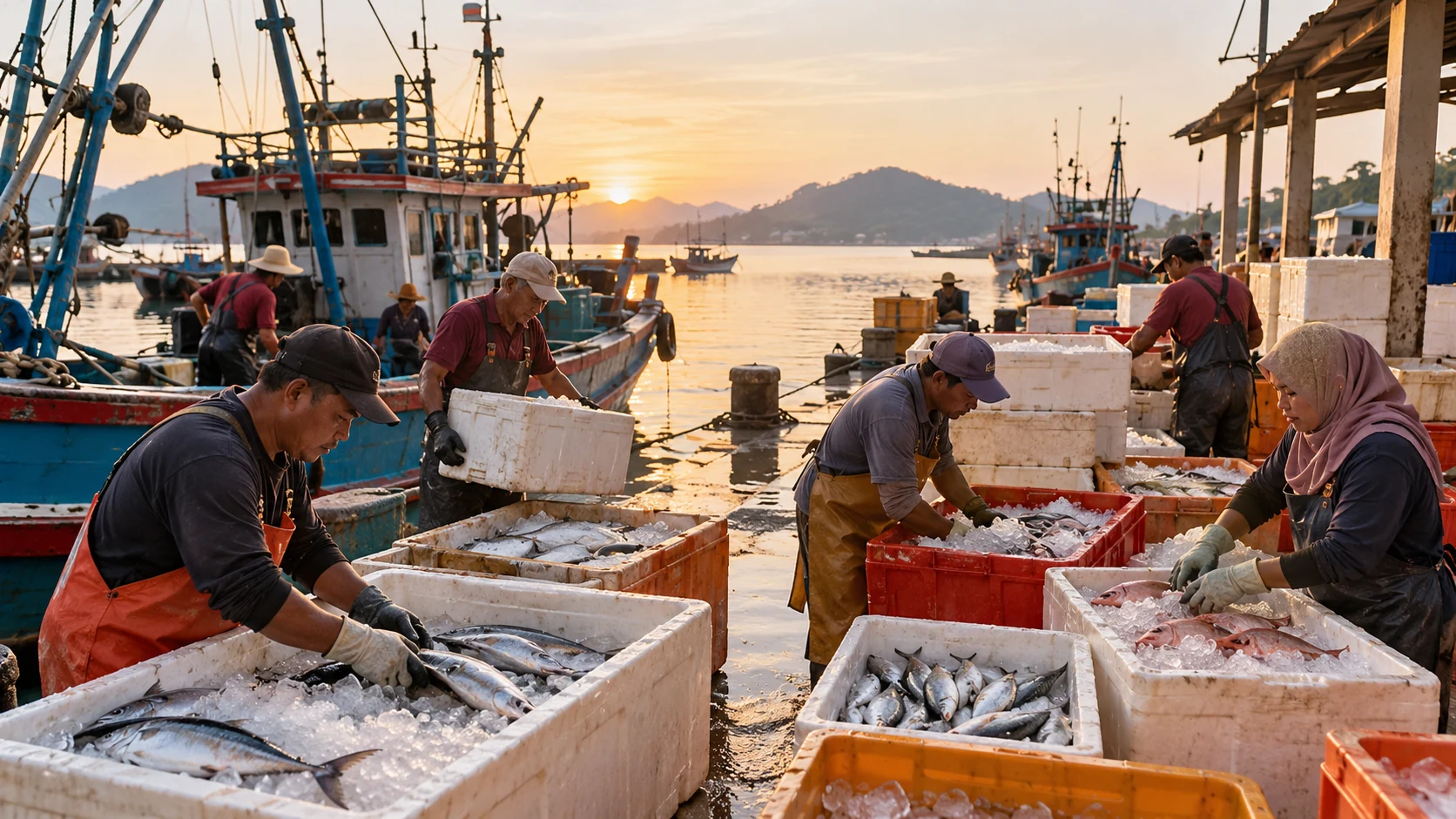
Ask for evidence suited to the product
- Lawful catch or farm source
- Origin and harvest details
- Lot records
- Any required catch or health documentation
- Worker safety and welfare controls
SEA16 — DOF — IUU resource; no unsupported current international status badges (opens in a new tab)
Keep farm assurance separate from wild-capture sustainability: they answer different questions and are evidenced differently.
Traceability software is useful only when the underlying records are accurate and checked. No green sustainability badge, “IUU-free” claim or international approval appears on this page without current supporting evidence, which means none appears.
Verify protected-species and market rules rather than assuming a product name settles legality.
R&D and Skills
Research, skills and technology
Starting points for a technical conversation. Confirm the relevant research team, the available service, the training date and the commercial terms directly — a listing is not a ready programme.
Development questions worth scoping
- Seed quality
- Selective breeding
- Feed efficiency
- Water monitoring
- Disease diagnosis
- Processing yield
- Waste handling
- Traceability
- Climate exposure
These are editorial investigation areas, not promises of a proven technology outcome. The illustrations in this section are generic and do not portray a real campus, laboratory or institutional partnership.
SEA22 — Malaysian Fisheries Society — Professional fisheries society and research-community resource (opens in a new tab)SEA24 — DOF / FRI — Fisheries research institute portal and current research resources (opens in a new tab)SEA25 — UMT / AKUATROP — Institute of Tropical Aquaculture and Fisheries identity/research resource (opens in a new tab)SEA26 — Universiti Malaysia Sabah — Borneo Marine Research Institute; marine/aquaculture research (opens in a new tab)SEA30 — SEAFDEC — Marine Fishery Resources Development and Management Department resource; do not assert current programmes (opens in a new tab)
Investment
Investment orientation
Seven workstreams worth evaluating before any capital decision.
- Value-added seafood processing
- Cold-chain reliability
- Hatchery quality
- Feed
- Water monitoring
- Testing
- Resource efficiency
Evaluate all of these first
- Actual buyer demand
- Operating costs
- Biological risk
- Site constraints
- Permissions
Use the relevant food-processing investment resource and the fisheries or state authorities for activity-specific conversations. General food-processing approval figures are not seafood-only investment values, and no tax-exemption period, foreign-ownership threshold, return forecast or project eligibility is verified here.
GEN-S02 — MIDA — Food-processing investment approvals, projects and job opportunities (opens in a new tab)SEA09 — DOF — Aquaculture Licensing page; jurisdiction and project conditions require authority confirmation (opens in a new tab)
Who to Ask
Find the right resource in Malaysia's seafood ecosystem
Regulators, development bodies, trade and community networks, research institutions and selected companies. Listing is editorial: it establishes no partnership, endorsement or supplier approval.


Bodies and institutions
Showing 27 of 27 institutions and resources.
DOF Malaysia
Government / fisheries
Licensing, fisheries management, aquaculture and export/biosecurity resources
- Verification:
- primary-page-read
- ?
KPKM
Government / policy
Agrofood policy includes fisheries and aquaculture
- Verification:
- official-search-result; full-page-fetch-failed
LKIM
Fisheries development
Landing, market, infrastructure and fishing-community resources
- Verification:
- primary-page-read
LKIM fishermen association directory
Trade / community network
Discover national, state and area fishermen associations
- Verification:
- primary-page-read
NEKMAT
Fishermen association
National fishermen association referral via LKIM; current direct-site services not readable
- Verification:
- primary-page-read
MFS — Malaysian Fisheries Society
Professional society
Fisheries research and professional community
- Verification:
- primary-page-read
- ?
MADA — Malaysia Aquaculture Development Association
Industry association
Aquaculture association identity; current membership terms require direct check
- Verification:
- primary-historical-PDF-read
FMM / MAFMAG
Trade body
Food-manufacturing industry representation
- Verification:
- page-read
FRI — Fisheries Research Institute
Research institute
Fisheries and aquaculture research resources
- Verification:
- primary-page-read
- ?
UMT / AKUATROP
University / research
Tropical aquaculture and fisheries research
- Verification:
- official-search-result; direct-fetch-timeout
UMS Borneo Marine Research Institute
University / research
Borneo marine science and aquaculture research
- Verification:
- primary-page-read
- ?
SEAFDEC / MFRDMD
Regional research body
Southeast Asian marine fisheries research resource; linked by DOF
- Verification:
- linked-by-DOF; direct-fetch-timeout
Department of Fisheries Sabah
State authority
Sabah-specific fisheries guidance
- Verification:
- primary-page-read
Department of Marine Fisheries Sarawak
State / marine authority
Sarawak marine fisheries resource
- Verification:
- primary-page-read
MAQIS
Border / quarantine
Product-specific quarantine and permit orientation
- Verification:
- page-read
MOH Food Safety and Quality Programme
Food safety
Processing food-safety schemes and resources
- Verification:
- page-read
MITI
Trade policy
Agreement, origin and trade-policy resources
- Verification:
- page-read
MATRADE
Export development
Export statistics/resources; DOF supplies this page fishery data
- Verification:
- original-XLSX-tables-read-and-reconciled
MIDA
Investment
Activity-specific investment orientation; no promised incentive
- Verification:
- page-read
- ?
Royal Malaysian Customs
Customs
HS classification and Customs resource
- Verification:
- homepage-read-limited-detail
JAKIM / Malaysian Halal Directory
Halal verification
Exact product, premises, certificate scope and validity checks
- Verification:
- page-read
HDC
Halal industry development
Halal business resources; not the certificate-status authority
- Verification:
- page-read
Department of Environment
Environment
Project-specific environmental resource; check jurisdiction
- Verification:
- primary-page-read
MMEA / APMM
Maritime enforcement
Maritime enforcement resource
- Verification:
- primary-page-read
SSM
Company registration
Legal-entity resource; no incorporation eligibility assumed
- Verification:
- homepage-read
Standards Malaysia
Standards / accreditation
Standards and accreditation resource
- Verification:
- page-read
SIRIM
Testing / technology
Testing/technology resource; check exact service scope
- Verification:
- page-read
A curated directory, not an assertion that every local association in Malaysia has been enumerated. Use the official fishermen-association directory for national, state and area coverage rather than relying on a name invented to fill a gap.
MADA here means the Malaysia Aquaculture Development Association, not the Muda Agricultural Development Authority. Its historical document establishes identity, not current membership terms or leadership.
Entries whose link or page could not be confirmed
These records are shown with the pack's own wording. A timeout, a failed page fetch or a historical document is recorded as exactly that, and each needs a current working-link check before public release.
- KPKM — official-search-result; full-page-fetch-failed
- MADA — Malaysia Aquaculture Development Association — primary-historical-PDF-read
- UMT / AKUATROP — official-search-result; direct-fetch-timeout
- SEAFDEC / MFRDMD — linked-by-DOF; direct-fetch-timeout
- Royal Malaysian Customs — homepage-read-limited-detail
Company examples
Showing 9 of 9 company examples.
QL Resources Berhad
Processing and marine products
Marine-products manufacturing resource; confirm actual Malaysian supplying entity and facility.
- Certification:
- No current certificate independently verified
- Capacity / MOQ:
- Confirm directly; no universal MOQ/capacity verified
- Affiliation:
- No TTM partnership or endorsement established
Ocean Fresh
Frozen seafood processing and export
Company lists frozen fish, molluscs and other seafood products; processor, wholesaler and exporter.
- Certification:
- No current certificate independently verified
- Capacity / MOQ:
- Confirm directly; no universal MOQ/capacity verified
- Affiliation:
- No TTM partnership or endorsement established
GST Group
Fish farming, processing and supply
Company site presents barramundi, tiger prawn and seafood product/facility resources.
- Certification:
- No current certificate independently verified
- Capacity / MOQ:
- Confirm directly; no universal MOQ/capacity verified
- Affiliation:
- No TTM partnership or endorsement established
Camaroe Berhad
Integrated black tiger shrimp
Company describes hatchery, farming, processing and customised packaging for black tiger prawns.
- Certification:
- No current certificate independently verified
- Capacity / MOQ:
- Confirm directly; no universal MOQ/capacity verified
- Affiliation:
- No TTM partnership or endorsement established
Blue Archipelago Berhad
Integrated shrimp aquaculture
Company describes hatcheries, grow-out ponds and a processing plant; farms in Kedah and Terengganu.
- Certification:
- No current certificate independently verified
- Capacity / MOQ:
- Confirm directly; no universal MOQ/capacity verified
- Affiliation:
- No TTM partnership or endorsement established
North Cube
Shrimp farming and export
Company describes shrimp production, processing and packaging operations.
- Certification:
- No current certificate independently verified
- Capacity / MOQ:
- Confirm directly; no universal MOQ/capacity verified
- Affiliation:
- No TTM partnership or endorsement established
Texchem Resources — Food Division
Seafood processing and distribution
Malaysian group describes local and Myanmar seafood factories. Do not label all operations as Malaysian production.
- Certification:
- No current certificate independently verified
- Capacity / MOQ:
- Confirm directly; no universal MOQ/capacity verified
- Affiliation:
- No TTM partnership or endorsement established
Gold Coin Malaysia
Aquaculture feed
Malaysia aquaculture feed products include shrimp and fish feeds; upstream supply-chain example.
- Certification:
- No current certificate independently verified
- Capacity / MOQ:
- Confirm directly; no universal MOQ/capacity verified
- Affiliation:
- No TTM partnership or endorsement established
Far East Fisheries
Seafood trade and sourcing
Company reports Kuala Lumpur headquarters and a seafood export/sourcing business with international history.
- Certification:
- No current certificate independently verified
- Capacity / MOQ:
- Confirm directly; no universal MOQ/capacity verified
- Affiliation:
- No TTM partnership or endorsement established
Nine company examples spanning processing, farming, trade and upstream feed. Descriptions are company-reported and are not a market-share ranking. A Malaysian company's Myanmar facilities are not Malaysian production, and imported product sold by a Malaysian firm is not Malaysian output.
Events
Trade events and professional connections
Status is computed from each record's own end date against this page's check date, so a concluded edition cannot be displayed as upcoming.
Pakar Pertanian Expo 2027
Announced future event
23–25 April 2027
MAEPS Serdang, Selangor
Agriculture and food exhibition whose scope includes aquaculture. Announced by the organiser; not a seafood-only event.
Recheck dates and registration with the organiser before spending.
MIFB 2027
Announced future event
21–23 July 2027
Kuala Lumpur Convention Centre
Processed-food exhibition relevant to seafood buyer discovery. Announced by the organiser; not a seafood-only event.
Recheck dates and registration with the organiser before spending.
For technical programmes, use the professional society and institute event resources. No seafood conference is listed here without a verified current organiser page, and no expired registration button is reproduced.
Next Steps
Buyer pathway
Eight steps, in order. Each one is cheaper than discovering its problem at the next.
1 / 8
Specify the exact species and product, the origin, wild or farmed status, format, size or count and intended use.
2 / 8
Define the buyer market, pack, volume, temperature and delivery conditions.
3 / 8
Check product admissibility, facility approval and required certificates with the competent authorities and the importer.
4 / 8
Shortlist by demonstrated process and product fit; verify the exact legal entity and premises.
5 / 8
Agree samples, inspection and testing, acceptable treatments, net weight and quality criteria.
6 / 8
Compare written minimum order, lead time, price, payment, delivery terms and landed cost.
7 / 8
Confirm traceability, health, catch and origin documentation and cold-chain responsibilities.
8 / 8
Trial the agreed product and inspect performance before increasing volumes.
Prepare a seafood sourcing brief
There is no enquiry submission on this page. The brief below is assembled in your browser: nothing is sent anywhere, nothing is stored, and this platform does not receive it.
Seafood sourcing brief
Do not enter personal data. This builder asks for product and commercial requirements only.
Preview
Fill in a field to build the brief.
Verify the supplying legal entity, the premises, the certificate scope for the selected product and the destination's admissibility requirements before placing an order.
Questions worth settling early
Is the aquaculture figure all fish?
No. The published total includes wet-weight seaweed, and this page shows the seaweed component separately alongside a clearly derived remainder.
Does the export total cover only edible seafood?
No. It is the broader fishery-commodity basket, including fishmeal, ornamental fish and aquatic plants. Use the category table for the product you need.
Does per-capita availability measure how much everyone eats?
No. It estimates food available per person through supply-and-utilisation accounts. It is not individual dietary-survey intake.
Does an FTA replace export permits or health requirements?
No. Verify tariff and origin treatment and the product-specific regulatory conditions separately.
Are these certified or approved suppliers?
No. The company records support discovery. Check credentials, validity, capacity and suitability directly with each company.
Are the fish images scientific identification plates?
No. They are illustrative product-group visuals. Verify the exact species independently.
Evidence
Sources and editorial methodology
Production uses the 2025 fisheries tables; broader trade uses the 2024 workbooks; selected consumption and commodity quantities use the 2025 release of 29 September 2026. Periods and scope remain separate throughout. Company activities are attributed to their own publications. Images illustrate sector concepts and do not document named facilities. Checked 12 October 2026.
5 register entries record a timeout, a failed page fetch, a homepage-only read or a historical document (SEA18, SEA23, SEA25, SEA30, GEN-S29). They are shown with that wording and are not treated as verified.
18 register entries are not cited by a row on this page. They support prose or are held as referrals, and stay in the register so the evidence trail is complete.
The Thailand sector page was used as a design and functional reference only. No Malaysian figure, institution, image or sentence comes from it.
Show the complete source registerHide the complete source register
| ID | Publisher | What it supports | Reference period | Checked | Verification status |
|---|---|---|---|---|---|
| SEA01 (opens in a new tab) | DOF Malaysia | Original archive downloaded; marine landings Table 4.2, inland landings Table 33.1, aquaculture Tables 14.1/14.2/14.10/14.13/28.2 | 2025; archive published in 2026/08 | 2026-10-12 | original-PDF-tables-read-and-summary-rendered |
| SEA02 (opens in a new tab) | DOF Malaysia | Original workbooks read: Table 1.2 composition/totals, Tables 2.3/3.3 country values. Stored monetary values are MYR; million-unit custom display confirmed. Do not use erroneous historic regional-table percentages. | 2024; archive published in 2026/08 | 2026-10-12 | original-XLSX-tables-read-and-reconciled |
| SEA03 (opens in a new tab) | DOSM | 2025 selected fisheries production/import/export/PCC; Exhibit 5 page 37 (PDF page 47); detailed Table 4 and technical notes. PCC is food available per person, not surveyed intake. | 2025; release 29 September 2026 | 2026-10-12 | original-PDF-read-and-Exhibit-5-rendered |
| SEA04 (opens in a new tab) | DOF / Department of Information official release | 2024/2025 farmed marine shrimp volume/wholesale value; whiteleg and tiger shrimp; RAS/IoT/SPF orientation | 13 June 2026 release; 2025 annual figures | 2026-10-12 | primary-release-read |
| SEA05 (opens in a new tab) | DOF | Production archive discovery; 2025 archive identified in official HTML | Current resource checked 12 October 2026 | 2026-10-12 | primary-page-read |
| SEA06 (opens in a new tab) | DOF | Trade archive discovery; newest listed archive 2024 at checked date | Current resource checked 12 October 2026 | 2026-10-12 | primary-page-read |
| SEA07 (opens in a new tab) | DOF | Fisheries Act 1985 [Act 317]; amendments and rules discovery; no consolidated-current-law analysis | Current resource checked 12 October 2026 | 2026-10-12 | primary-page-read |
| SEA08 (opens in a new tab) | DOF | Import/export disease controls and prohibited-species rules, including listed 2024 amendments | Current resource checked 12 October 2026 | 2026-10-12 | primary-page-read |
| SEA09 (opens in a new tab) | DOF | Aquaculture Licensing page; jurisdiction and project conditions require authority confirmation | Current resource checked 12 October 2026 | 2026-10-12 | primary-page-read |
| SEA10 (opens in a new tab) | DOF | Vessel licensing, eLogbook and related official resource | Current resource checked 12 October 2026 | 2026-10-12 | primary-page-read |
| SEA11 (opens in a new tab) | DOF | Product/species-specific export orientation; importing-country conditions must be confirmed | Current resource checked 12 October 2026 | 2026-10-12 | primary-page-read |
| SEA12 (opens in a new tab) | DOF | Aquaculture myGAP scheme; page refers to older standards, so current version/criteria must be checked | Current resource checked 12 October 2026 | 2026-10-12 | primary-page-read |
| SEA13 (opens in a new tab) | DOF | Farm/premises register with certificate dates; do not infer blanket certification | Current resource checked 12 October 2026 | 2026-10-12 | primary-page-read |
| SEA14 (opens in a new tab) | DOF | Feed/fishmeal myGMP list shows 2021–2022 dates despite active labels; not evidence of current certificates | Current resource checked 12 October 2026 | 2026-10-12 | primary-page-read |
| SEA15 (opens in a new tab) | DOF | FQC programme orientation for EU-linked supply chains; historical 2008 discussion is not a current blanket ban | Current resource checked 12 October 2026 | 2026-10-12 | primary-page-read |
| SEA16 (opens in a new tab) | DOF | IUU resource; no unsupported current international status badges | Current resource checked 12 October 2026 | 2026-10-12 | primary-page-read |
| SEA17 (opens in a new tab) | DOF | DAN 2.0 2021–2030 and fisheries climate action plan 2024–2030 listed; expired 2021–2025 plan not presented as new | Current resource checked 12 October 2026 | 2026-10-12 | primary-page-read |
| SEA18 (opens in a new tab) | KPKM | NAP/DAN 2.0 policy includes fisheries/aquaculture; resilient, technology-enabled agrofood orientation | 2021–2030 | 2026-10-12 | official-search-result; full-page-fetch-failed |
| SEA19 (opens in a new tab) | LKIM | Fisheries development, landing facilities, markets, cold storage and community resources | Current resource checked 12 October 2026 | 2026-10-12 | primary-page-read |
| SEA20 (opens in a new tab) | LKIM | National/state/area fishermen association discovery resource | Current resource checked 12 October 2026 | 2026-10-12 | primary-page-read |
| SEA21 (opens in a new tab) | LKIM | NEKMAT and fishermen association referral links | Current resource checked 12 October 2026 | 2026-10-12 | primary-page-read |
| SEA22 (opens in a new tab) | Malaysian Fisheries Society | Professional fisheries society and research-community resource | Current resource checked 12 October 2026 | 2026-10-12 | primary-page-read |
| SEA23 (opens in a new tab) | Malaysia Aquaculture Development Association | Association identity and historical membership categories, not current fees or leadership | 2017 form hosted by association | 2026-10-12 | primary-historical-PDF-read |
| SEA24 (opens in a new tab) | DOF / FRI | Fisheries research institute portal and current research resources | Current resource checked 12 October 2026 | 2026-10-12 | primary-page-read |
| SEA25 (opens in a new tab) | UMT / AKUATROP | Institute of Tropical Aquaculture and Fisheries identity/research resource | Current institution resource | 2026-10-12 | official-search-result; direct-fetch-timeout |
| SEA26 (opens in a new tab) | Universiti Malaysia Sabah | Borneo Marine Research Institute; marine/aquaculture research | Current resource checked 12 October 2026 | 2026-10-12 | primary-page-read |
| SEA27 (opens in a new tab) | DOF Sabah | Sabah fisheries authority and local resource | Current resource checked 12 October 2026 | 2026-10-12 | primary-page-read |
| SEA28 (opens in a new tab) | DOF Malaysia | Department of Marine Fisheries Sarawak contact/resource | Current resource checked 12 October 2026 | 2026-10-12 | primary-page-read |
| SEA29 (opens in a new tab) | DOF | Fisheries biosecurity laboratory discovery | Current resource checked 12 October 2026 | 2026-10-12 | primary-page-read |
| SEA30 (opens in a new tab) | SEAFDEC | Marine Fishery Resources Development and Management Department resource; do not assert current programmes | Current resource | 2026-10-12 | linked-by-DOF; direct-fetch-timeout |
| SEA31 (opens in a new tab) | Department of Environment | Environmental authority resource; no blanket project threshold inferred | Current resource checked 12 October 2026 | 2026-10-12 | primary-page-read |
| SEA32 (opens in a new tab) | Malaysian Maritime Enforcement Agency | Maritime enforcement resource; no licensing mandate invented | Current resource checked 12 October 2026 | 2026-10-12 | primary-page-read |
| GEN-S02 (opens in a new tab) | MIDA | Food-processing investment approvals, projects and job opportunities | 2024 | 2026-10-12 | page-read |
| GEN-S03 (opens in a new tab) | HDC | Halal exports and growth, covering food and non-food; industry-development mandate | 2025 | 2026-10-12 | page-read |
| GEN-S04 (opens in a new tab) | JAKIM | Official Malaysian Halal Directory orientation and scope | Current page at check date | 2026-10-12 | page-read |
| GEN-S05 (opens in a new tab) | MOH FSQP | MeSTI food-safety assurance scheme | Current page at check date | 2026-10-12 | page-read |
| GEN-S06 (opens in a new tab) | MOH FSQP | GMP scheme; do not publish processing-time guarantees | Current page at check date | 2026-10-12 | page-read |
| GEN-S07 (opens in a new tab) | MOH FSQP | HACCP scheme and application guidance | Current page at check date | 2026-10-12 | page-read |
| GEN-S08 (opens in a new tab) | MITI | Regional/bilateral agreement discovery and HS/origin tools; listing is not proof every agreement is in force | Current page at check date | 2026-10-12 | page-read |
| GEN-S12 (opens in a new tab) | FMM | MAFMAG food-manufacturing representation and industry communication | Current page at check date | 2026-10-12 | page-read |
| GEN-S16 (opens in a new tab) | MAQIS | Product-specific quarantine/import permits and agency referral; FAQ mixes 2017/2023 order references, so no fixed legal checklist inferred | Current page at check date | 2026-10-12 | page-read |
| GEN-S20 (opens in a new tab) | Standards Malaysia | Standards and accreditation authority resource | Current page at check date | 2026-10-12 | page-read |
| GEN-S21 (opens in a new tab) | SIRIM | Testing and technology resource; confirm relevant service scope | Current page at check date | 2026-10-12 | page-read |
| GEN-S28 (opens in a new tab) | SSM | Company registration authority resource; exact incorporation requirements not assessed | Current page at check date | 2026-10-12 | homepage-read |
| GEN-S29 (opens in a new tab) | Royal Malaysian Customs | Customs authority resource; no shipment-specific tariff decision | Current page at check date | 2026-10-12 | homepage-read-limited-detail |
| SEA-FTA01 (opens in a new tab) | MITI | ATIGA / ASEAN Free Trade Area official resource; seafood-specific HS/origin/tariff verification required | Current resource checked 12 October 2026 | 2026-10-12 | MITI resource page read; product treatment and current schedules require shipment-specific check |
| SEA-FTA02 (opens in a new tab) | MITI | ASEAN–Australia–New Zealand (AANZFTA) official resource; seafood-specific HS/origin/tariff verification required | Current resource checked 12 October 2026 | 2026-10-12 | MITI resource page read; product treatment and current schedules require shipment-specific check |
| SEA-FTA03 (opens in a new tab) | MITI | ASEAN–China (ACFTA) official resource; seafood-specific HS/origin/tariff verification required | Current resource checked 12 October 2026 | 2026-10-12 | MITI resource page read; product treatment and current schedules require shipment-specific check |
| SEA-FTA04 (opens in a new tab) | MITI | ASEAN–India (AIFTA) official resource; seafood-specific HS/origin/tariff verification required | Current resource checked 12 October 2026 | 2026-10-12 | MITI resource page read; product treatment and current schedules require shipment-specific check |
| SEA-FTA05 (opens in a new tab) | MITI | ASEAN–Japan (AJCEP) official resource; seafood-specific HS/origin/tariff verification required | Current resource checked 12 October 2026 | 2026-10-12 | MITI resource page read; product treatment and current schedules require shipment-specific check |
| SEA-FTA06 (opens in a new tab) | MITI | ASEAN–Korea (AKFTA) official resource; seafood-specific HS/origin/tariff verification required | Current resource checked 12 October 2026 | 2026-10-12 | MITI resource page read; product treatment and current schedules require shipment-specific check |
| SEA-FTA07 (opens in a new tab) | MITI | ASEAN–Hong Kong, China (AHKFTA) official resource; seafood-specific HS/origin/tariff verification required | Current resource checked 12 October 2026 | 2026-10-12 | MITI resource page read; product treatment and current schedules require shipment-specific check |
| SEA-FTA08 (opens in a new tab) | MITI | RCEP official resource; seafood-specific HS/origin/tariff verification required | Current resource checked 12 October 2026 | 2026-10-12 | MITI resource page read; product treatment and current schedules require shipment-specific check |
| SEA-FTA09 (opens in a new tab) | MITI | CPTPP official resource; seafood-specific HS/origin/tariff verification required | Current resource checked 12 October 2026 | 2026-10-12 | MITI records Malaysia entry into force 29 November 2022; current party/schedule coverage needs shipment-specific check |
| SEA-FTA10 (opens in a new tab) | MITI | Malaysia–Australia (MAFTA) official resource; seafood-specific HS/origin/tariff verification required | Current resource checked 12 October 2026 | 2026-10-12 | MITI resource page read; product treatment and current schedules require shipment-specific check |
| SEA-FTA11 (opens in a new tab) | MITI | Malaysia–Chile (MCFTA) official resource; seafood-specific HS/origin/tariff verification required | Current resource checked 12 October 2026 | 2026-10-12 | MITI resource page read; product treatment and current schedules require shipment-specific check |
| SEA-FTA12 (opens in a new tab) | MITI | Malaysia–India (MICECA) official resource; seafood-specific HS/origin/tariff verification required | Current resource checked 12 October 2026 | 2026-10-12 | MITI resource page read; product treatment and current schedules require shipment-specific check |
| SEA-FTA13 (opens in a new tab) | MITI | Malaysia–Japan (MJEPA) official resource; seafood-specific HS/origin/tariff verification required | Current resource checked 12 October 2026 | 2026-10-12 | MITI resource page read; product treatment and current schedules require shipment-specific check |
| SEA-FTA14 (opens in a new tab) | MITI | Malaysia–New Zealand (MNZFTA) official resource; seafood-specific HS/origin/tariff verification required | Current resource checked 12 October 2026 | 2026-10-12 | MITI resource page read; product treatment and current schedules require shipment-specific check |
| SEA-FTA15 (opens in a new tab) | MITI | Malaysia–Pakistan (MPCEPA) official resource; seafood-specific HS/origin/tariff verification required | Current resource checked 12 October 2026 | 2026-10-12 | MITI resource page read; product treatment and current schedules require shipment-specific check |
| SEA-FTA16 (opens in a new tab) | MITI | Malaysia–Türkiye (MTFTA) official resource; seafood-specific HS/origin/tariff verification required | Current resource checked 12 October 2026 | 2026-10-12 | MITI resource page read; product treatment and current schedules require shipment-specific check |
| SEA-FTA17 (opens in a new tab) | MITI | Malaysia–EFTA (MEEPA) official resource; seafood-specific HS/origin/tariff verification required | Current resource checked 12 October 2026 | 2026-10-12 | Signed 23 June 2025; checked MITI page records entry into force N/A; do not claim an active preference |
| SEA-C01 (opens in a new tab) | QL Resources Berhad | Marine-products manufacturing resource; confirm actual Malaysian supplying entity and facility. | Current resource checked 12 October 2026 | 2026-10-12 | company-primary-site-read; current capability not independently audited |
| SEA-C02 (opens in a new tab) | Ocean Fresh | Company lists frozen fish, molluscs and other seafood products; processor, wholesaler and exporter. | Current resource checked 12 October 2026 | 2026-10-12 | company-primary-site-read; current capability not independently audited |
| SEA-C03 (opens in a new tab) | GST Group | Company site presents barramundi, tiger prawn and seafood product/facility resources. | Current resource checked 12 October 2026 | 2026-10-12 | company-primary-site-read; current capability not independently audited |
| SEA-C04 (opens in a new tab) | Camaroe Berhad | Company describes hatchery, farming, processing and customised packaging for black tiger prawns. | Current resource checked 12 October 2026 | 2026-10-12 | company-primary-site-read; current capability not independently audited |
| SEA-C05 (opens in a new tab) | Blue Archipelago Berhad | Company describes hatcheries, grow-out ponds and a processing plant; farms in Kedah and Terengganu. | Current resource checked 12 October 2026 | 2026-10-12 | company-primary-site-read; current capability not independently audited |
| SEA-C06 (opens in a new tab) | North Cube | Company describes shrimp production, processing and packaging operations. | Current resource checked 12 October 2026 | 2026-10-12 | company-primary-site-read; current capability not independently audited |
| SEA-C07 (opens in a new tab) | Texchem Resources — Food Division | Malaysian group describes local and Myanmar seafood factories. Do not label all operations as Malaysian production. | Current resource checked 12 October 2026 | 2026-10-12 | company-primary-site-read; current capability not independently audited |
| SEA-C08 (opens in a new tab) | Gold Coin Malaysia | Malaysia aquaculture feed products include shrimp and fish feeds; upstream supply-chain example. | Current resource checked 12 October 2026 | 2026-10-12 | company-primary-site-read; current capability not independently audited |
| SEA-C09 (opens in a new tab) | Far East Fisheries | Company reports Kuala Lumpur headquarters and a seafood export/sourcing business with international history. | Current resource checked 12 October 2026 | 2026-10-12 | company-primary-site-read; current capability not independently audited |
| SEA-E01 (opens in a new tab) | Pakar Pertanian organiser | 23–25 April 2027 at MAEPS Serdang, Selangor; agriculture/aquaculture/food trade event | Announced 2027 event | 2026-10-12 | primary-page-read |
| SEA-E02 (opens in a new tab) | MIFB organiser | 21–23 July 2027 at Kuala Lumpur Convention Centre; food/beverage trade event | Announced 2027 event | 2026-10-12 | primary-page-read |
| SEA-REF (opens in a new tab) | The True Thailand | Structure/function reference only; Thailand figures and regulatory conclusions not copied | Current resource checked 12 October 2026 | 2026-10-12 | primary-page-read |
14 · 15 · 12 · 10+10 · 8 · 11 · 27 · 9 · 17 · 27 · 74 statistics, consumption records, trade categories, export and import market rows, regional records, product groups, institutions, companies, agreement resources, assets and source register entries.